
Space telescope spots possible black hole feeding on a white dwarf
Astronomers say Einstein Probe detected an unusual X-ray event that may show an intermediate-mass black hole consuming a white dwarf star.
By Tom Brennan · Health & Medicine Correspondent
3 min read
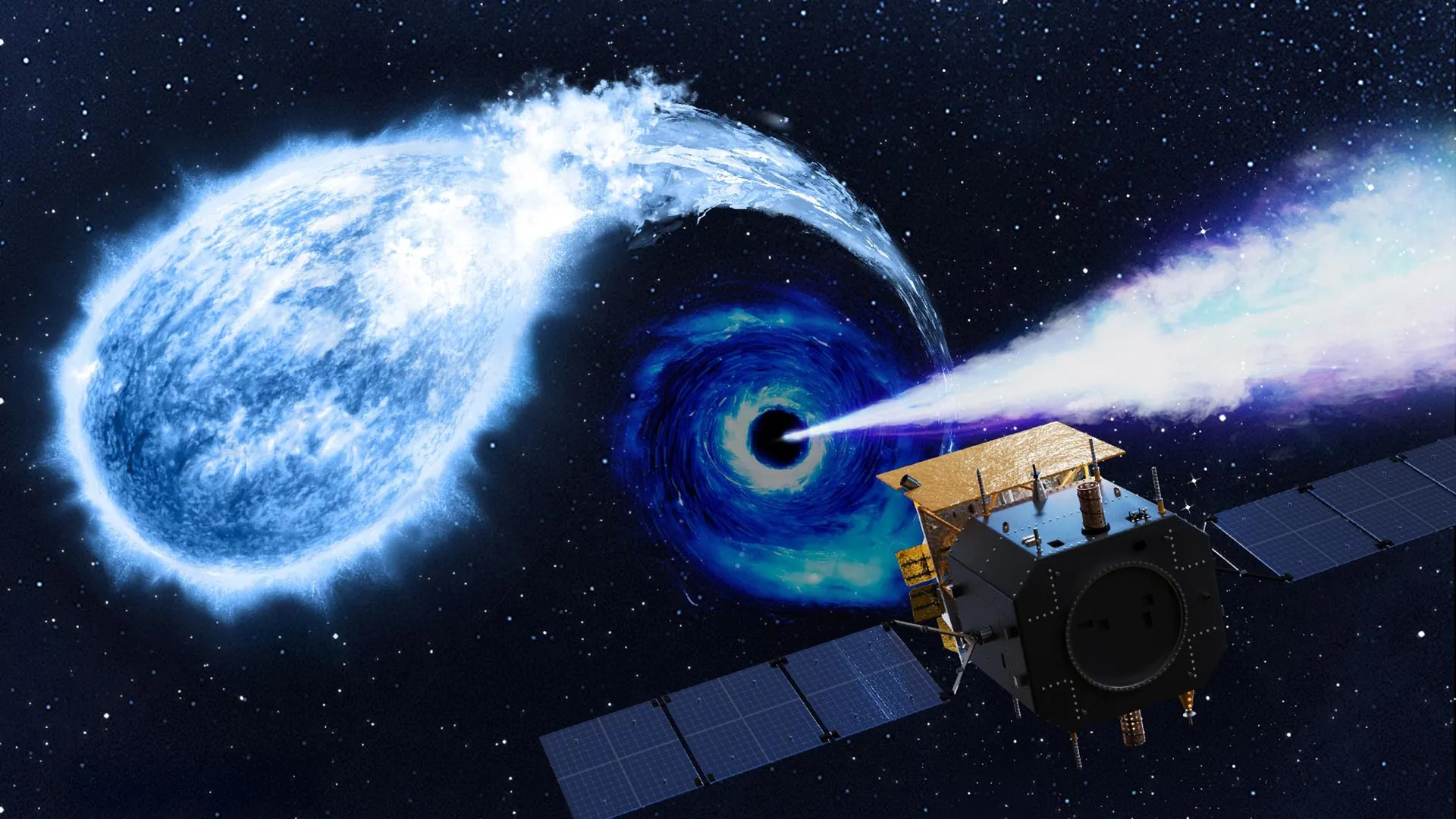
A China-led space telescope has detected an unusual eruption that astronomers say may be an intermediate-mass black hole tearing apart a white dwarf star. If confirmed, the University of Hong Kong said the event would offer the first direct observational evidence for this kind of black hole feeding episode.
The event, cataloged as EP250702a and also known as GRB 250702B, was first spotted on July 2, 2025, during a sky survey by the Einstein Probe mission. The University of Hong Kong said the object stood out because its X-ray brightness changed quickly and did not match the usual pattern of cosmic X-ray sources.
The research was coordinated by the Einstein Probe Science Center at the National Astronomical Observatories of the Chinese Academy of Sciences, with contributions from scientists in China and other countries. Researchers from the University of Hong Kong’s Department of Physics helped interpret the observations, according to the university.
An early X-ray signal
Einstein Probe made the detection with its Wide-field X-ray Telescope, an instrument designed to watch large areas of the sky with high sensitivity. Around the same time, NASA’s Fermi Gamma-ray Space Telescope detected several gamma-ray bursts from the same region, according to the University of Hong Kong.
Researchers then found that the Wide-field X-ray Telescope had already recorded steady X-ray emission from the same location about a day before the gamma-ray bursts. The University of Hong Kong said that sequence is unusual for powerful cosmic explosions and helped set EP250702a apart from ordinary gamma-ray bursts.
About 15 hours after the first detection, the source produced a series of strong X-ray flares. At peak brightness, researchers reported a luminosity of about 3 × 10^49 erg per second, making it one of the brightest instantaneous outbursts recorded in the universe, according to the university.
Fast fading and a distant host
Follow-up observations used the position measured by Einstein Probe to aim major telescopes at the source across multiple wavelengths. The University of Hong Kong said those observations placed the object in the outskirts of a distant galaxy.
Einstein Probe’s Follow-up X-ray Telescope continued monitoring the event as it changed. Over about 20 days, the object dimmed by more than a factor of 100,000, while its X-ray signal shifted from higher-energy hard X-rays toward lower-energy soft X-rays, according to the research team.
The scientists reported that several features challenged existing explanations: X-rays appeared before the gamma-ray burst, the flare reached exceptional brightness, the event evolved quickly, and the location was outside the central region of its host galaxy. After weighing possible causes, the team identified a tidal disruption of a white dwarf by an intermediate-mass black hole as the strongest candidate, according to the University of Hong Kong.
White dwarfs are dense stellar remnants, while intermediate-mass black holes occupy a range between stellar-mass black holes and the supermassive black holes found in many galactic centers. The University of Hong Kong said an event like EP250702a could give astronomers a rare way to study that hard-to-observe class of black holes.
The findings were published in Science Bulletin in a paper led by Dongyue Li of the National Astronomical Observatories of China. The university said the result remains a candidate interpretation, with confirmation needed before astronomers can treat it as the first direct example of an intermediate-mass black hole consuming a white dwarf.
This story draws on original reporting from ScienceDaily.