
Small black hole signal renews dark matter search
University of Miami physicists say a LIGO alert may point to a primordial black hole, a long-theorized candidate for dark matter.
By Priya Raghavan · Science Reporter
3 min read
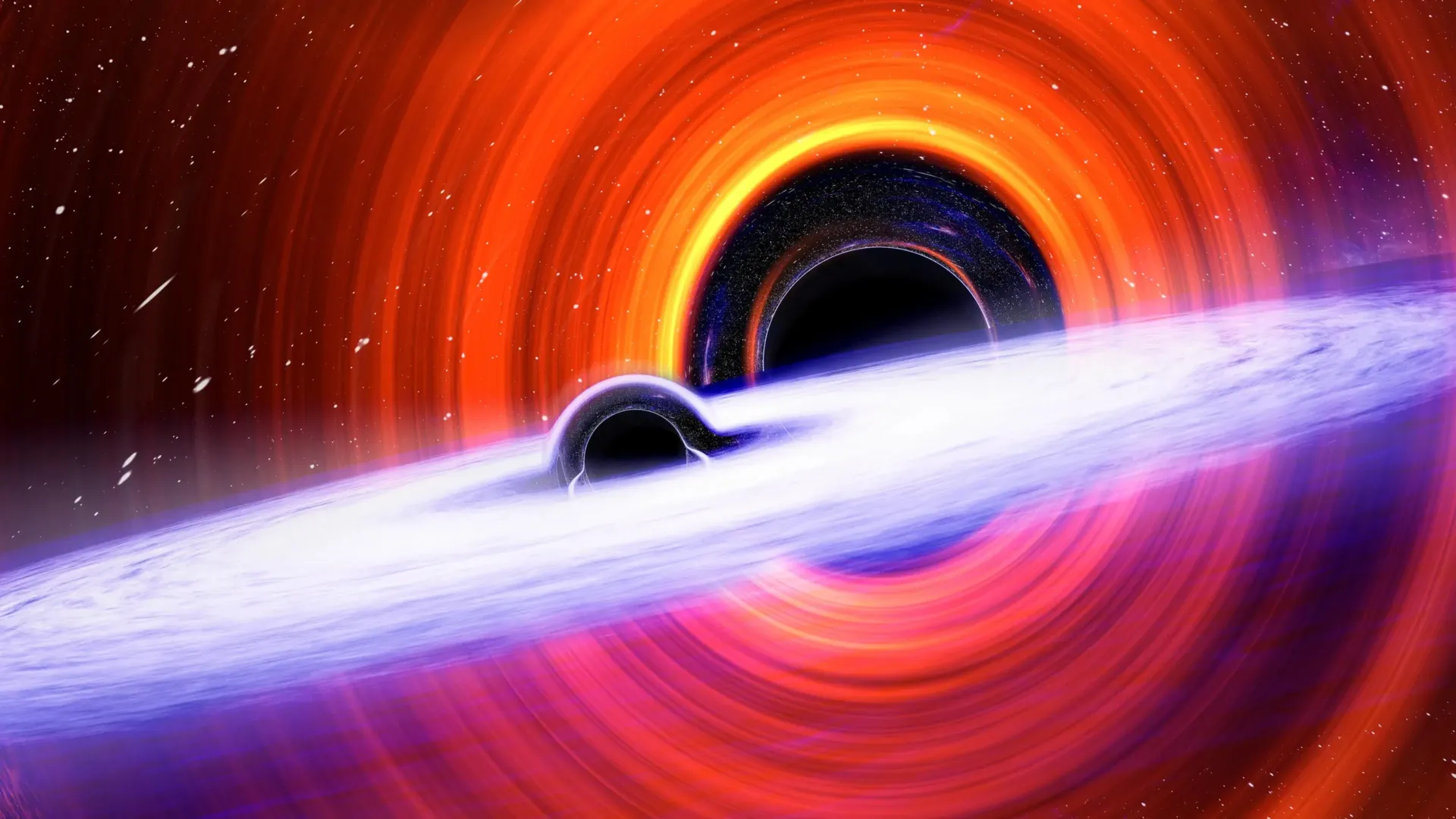
A gravitational-wave signal flagged by LIGO in November may have involved a black hole smaller than the Sun, according to University of Miami researchers. If follow-up detections support that reading, the event could strengthen the case for primordial black holes as a possible explanation for dark matter.
The claim comes from Alberto Magaraggia and Nico Cappelluti of the University of Miami, whose study was published in The Astrophysical Journal. They argue that an object below one solar mass would be hard to produce through the known life cycles of stars and fits better with a black hole formed in the earliest moments after the Big Bang.
Primordial black holes remain hypothetical. According to the University of Miami, they are thought to have emerged during the first fraction of a second after the universe began, before stars and galaxies formed. Unlike black holes made when massive stars collapse, they could span a wide range of sizes, from asteroid-scale objects to far larger bodies.
Dark matter is the other unresolved piece of the story. The University of Miami said the unseen material accounts for about 85% of all matter and supplies gravitational pull that helps bind galaxies, but its composition has not been identified. Cappelluti and Magaraggia say primordial black holes could make up a significant share of it, possibly all of it.
Why the LIGO alert drew attention
LIGO, the Laser Interferometer Gravitational-Wave Observatory, detects ripples in spacetime from violent cosmic events such as black hole mergers. According to the University of Miami account, an automated alert issued in November pointed to a merger in which at least one body appeared to have less than the mass of the Sun.
That mass range is the key issue. Cappelluti said ordinary black holes usually form after massive stars die in supernova explosions, producing objects that range from several solar masses to billions of times the Sun’s mass. A subsolar black hole would therefore sit outside the usual explanation for stellar black hole formation.
The researchers did not present the event as settled evidence. The University of Miami said some astrophysicists have argued the signal could be noise in LIGO’s highly sensitive detectors rather than a new kind of object.
Magaraggia and Cappelluti tested whether the candidate event fits a primordial black hole population. According to the university, they estimated how many such objects could exist and how often LIGO should see mergers involving them. Their result suggests subsolar black hole detections should be uncommon, matching the fact that events of this kind have rarely appeared in LIGO observations.
More detections needed
Cappelluti said the study points to a primordial black hole as the most plausible interpretation for a LIGO signal without a conventional astrophysical explanation, according to the University of Miami. He also said more events with the same pattern would be needed before scientists could claim confirmation.
The idea has a long history. The University of Miami traced primordial black hole theory to Soviet scientists Yakov Zeldovich and Igor Novikov during the Cold War era, followed by work in the early 1970s by Stephen Hawking, who argued such objects could be widespread, emit radiation and help explain dark matter.
LIGO opened a new way to test those ideas after its first gravitational-wave detection on Sept. 14, 2015, which confirmed a prediction of Albert Einstein’s general relativity. The observatory uses two L-shaped detectors in Hanford, Washington, and Livingston, Louisiana, each with 2.5-mile vacuum arms.
According to the University of Miami, LIGO works with Virgo in Italy and KAGRA in Japan as part of the LVK collaboration. Planned upgrades should improve LIGO’s sensitivity, while future projects could broaden the search. The European Space Agency’s LISA mission is scheduled for launch in 2035, and the proposed U.S. Cosmic Explorer is expected to be about 10 times more sensitive than LIGO.
This story draws on original reporting from ScienceDaily.