
Bumble bees use ball as tool in problem-solving test
Finnish researchers say bumble bees reached a hidden reward by moving a ball into place, showing flexible problem-solving without prior training.
By Lucas Ferreira · Science & Environment Writer
3 min read
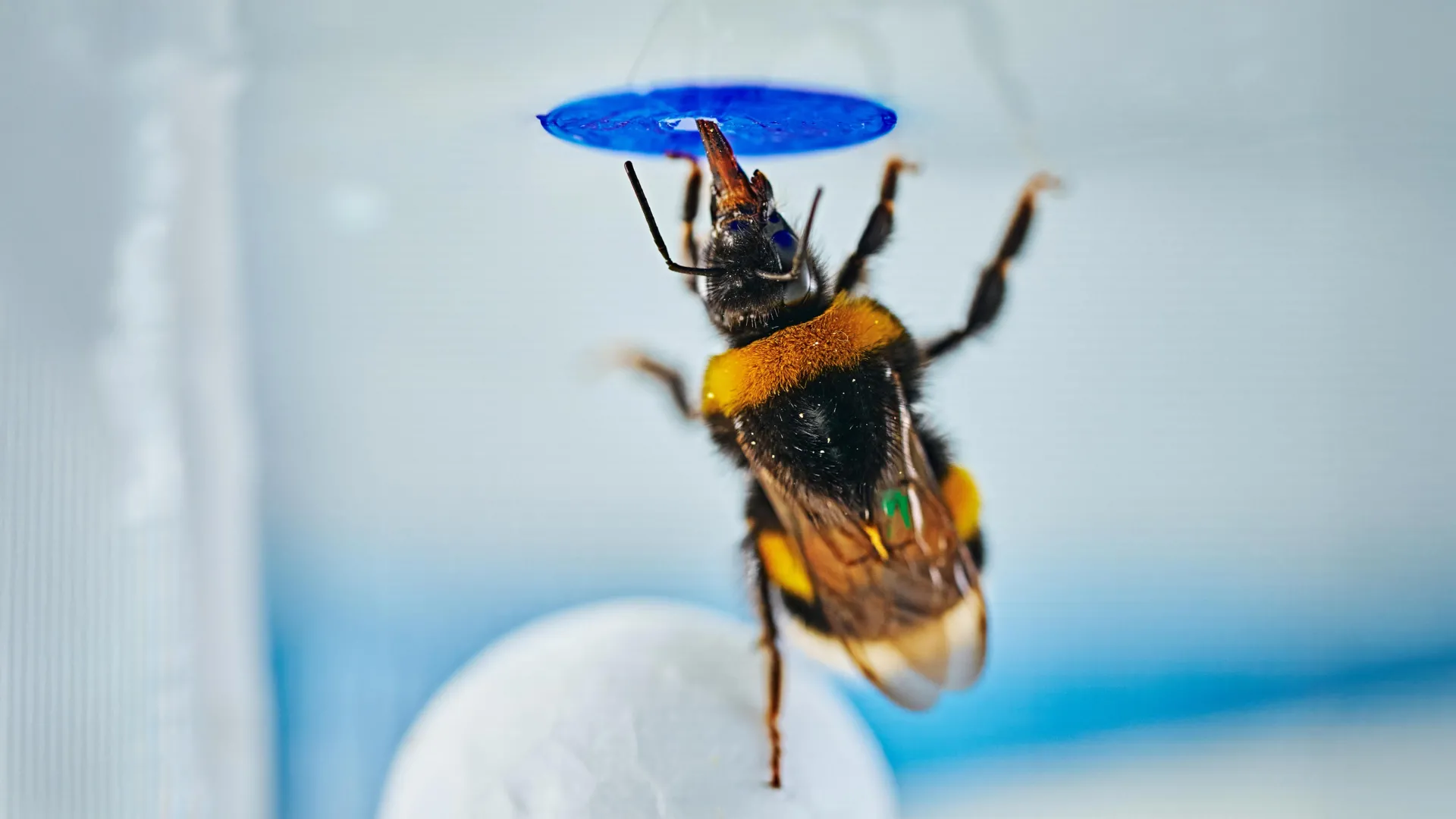
Bumble bees solved an unfamiliar object-use task without being trained for the key step, according to researchers in Finland. The finding matters because spontaneous problem-solving with objects has long been studied mainly in humans, other primates and larger-brained vertebrates.
The study, published June 4 in Science, was carried out by researchers from the University of Oulu, the University of Helsinki and the University of Turku. The team tested buff-tailed bumble bees, known scientifically as Bombus terrestris, in a setup modeled on a classic animal-intelligence problem.
In early 20th-century experiments, psychologist Wolfgang Köhler showed chimpanzees using objects in new combinations, including stacking boxes to reach food. The Finnish team designed what senior author Olli Loukola of the University of Oulu described as an insect version of that kind of challenge, according to materials released by the university.
How the test worked
The bees first learned that a blue artificial flower held a food reward. Researchers then placed that flower on the ceiling of a transparent arena, putting it out of reach.
A small movable ball was available below. To reach the reward, successful bees moved the ball under the flower and climbed onto it, completing a sequence they had not been taught to perform, according to the University of Oulu.
The researchers said the bees had only learned two separate facts before the main test: the flower was rewarding, and the ball could be moved without harm. They were not trained to roll the ball into position or to use it as a platform.
Lead author Akshaye Bhambore of the University of Oulu said the successful bees showed movement patterns directed toward the goal, according to the university. The team interpreted the behavior as more than random contact with the ball.
Controls tested simpler explanations
The researchers ran control experiments to check whether the bees might have succeeded by chance, by play-like behavior, through trial and error during the test, or by steering directly toward a visible target. In some tests, the flower was not visible while the bees moved the ball.
Even under those conditions, many bees still moved the ball to the correct spot, according to the University of Oulu. Bhambore said the controls indicated the insects were not merely following visual cues or moving the object randomly.
Loukola said the bees were fully naive to this kind of solution, unlike animals in some earlier studies that had extensive experience with objects or test arenas. The university said the experimental design was intended to rule out the most direct alternative explanations for the behavior.
Small brains, flexible behavior
The findings add to earlier work showing that bees can learn from one another, solve puzzle-like tasks, cooperate and adjust behavior when conditions change, according to the University of Oulu. The new study focuses on whether they can combine prior experiences to solve a new physical problem.
The researchers cautioned against treating the result as evidence that bees think like people or have human-like consciousness. Loukola, who also works as a senior researcher at the University of Turku, said the result instead shows that very small brains can produce flexible responses to new problems.
The paper, titled “Spontaneous problem-solving in bumble bees,” lists Akshaye A. Bhambore, Ece N. Akmeşe, Emma Häkkinen, Milla K. Jussila, Juha-Heikki Kantola and Olli J. Loukola as authors. It appeared in Science, volume 392, issue 6802, with the DOI 10.1126/science.ady1618.
This story draws on original reporting from ScienceDaily.