
Single molecule quantum sensor could sharpen protein imaging
University of Waterloo researchers used one molecule as a quantum sensor, a step toward imaging individual protein structures.
By Priya Raghavan · Science Reporter
3 min read
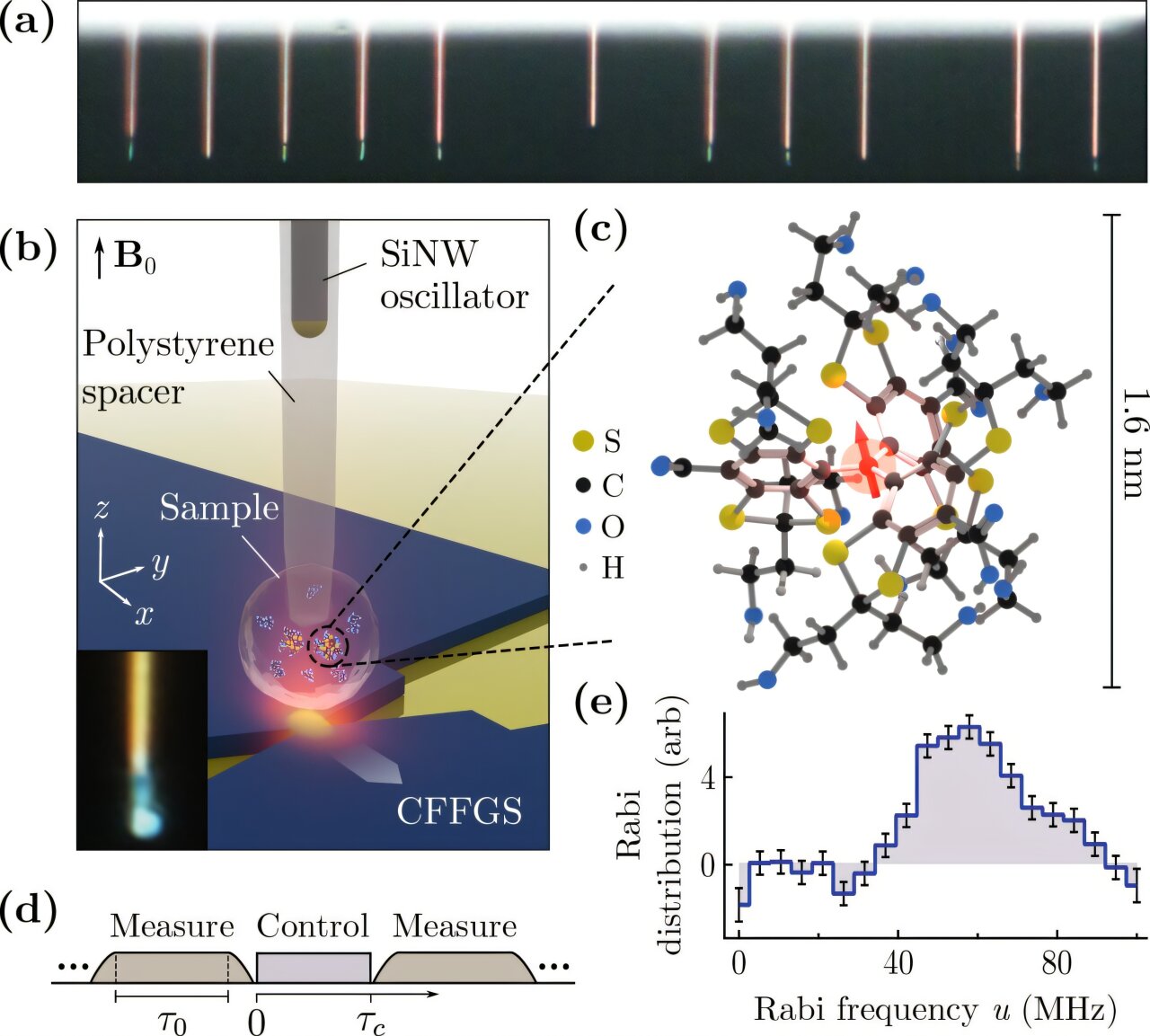
University of Waterloo researchers have demonstrated a single molecule quantum sensor that could help measure protein structures and other biomolecules at the nanoscale. The Institute for Quantum Computing team says the approach may aid structural biology and drug discovery by moving researchers closer to imaging individual molecules.
The work, published in Physical Review X, uses a molecule called trityl-OX063 as the sensing element. Waterloo said the technique had not been shown before and that this class of molecule had not previously been used for this purpose.
How does a single molecule quantum sensor image proteins?
Quantum sensors use quantum-mechanical properties to make measurements beyond the reach of conventional sensors, according to Waterloo. In this case, the sensor reads the spin, or local magnetic environment, of nearby atoms; atoms have distinct resonance frequencies, and atoms close to one another can magnetically influence each other.
Waterloo said the method relies on the electron spin of the OX063 molecule. Magnetic fields from nearby nuclear spins alter how that electron spin evolves, creating a signal the researchers can detect.
The team detected that signal mechanically with nanowire probes, according to the university. The probes are 100 nanometers wide, roughly virus-sized, and 20 microns long, about the diameter of a human hair.
Why use a molecule instead of diamond?
A common quantum-sensing method uses engineered synthetic diamonds with atomic-scale defects and reads signals with light, Waterloo said. Raffi Budakian, a physics and astronomy professor and Institute for Quantum Computing faculty member, used trityl-OX063 instead because its spin is isolated and protected, helping preserve its quantum properties.
Waterloo said the molecular sensor can be placed nearer to its target than diamond-based sensors, which can improve sensitivity. Budakian said the experiment establishes “a new paradigm in nanoscale quantum sensing,” while adding that more milestones remain before the sensor can measure single molecules.
Sahand Tabatabaei, a Ph.D. candidate at the Institute for Quantum Computing and first author of the paper, said one central challenge was keeping OX063 spins coherent long enough to function as sensors. The team developed a control sequence that extended coherence time to 400 microseconds, about 60 times longer than standard spin-echo techniques in the same system, according to Waterloo.
What could this mean for protein research?
Precise imaging of single molecules can show how proteins and other biomolecules behave, Waterloo said. The university said that information could help researchers understand disease development and drug interactions, with possible use in designing better treatments.
Budakian said the sensor can already detect the magnetic state of about 10 spins, and the team understands how to push toward single-spin detection. Waterloo described that as an important step toward mapping the structures of individual molecules.
Current molecular-imaging methods are powerful but require larger samples, which limits their ability to reveal unique molecular structures, according to Waterloo. Budakian said using force detection in quantum sensing opens another route toward mapping single protein structures.
This story draws on original reporting from Phys.org.