
NASA rover test targets longer trips across the moon and Mars
NASA says its four-wheeled ERNEST prototype drove 16 miles in desert trials, testing mobility and autonomy tools for possible future lunar and Mars missions.
By Lucas Ferreira · Science & Environment Writer
4 min read
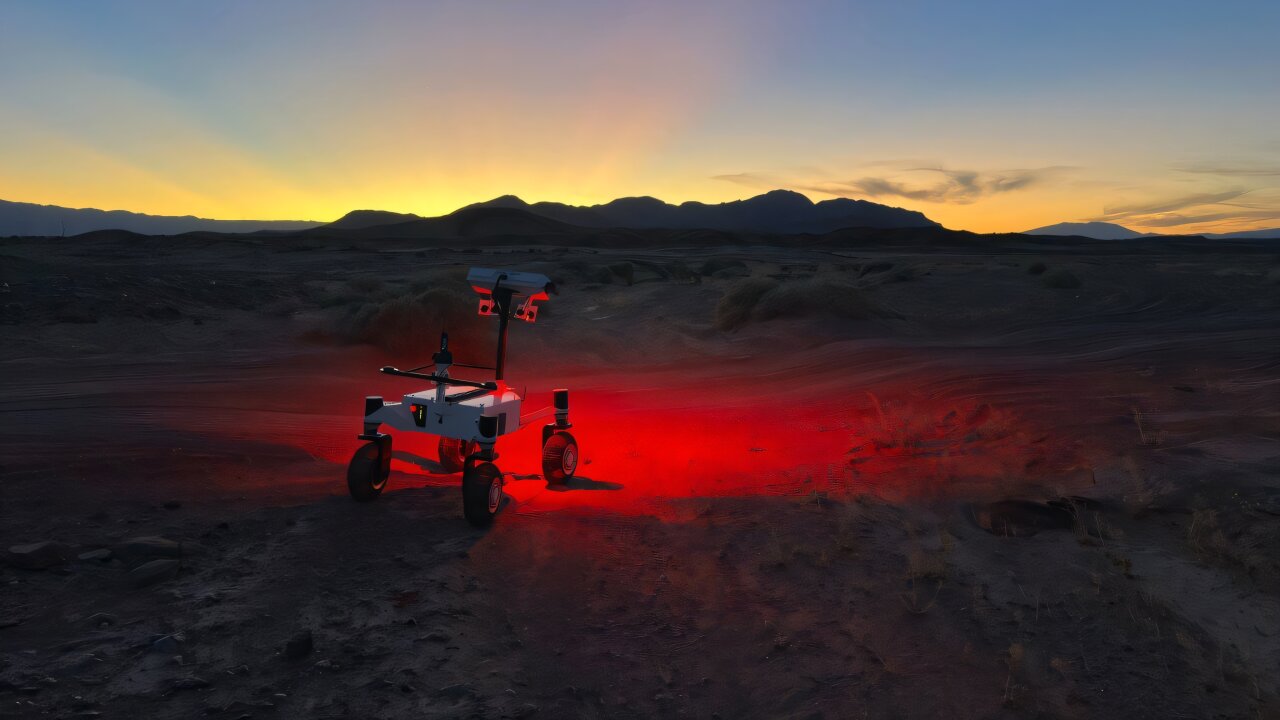
NASA is testing a small experimental rover meant to help future missions travel farther and handle rougher terrain on the moon and Mars. The agency said the prototype, called ERNEST, recently covered 16 miles in Southern California’s Colorado Desert with limited help from engineers following nearby.
ERNEST, short for Exploration Rover for Navigating Extreme Sloped Terrain, was developed at NASA’s Jet Propulsion Laboratory in Southern California. NASA said the work is aimed at improving both rover movement systems and autonomous driving software for places current rovers cannot easily reach.
The four-wheeled vehicle is 4 feet long and can lift each of its mesh wheels to get past obstacles. NASA said that capability could help future rovers move through terrain that would challenge Curiosity and Perseverance, the agency’s six-wheeled Mars rovers.
During the recent test campaign, ERNEST drove across seven days of intermittent field work, logging 37 hours of driving, according to NASA. The rover reached speeds of up to 0.6 mph, or 1 kph, which NASA said is about 10 times faster than the top speed at which Curiosity and Perseverance can autonomously travel.
Issa Nesnas, a principal technologist at JPL who led the recent test work, said the trials are helping engineers improve hardware and software for long-distance driving across varied terrain and lighting conditions expected on the moon. Nesnas leads autonomy work for a NASA mission concept involving a possible future long-range lunar rover.
NASA said the team is using ERNEST to show that a rover twice the prototype’s size could support a long-distance lunar mission. James Keane, a JPL planetary scientist working on lunar missions, said the vehicle could support a science-focused road trip across the moon or Mars.
New suspension and autonomous driving
ERNEST grew out of an effort to improve on the rocker-bogie suspension used by every NASA Mars rover since Sojourner. That older passive system uses pivots and struts to keep weight distributed across six wheels as the rover crosses uneven ground.
NASA said ERNEST uses an active suspension that can shift weight among its wheels. Two powered front joints move a gimbal, allowing the rover to use different movements, including wheel-walking, squirming and climbing over obstacles.
The rover also has a clutch system that lets it switch between active suspension and a more energy-efficient passive mode. With four steerable wheels, NASA said ERNEST can drive in any direction, including sideways.
Hari Nayar, a JPL principal technologist who leads the ERNEST team, said the group began with the idea that planetary rover mobility could be improved. He said decades of research since rocker-bogie systems were introduced have expanded understanding of how wheels interact with terrain.
Before building the current rover, the JPL team tested two smaller prototypes, each about 2 feet long, according to NASA. Engineers tried 11 active-suspension designs in a trailer filled with simulated lunar soil, running tests at different slope angles for months before settling on the current design.
The larger version was completed in September 2024 and later equipped with a rectangular sensor head on a 4.5-foot mast. At first, NASA said, it still needed a human operator using a joystick to tell it how to cross obstacles.
Training in simulation
To give ERNEST more independence, the team used reinforcement learning, a form of artificial intelligence in which a robot improves through interactions with its environment. JPL’s Dynamics and Real-Time Simulation Laboratory built a detailed virtual test setting based on data from the physical rover’s response to different terrain.
NASA said engineers ran many simulations at once on a high-performance computing cluster, at times completing thousands of hours of virtual tests in a weekend. After months of that work, the team tested ERNEST in JPL’s Mars Yard, where it drove itself over sand ripples, rubble piles, steps and steep slopes.
Nayar’s team has now begun another autonomy project that combines decisions about when to use active suspension with longer-range route planning, NASA said. The goal is for ERNEST to choose efficient paths, cross obstacles it can manage and go around hazards it should avoid.
This story draws on original reporting from Phys.org.