
Basel team builds modular nanorobot tested on cancer cells
Researchers say the self-assembling system can carry enzyme payloads, dock to cells and be magnetically retrieved for reuse.
By Priya Raghavan · Science Reporter
3 min read
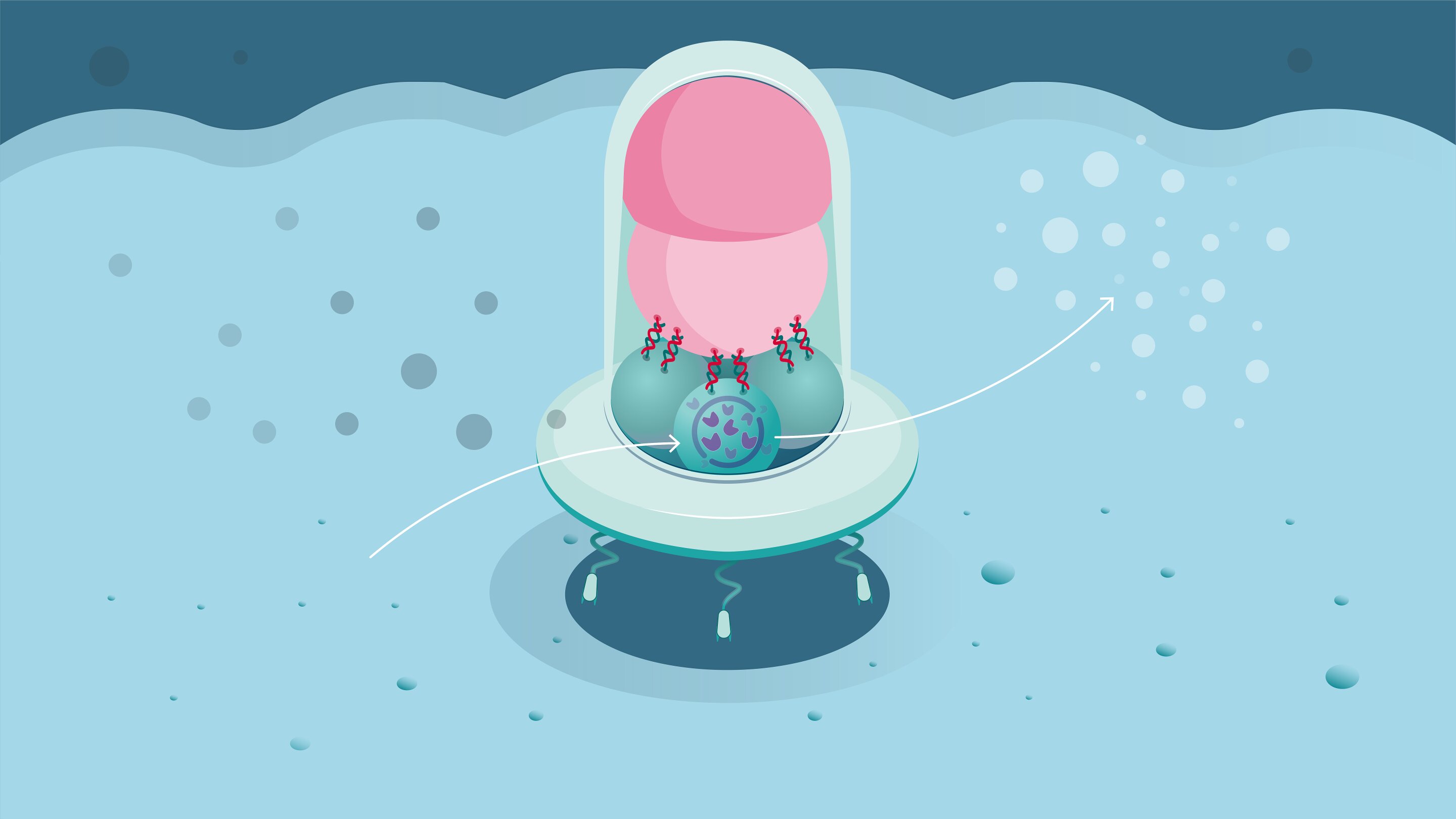
Researchers at the University of Basel have developed a modular nanorobot that self-assembles from separate propulsion and payload parts, a design they say could make nanoscale machines easier to adapt for different jobs. In laboratory tests reported by the team, an enzyme-equipped version produced an anticancer compound near HeLa cancer cells and reduced their viability to 16% after 72 hours.
The work, led by Prof. Dr. Cornelia Palivan, was published in Advanced Functional Materials under the title “Multiplex Modular Nanorobotic Systems with Catalytic Activity under Magnetic Navigation.” The University of Basel said the approach is intended as a reusable platform rather than a one-task device.
Nanorobots in this field are not tiny electronic machines with computer chips, according to the university. They are built from biomolecules and nanoparticles, with researchers seeking ways to move active substances or catalytic systems to specific locations in medicine, industry or environmental technology.
Palivan said earlier nanorobots are often made for one defined function, while the Basel system can be altered for different uses. The design pairs a magnetic propulsion module with a payload capsule, giving the structure a form the university compared to a multi-part lunar rocket.
How the modular system works
The propulsion unit lets researchers move the nanorobot using magnetic control, according to the Basel team. The payload capsule can carry therapeutic agents or enzymes to a target site.
The payload component contains four enzyme-loaded polymer vesicles, building on earlier work by Palivan’s group. The university said these vesicles protect enzymes while allowing surrounding molecules to pass through pores, be processed inside and then leave as reaction products.
The team also designed the vesicles so they can be opened selectively in some versions, including for the release of bioactive compounds, according to the university. That modularity is central to the system’s proposed use across different tasks.
The two main parts connect through complementary DNA strands, which act like a programmable fastening system, the researchers reported. The University of Basel said the DNA-based coupling allows the propulsion module and payload capsule to assemble on their own and remain linked.
To test targeting, the scientists added biomolecules to the payload capsule that support docking to selected cells or materials. In experiments with HeLa cells, a human cancer cell line, nanorobots loaded with fluorescent molecules gathered on the cell surface when viewed under a microscope, according to the university.
Cancer-cell test and reuse
In a further test, the team equipped the nanorobots with enzymes needed to generate an anticancer drug. Dr. Voichita Mihali, the study’s first author, said the device could concentrate the drug’s local effect when directed to cancer cells.
The researchers reported that the treated HeLa cells’ viability fell to 16% within 72 hours. The university did not describe the system as ready for treatment in people, and said human use remains a long-term goal.
The magnetic propulsion module may also support uses outside medicine, including catalysis, because the nanorobots can be collected after completing a task, according to the Basel team. The researchers said they were able to separate the two modules, refill the payload capsules and reconnect them with propulsion modules.
The University of Basel said the study points toward a multifunctional nanoscale tool whose function can be changed by modifying the payload capsule. The paper’s authors include Voichita Mihali and colleagues, with the study published in Advanced Functional Materials in 2026.
This story draws on original reporting from Phys.org.