
Study links MINDY3 enzyme to DNA repair and protein disposal
Researchers report that MINDY3 binds RAD23 proteins, connecting protein degradation machinery with cellular responses to DNA damage.
By Priya Raghavan · Science Reporter
3 min read
Researchers have identified a molecular connection between the cell’s protein disposal system and its response to DNA damage. The findings matter because cells must remove or process ubiquitylated proteins while repairing damaged DNA, and the study places the enzyme MINDY3 in that process.
The work, published in EMBO Reports, was carried out by researchers at the MRC Protein Phosphorylation and Ubiquitylation Unit at the University of Dundee with collaborators at ETH Zürich, the Małopolska Center of Biotechnology and the University of Veterinary Medicine Vienna, according to the University of Veterinary Medicine Vienna.
The study focuses on MINDY3, a deubiquitinase. Such enzymes remove ubiquitin tags, which cells use to mark proteins for different outcomes, including degradation by the proteasome.
A new binding role for MINDY3
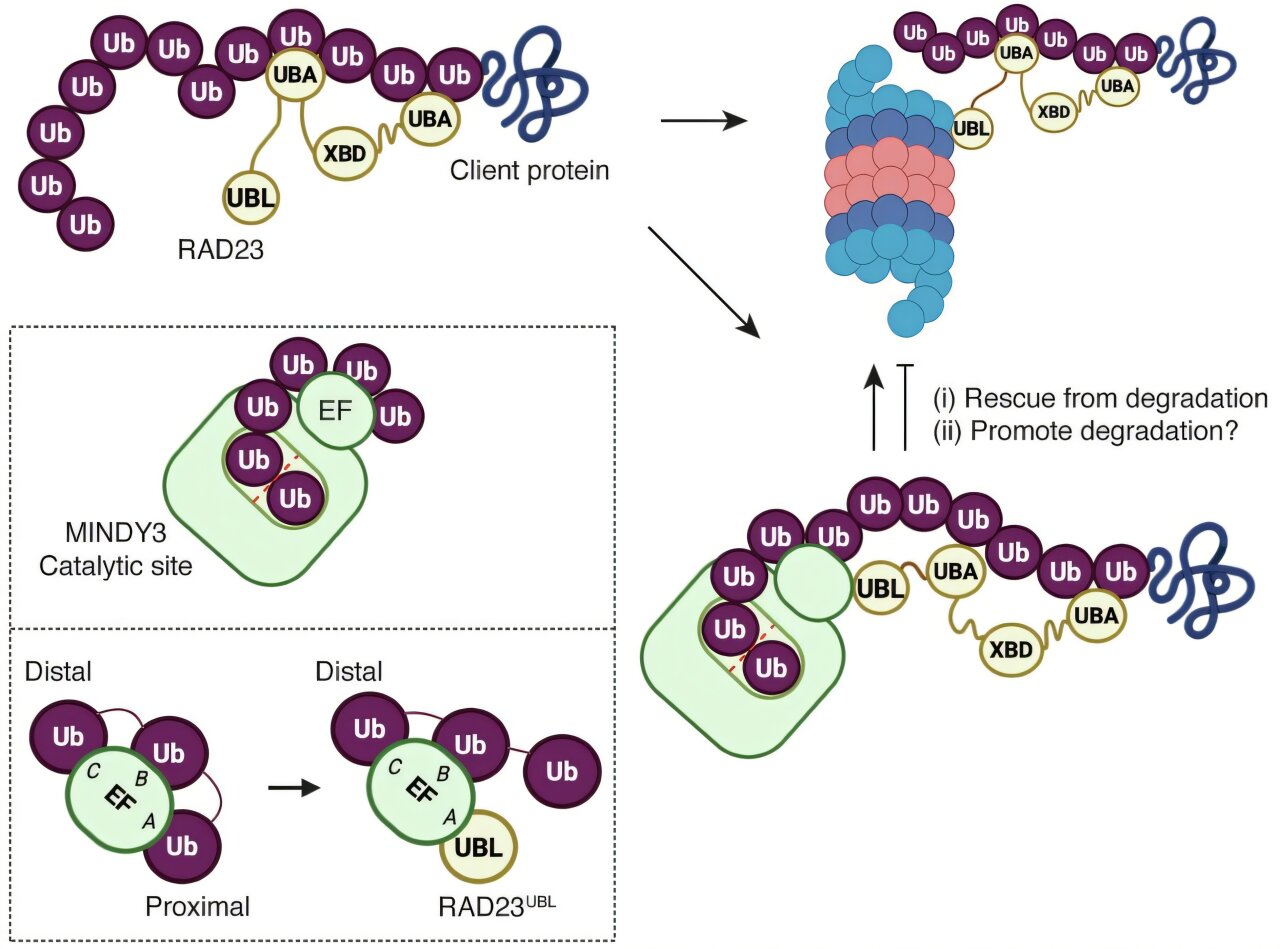
According to the researchers, MINDY3 contains an EF-hand region that functions as a ubiquitin-binding domain. The team reported that this region has three binding surfaces, allowing the enzyme to recognize and cut long polyubiquitin chains more efficiently.
The study also found that the same EF-hand region binds the ubiquitin-like domains of RAD23A and RAD23B. Those RAD23 proteins help carry ubiquitylated cargo to the proteasome, the cell machinery that breaks down selected proteins, according to the University of Veterinary Medicine Vienna.
That interaction links MINDY3 to what the researchers describe as the RAD23-proteasome axis. The study suggests that RAD23A and RAD23B can help direct MINDY3 to sites where DNA damage has occurred.
Sebastian Glatt, professor of systems genetics at the University of Veterinary Medicine Vienna and a group leader at the Małopolska Center of Biotechnology at Jagiellonian University, said the work identifies another part of the cellular systems that manage damaged proteins and DNA repair.
Structure and cell experiments
The researchers solved the crystal structure of the MINDY3 EF-hand bound to the RAD23A ubiquitin-like domain. According to the study, that structure showed the molecular contact points between the two proteins and identified residues needed for binding.
The team said the structural data help explain how MINDY3 recognizes RAD23A and RAD23B while maintaining binding features that differ from its interactions with ubiquitin. The paper reports that this gives MINDY3 a way to connect ubiquitin-chain processing with RAD23-associated protein handling.
Cell experiments supported the structural findings, according to the University of Veterinary Medicine Vienna. The researchers reported that RAD23A and RAD23B affect where MINDY3 appears in cells after DNA damage, consistent with a model in which MINDY3 acts on RAD23-bound substrates at damaged sites.
The study used several methods to support that model. The researchers used crystallography to map the binding interface, isothermal titration calorimetry to measure interactions, pull-down experiments to test protein partnerships and live-cell imaging to follow MINDY3 recruitment to DNA lesions.
The paper, by Lee A. Armstrong and colleagues, is titled “The EF-hand domain of MINDY3 is a ubiquitin and RAD23 UBL-binding domain.” Its DOI is 10.1038/s44319-026-00825-1.
This story draws on original reporting from Phys.org.