
Mindelo lidar station marks five years tracking Atlantic aerosols
TROPOS says its Cabo Verde station has become a key site for observing dust, clouds and atmospheric change over the tropical Atlantic.
By Priya Raghavan · Science Reporter
3 min read
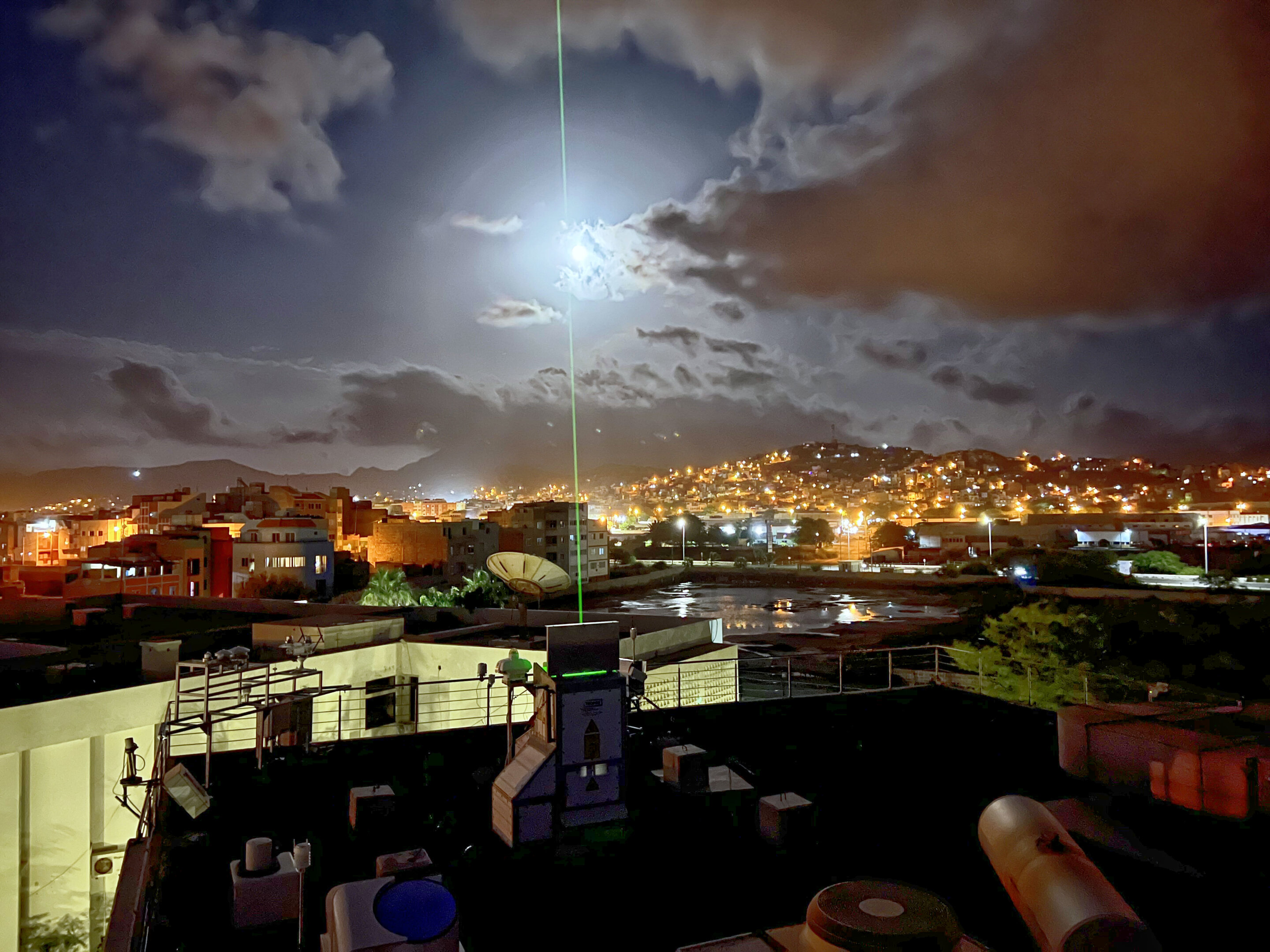
A laser-based atmospheric observatory in Mindelo has completed five years of continuous aerosol measurements, the Leibniz Institute for Tropospheric Research said. The work matters because the station gives researchers a steady view of Saharan dust, marine particles and cloud processes over the tropical Atlantic, a region central to weather and climate studies.
TROPOS said the system sends a green lidar beam into the night sky above Mindelo Bay, reaching as high as 30 kilometers. The instrument operates at the Ocean Science Center Mindelo and is part of PollyNET, a TROPOS-coordinated network of fixed and mobile lidar systems used to identify airborne particles and trace their movement.
According to TROPOS, the instruments can detect aerosols including desert dust, smoke from wildfires, industrial pollution and sea salt. Researchers involved in the project have now reviewed the first years of measurements, with results reported in the journal Atmospheric Measurement Techniques.
Dust, clouds and seasonal change
TROPOS said the Mindelo measurements have focused on the vertical structure of Saharan dust, the role of aerosols in cloud formation, changes in aerosol amounts over time and the optical behavior of the atmosphere. The institute said the site has become a reference point for observations in the tropical Atlantic.
The station was built up in phases, according to TROPOS. Continuous lidar-based aerosol remote sensing began in 2021, cloud remote-sensing equipment was added later to study aerosol-cloud links and precipitation, and a radiation measurement station started operating in 2024 to assess how atmospheric conditions affect radiation at ground level.
One early test came after the Cumbre Vieja eruption on La Palma in September 2021, TROPOS said. The Mindelo lidar detected volcanic aerosol particles, showing how the system could record unusual atmospheric events from the ground.
Long-term data from the station show strong seasonal Saharan dust events, layered aerosol structures and large variation in dust intensity through the year, according to TROPOS. Outside the dust season, the institute said, marine salt particles provide a steadier natural aerosol background in the region.
Campaigns and international partners
TROPOS said three international measurement campaigns have supported the station’s work. The ASKOS campaigns in 2021 and 2022 collected data for comparison and calibration with the AEOLUS space lidar, while the ORCESTRA/CLARINET campaign in 2024 studied tropical weather systems between West Africa and the Caribbean.
The institute said the station received a high-level visit on Oct. 4, 2023, from Cabo Verde President José Maria Neves and German President Frank-Walter Steinmeier. TROPOS said the full set of its remote-sensing and radiation instruments at the site was put into operation that day.
TROPOS staff travel to Mindelo at least twice a year for major maintenance, while daily tasks are handled by personnel from the Ocean Science Center Mindelo and IMar, the Instituto do Mar, the institute said. TROPOS also credited GEOMAR, IMar and Cabo Verde’s Instituto Nacional de Meteorologia e Geofísica with support for the wider ocean and atmosphere research effort.
According to TROPOS, the Cape Verde Atmospheric Observatory is now among the long-term atmospheric monitoring sites used to track climate change. The institute said the measurements are part of the European research infrastructure ACTRIS and provide data for studying the atmosphere over the tropical Atlantic off West Africa.
This story draws on original reporting from Phys.org.