
Japan hot spring study traces magmatic water to Pacific Plate
University of Tsukuba researchers used isotope data and simulations to link hot spring water beneath Hokkaido’s Kussharo Caldera to a subducting ocean plate.
By Priya Raghavan · Science Reporter
3 min read
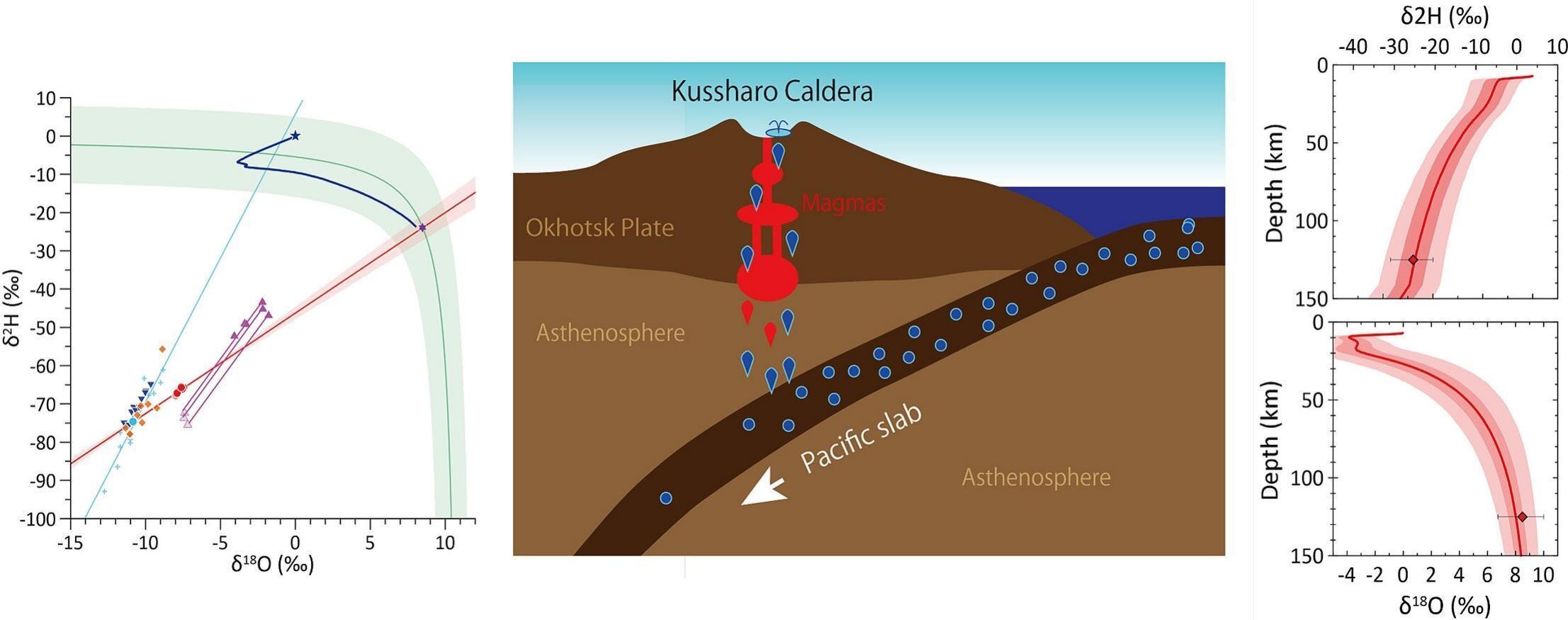
Researchers in Japan say water rising through hot springs near a Hokkaido volcano carries a chemical fingerprint from the subducting Pacific Plate. The finding matters because it gives direct isotopic support for a long-discussed link between ocean plates sinking into the mantle and fluids feeding volcanic systems, according to the University of Tsukuba.
The study, led by Tsutomu Yamanaka and colleagues, was published in the Journal of Volcanology and Geothermal Research, according to the university. The team examined Kawayu Onsen, a hot spring area in Kussharo Caldera, and compared reconstructed isotope signatures of magmatic water with numerical models of water released during subduction.
Hot springs in volcanic regions usually contain rain or snowmelt that has seeped underground and been heated by magma, the University of Tsukuba said. Some also include magmatic water, a deeper component thought to be tied to subducting oceanic plates, though the university said direct evidence for that origin has been limited.
Modeling water carried down by a plate
The researchers modeled how the isotopic makeup of water changes as an oceanic plate descends. According to the university, the simulations tracked seawater held in oceanic crust and water bound in clay and rock-forming minerals.
Those model results were then checked against isotopic data reconstructed for magmatic water at Kawayu Onsen. The university said the match pointed to water released from the Pacific Plate at about 125 kilometers, or 78 miles, beneath Kussharo Caldera.
The Pacific Plate descends from the Kuril Trench in this region, according to the University of Tsukuba. The close agreement between the modeled and observed isotope values provides strong evidence that the magmatic water at the hot spring came from that slab, the university said.
The paper also reports that the isotopic composition of the magmatic water stayed largely stable when the interacting magma volume was below 2,000 cubic kilometers. The researchers estimated that at least 94.6 cubic kilometers of slab-derived water has been discharged over the past 400,000 years, according to the university.
Volcanic gas data also reviewed
The team also considered fumarolic gases from lava domes, where isotope values can be altered by vapor-liquid separation, the University of Tsukuba said. After adjusting for that process, the researchers reanalyzed previously published isotope data from fumarolic gases at Showa-Shinzan.
That review also supported a Pacific Plate origin for the magmatic water, according to the university. The study says the results add evidence for how water moves through the deep Earth and how subducting plates can affect volcanic and geothermal systems.
The paper is titled “Isotopic evidence for slab-derived magmatic water beneath the Kussharo Caldera, Japan.” It appears in the Journal of Volcanology and Geothermal Research with DOI 10.1016/j.jvolgeores.2026.108678, according to the publication details released by the University of Tsukuba.
This story draws on original reporting from Phys.org.