
JWST spots early barred spiral galaxy candidate
Astronomers report a possible barred spiral galaxy from less than 1.2 billion years after the Big Bang, challenging timelines for disk galaxy growth.
By Priya Raghavan · Science Reporter
3 min read
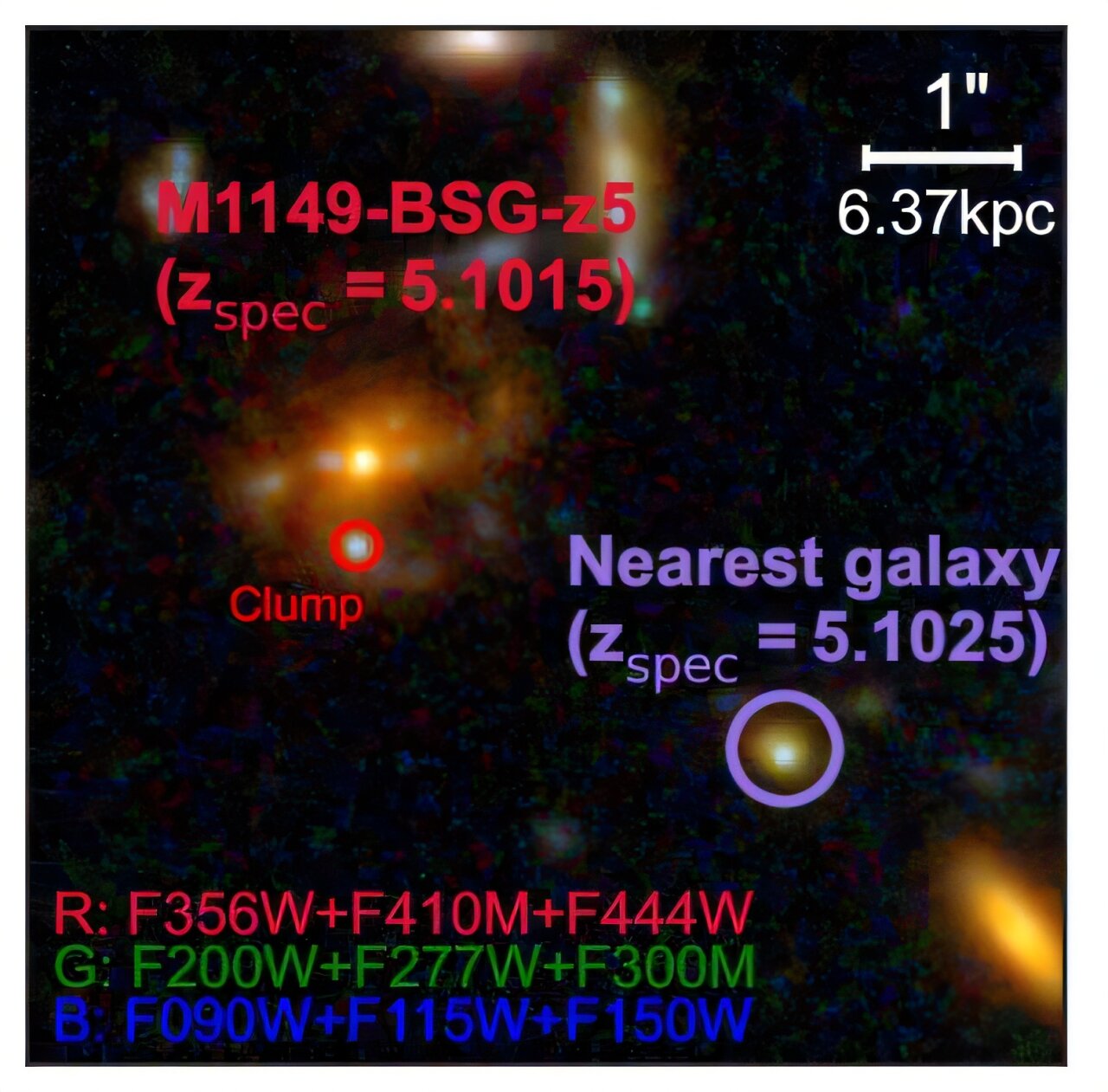
Astronomers using the James Webb Space Telescope have identified a candidate for the most distant barred spiral galaxy yet reported. The finding matters because barred galaxies require organized stellar disks, a level of structure researchers did not expect to see so early in cosmic history.
The object, called M1149-BSG-z5, appears at a redshift of 5.102, according to a paper led by Xiaohan Wang of Tsinghua University and posted June 23 to the arXiv preprint server. Phys.org reported that the galaxy dates to less than 1.2 billion years after the Big Bang.
Wang and colleagues used JWST data along with observations from the Hubble Space Telescope to study the galaxy’s form and physical properties, according to the preprint. The team describes M1149-BSG-z5 as a barred spiral galaxy candidate, meaning further observations are needed before the classification is secure.
Why a bar is notable
Stellar bars are long structures of stars crossing the central parts of some galaxies. According to Phys.org’s report on the study, bars can help drive gas toward galactic centers, where it may feed star formation, contribute to central bulge growth or supply a central black hole.
Such bars are common in nearby galaxies, including the Milky Way, according to Phys.org. The difficulty for early-universe studies is that bars are expected to form in settled, rotating disks, while young galaxies are often described as turbulent, gas-rich and disturbed by mergers or intense star formation.
The new candidate adds to recent JWST results suggesting that at least some galaxies built orderly disks faster than earlier models implied, Phys.org reported. Wang’s team wrote that the discovery and measured properties of M1149-BSG-z5 suggest bars can appear by redshifts greater than 5.
What the team found
The researchers used isophotal analysis, a method that follows changes in a galaxy’s brightness contours, to examine the object’s structure, according to Phys.org. That analysis indicated a bar, and the team reported that modeling of the galaxy’s overall shape supported the same interpretation.
The galaxy also appears to have spiral arms, according to the study summary. Wang and colleagues estimated its stellar mass at about 28 billion times the mass of the sun and its star formation rate at roughly 145 solar masses per year.
The team measured an effective radius of about 8,500 light-years, Phys.org reported. In the preprint, the researchers said that size is larger than typical galaxies around redshift 5, while still comparable to barred galaxies seen at redshifts between 2 and 4.
Wang’s team also studied emission-line ratios in the galaxy’s spectrum to assess its chemical state. The researchers wrote that those ratios are hard to explain if the gas is very metal-poor and instead point to material that is already chemically enriched.
The preprint also reports signs of an actively feeding supermassive black hole at the galaxy’s center, according to Phys.org. The black hole appears smaller relative to the galaxy’s stellar mass than black holes in other early-universe galaxies, and closer to ratios seen in present-day galaxies, the report said.
Follow-up work needed
The researchers found evidence that M1149-BSG-z5 sits in a crowded setting, with a possible companion galaxy projected about 70,000 light-years away, according to Phys.org. That nearby object could point to a past gravitational interaction, though the team has not determined whether the bar formed internally or was triggered by a merger or close pass.
Wang and colleagues said further observations are needed, especially measurements of how the galaxy’s stars and gas move. Those kinematic data would help confirm whether the bar is real and clarify how such structures formed in the early universe, according to the preprint.
This story draws on original reporting from Phys.org.