
Mars habitat proposal uses retractable tunnels to cut spacesuit trips
A University of Michigan team proposed lightweight pressurized tunnels that could link Mars habitats, vehicles and landing pads for crewed missions.
By Tom Brennan · Health & Medicine Correspondent
4 min read
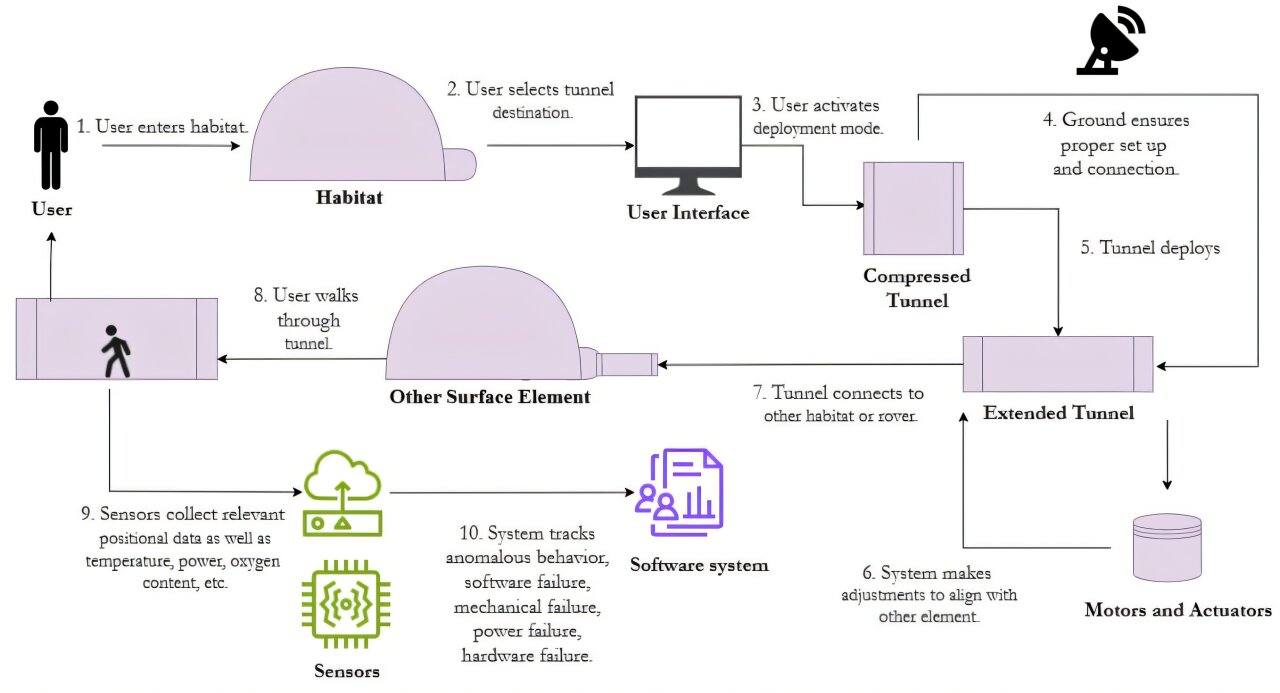
A University of Michigan team has proposed retractable, pressurized tunnels to let astronauts move between Mars surface systems without preparing for a full spacesuit excursion each time. The concept targets a practical problem for future Mars bases: crews will need to move often between habitats, vehicles and landing areas in a hostile environment.
The Bioastronautics and Life Support Systems team, known as BLiSS, described the idea in a report submitted to NASA’s Moon to Mars eXploration Systems and Habitation Academic Innovation Challenge, according to Universe Today. The paper, titled “LATCH: Lightweight Actuated Tunnels for Crewed Habitation,” lays out an active tunnel system that could extend, align with another hatch, pressurize and then retract after use.
NASA’s Moon to Mars architecture calls for using work from the Artemis program to support crewed Mars missions in the 2030s or 2040s, according to NASA. Universe Today reported that China’s national space agency also plans crewed Mars missions in the coming decades.
Why the tunnel system was proposed
Mars surface crews would face a thin, unbreathable atmosphere, wide temperature swings and elevated radiation levels, according to the BLiSS report described by Universe Today. Routine movement outside a habitat would usually require extravehicular activity procedures, including oxygen prebreathing, suiting up, airlock depressurization and cleanup after the trip.
The BLiSS team said that process can take a full day and can add risks from decompression and radiation exposure. The report also said pressure suits create problems for the Mars Ascent Vehicle because EVA suits take up cabin volume and add mass demands.
According to the team’s report, early analysis found that each EVA suit on the Mars Ascent Vehicle would require 560 kilograms more propellant than an intra-vehicular activity suit. The team argued that a pressurized tunnel could reduce some surface transfers from a day-long EVA process to a trip lasting minutes.
How LATCH would work
The proposed LATCH system would use an inflatable shell, structural rings, motor-driven actuators, extendable handrails, tracks and tread units mounted along each section, according to the BLiSS report. The tunnels would connect to airlocks on surface habitats and extend toward destinations such as another surface element or the Mars Ascent Vehicle.
Crew members would use an interface to select a destination and command the tunnel to extend, while sensors and ground controllers would help monitor alignment. The report said the system would use feedback to correct the tunnel’s path and support fine positioning before berthing with the target hatch.
After both ends were secured, the tunnel would slowly fill with oxygen and nitrogen, according to the team. Once sensors and ground controllers confirmed a safe internal environment, as many as two crew members could walk through while carrying cargo.
The BLiSS team said the interface would alert other crew members if a safety issue appeared during a transfer. In an emergency, the concept calls for automatic alerts and support systems such as lights and handrails to help astronauts reach an exit.
When idle, the tunnel would be depressurized and pulled back, according to the report. The team said retraction would limit dust buildup outside the structure, reduce radiation exposure inside it and make the system less vulnerable to damage from debris.
Testing, risks and a related proposal
The University of Michigan team supplied computer-aided design models, a prototype demonstrator for the tunnel and actuation system, and control software for testing, according to Universe Today. The team also produced a risk matrix covering technical, schedule, cost and safety concerns.
One risk identified by the BLiSS team was structural failure while astronauts were inside the tunnel. The report proposed added floor beams or a roll-out floor to handle greater loads or accidents, including dropped cargo.
The team also flagged inaccurate berthing as a risk that could make the tunnel unusable. Its proposed mitigation used multiple sensors, including LiDAR and computer vision, to compare readings and support small course corrections.
Universe Today also reported a related Baldwin Wallace University Engineering Department concept called Tunnel Ready Elements for Active Deployment, or T.R.E.A.D. That design used a double-tendon actuation system with pressurized bladders, with cable sets controlled by winches to shape and retract the tunnel across uneven terrain.
This story draws on original reporting from Phys.org.