
Interstellar medium 3D map finds turbulent gas around the sun
A new arXiv study maps nearby interstellar gas in 3D, finding far more unstable material than classic models predict.
By Tom Brennan · Health & Medicine Correspondent
3 min read
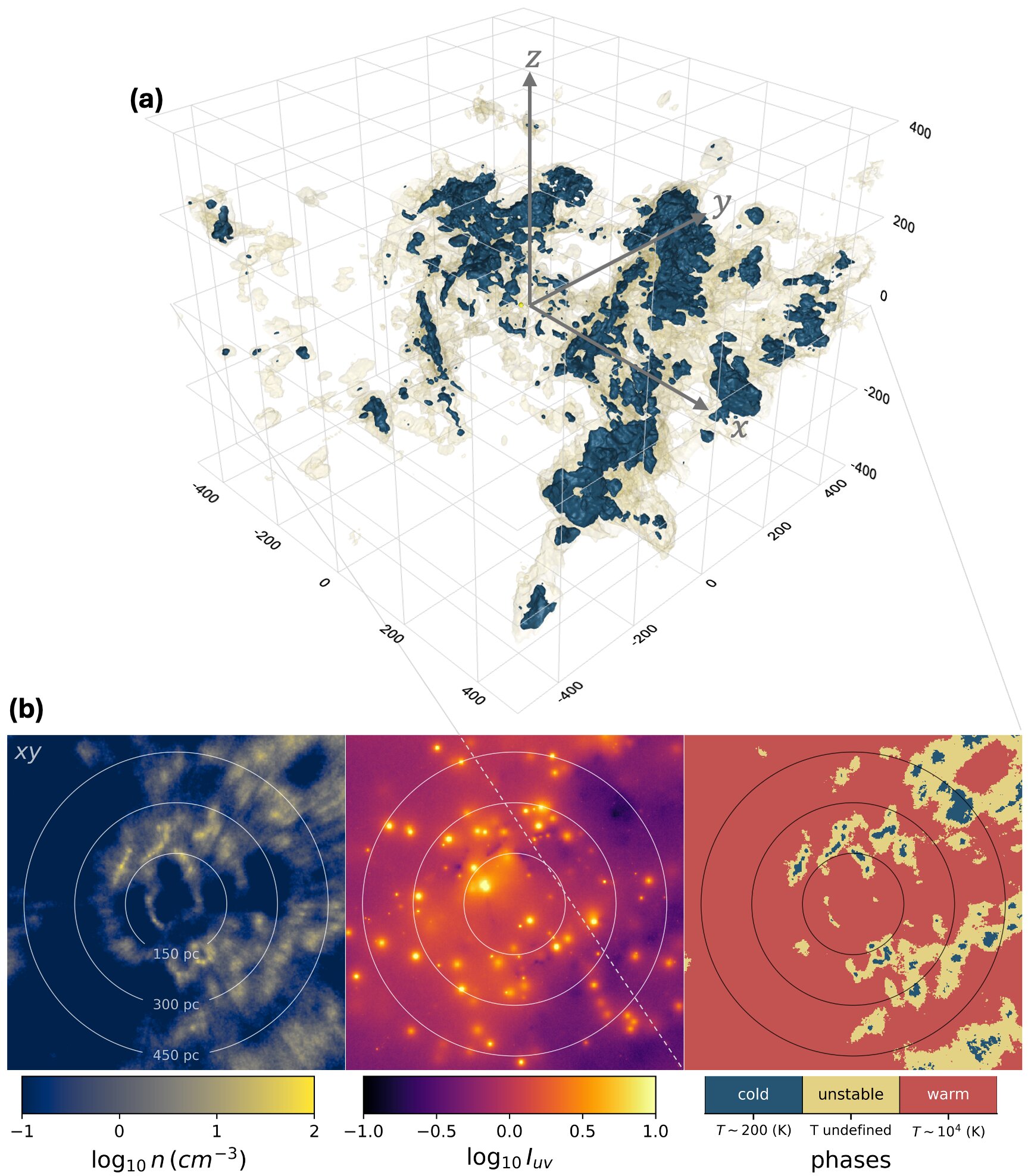
A new interstellar medium 3D map has traced the thermal structure of gas around the solar system, giving astronomers a fuller view of how nearby space is organized. The study, posted to the arXiv preprint server on July 16, reports that much of the gas sits in an unstable middle state rather than fitting neatly into the cold-or-warm picture used in classic models.
The work was led by Jonathan Shelest of the Technion—Israel Institute of Technology, according to the arXiv paper. The team mapped a region 1 kiloparsec wide, centered on the sun, or about 3,260 light-years across.
The interstellar medium is the thin gas between stars. It matters because that material can eventually become the raw ingredient for new stars and planets, depending on how it heats, cools and gathers into denser clouds.
What does the interstellar medium 3D map show?
The map shows cold clouds surrounded by layers of unstable gas, with both embedded in a broader zone of warm material, according to the paper. That three-part arrangement gives researchers a way to see how gas phases connect in space, rather than only measuring them along individual lines of sight.
Classic theory says neutral interstellar gas should mainly settle into two stable forms: cold, dense clouds at about 200 Kelvin and warm, diffuse gas at about 7,000 Kelvin. The region between those states, called the unstable neutral medium, has been treated as temporary and relatively uncommon.
Radio observations had already suggested that the unstable gas was more common than those models allowed, Phys.org reported. The arXiv study argues that turbulence may keep the gas changing on timescales comparable to how quickly it thermally relaxes.
How the researchers built the map
Shelest and colleagues used a tool called 𝒫3D, according to the paper. It combines a three-dimensional map of interstellar dust, a new three-dimensional map of ultraviolet starlight from nearby massive stars, and a model that classifies gas at each point as cold, warm or unstable.
The result is a kind of three-dimensional thermal map of the local interstellar medium. Earlier methods often averaged gas properties along a single direction, which made it hard to see where cold, warm and unstable regions sit relative to one another.
The paper says the structure follows the expected physics of heating and cooling. Dense cloud interiors cool efficiently and contain dust that blocks incoming starlight, while gas at cloud edges is less dense and not yet fully exposed to enough ultraviolet radiation to become warm, leaving it in the unstable range.
Why the unstable gas matters
Near the galactic plane, the team found that about 41% of the gas mass is unstable, compared with 27% cold gas and 32% warm gas, according to the arXiv study. The authors say that split implies gas is cycling between warm and cold phases over roughly 3 million to 6 million years.
Farther from the galactic plane, the paper reports that gas density falls quickly with height and warm gas becomes the dominant mass component.
The study also found that cold clouds keep a mostly steady internal density even though they are surrounded by unstable, turbulent material. The authors interpret that as evidence for relatively mild turbulence inside the clouds.
That finding could affect how star formation models treat cold gas. The researchers say future models should treat cold clouds as part of a larger, cycling multiphase system, rather than as isolated reservoirs of turbulent material.
This story draws on original reporting from Phys.org.