
Researchers track immune cells as they cluster around cancer cells
A Taiwan team found natural killer cells gather around oral cancer cells in culture, while treating healthy fibroblasts differently.
By Lucas Ferreira · Science & Environment Writer
3 min read
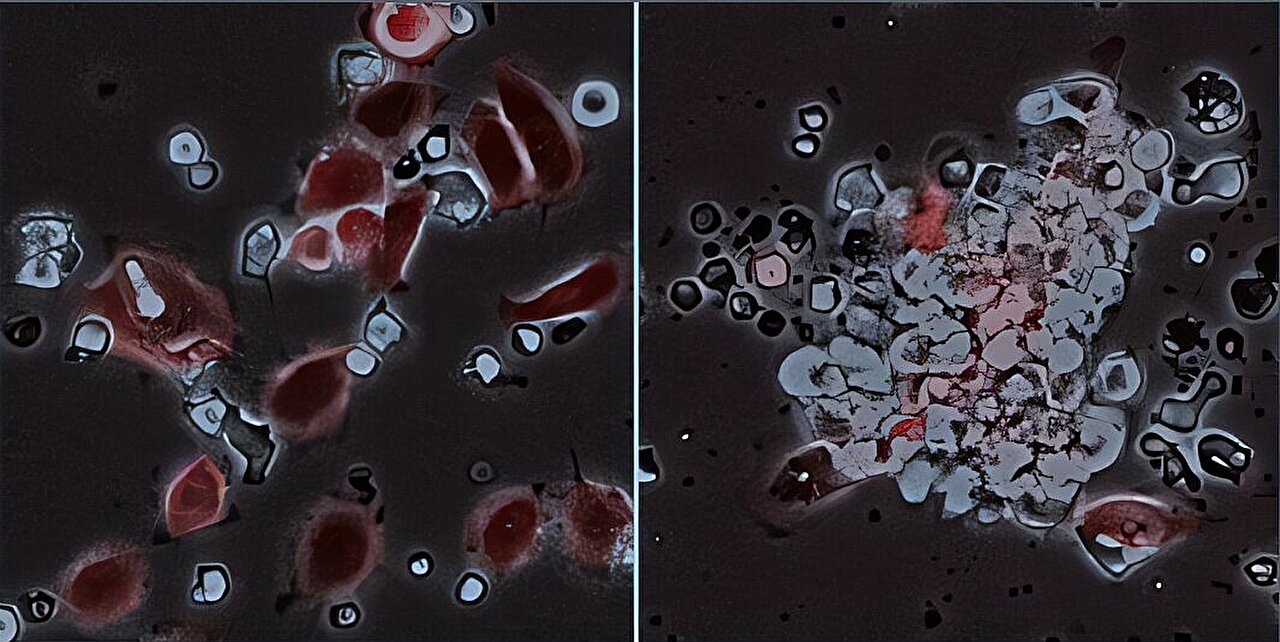
Researchers in Taiwan have tracked how natural killer immune cells gather around cancer cells in laboratory cultures, a finding that could help clarify how these cells recognize and attack abnormal tissue. The work matters because natural killer cells are a key part of the body’s antiviral and antitumor defenses, yet their collective movement around cancer cells has remained poorly understood.
Yun-Xuan Zhang and colleagues at National Central University studied the motion of natural killer cells, or NKCs, in mixtures containing either oral cancer cells or healthy fibroblasts, according to a paper published in Physical Review E. Fibroblasts are common connective-tissue cells.
The researchers used fluorescent microscopy and phase-contrast microscopy to record where the cells moved over tens of hours, taking measurements every few minutes, the study reported. Their goal was to compare how NKCs behaved near abnormal cells with how they behaved near normal cells.
Tracking cells in culture
According to the study, the team prepared two kinds of mixtures on collagen-coated surfaces: NKCs with cancer cells, and NKCs with fibroblasts. The researchers first seeded the dishes with about 50,000 cancer cells or 10,000 fibroblasts for 24 hours, then added about 1 million NKCs to stimulate interactions.
Phase-contrast microscopy allowed the team to follow transparent cells by converting shifts in light into differences in brightness. The cancer cells were also tracked with fluorescent microscopy after the researchers attached fluorophores, molecules that make the cells visible under that imaging method.
The paper frames the experiment as a study of coupled active systems, in which nearby cells affect one another’s movement. The authors noted that collective behavior has been studied in systems such as bird flocks, fish schools and dense bacterial groups, but immune cells interacting with abnormal cells remain less explored from both immunology and physics perspectives.
Cancer cells drew clustered attacks
In cultures containing cancer cells, the NKCs drifted toward the cancer cells and attached to them, the researchers found. The attached NKCs then drew in more NKCs, forming clusters in each experimental run.
Those clusters were larger than clusters seen in cultures containing only NKCs, according to the study. The researchers reported that the cancer cells slowed NKC motion, while the NKCs attacked by releasing toxic substances, though those substances were not directly observed in the experiments.
The cancer cells also changed their own behavior, the team found. They formed larger clusters than they did when cultured alone, a pattern the researchers interpreted as reducing collective surface area and limiting exposure to NKC attack.
After the cancer cells died, the NKCs moved away from the dead cells, according to the paper. The researchers described a sequence in which immune cells attached, aggregated and then departed after the target cells were eliminated.
Healthy cells prompted scouting, not clustering
The response looked different when NKCs were mixed with fibroblasts. The National Central University team found that NKCs moved along the main axis of fibroblast cells and appeared to survey the surrounding area.
But in those cultures, the NKCs did not form large clusters and did not alter the fibroblasts’ existing movements, according to the study. That contrast suggests the immune cells shifted behavior depending on whether they encountered cancer cells or healthy fibroblasts.
The researchers said future work could use mechanical and theoretical models to identify the small-scale interactions behind the switch between clustering around cancer cells and scouting near fibroblasts. They also said other cancer-cell types and healthy-cell types could be studied.
This story draws on original reporting from Phys.org.