
Europe gets a more sensitive superconducting X-ray detector
The BESSY II instrument is designed to study atom-thin materials, nanostructures and highly diluted samples with far higher photon efficiency.
By Tom Brennan · Health & Medicine Correspondent
3 min read
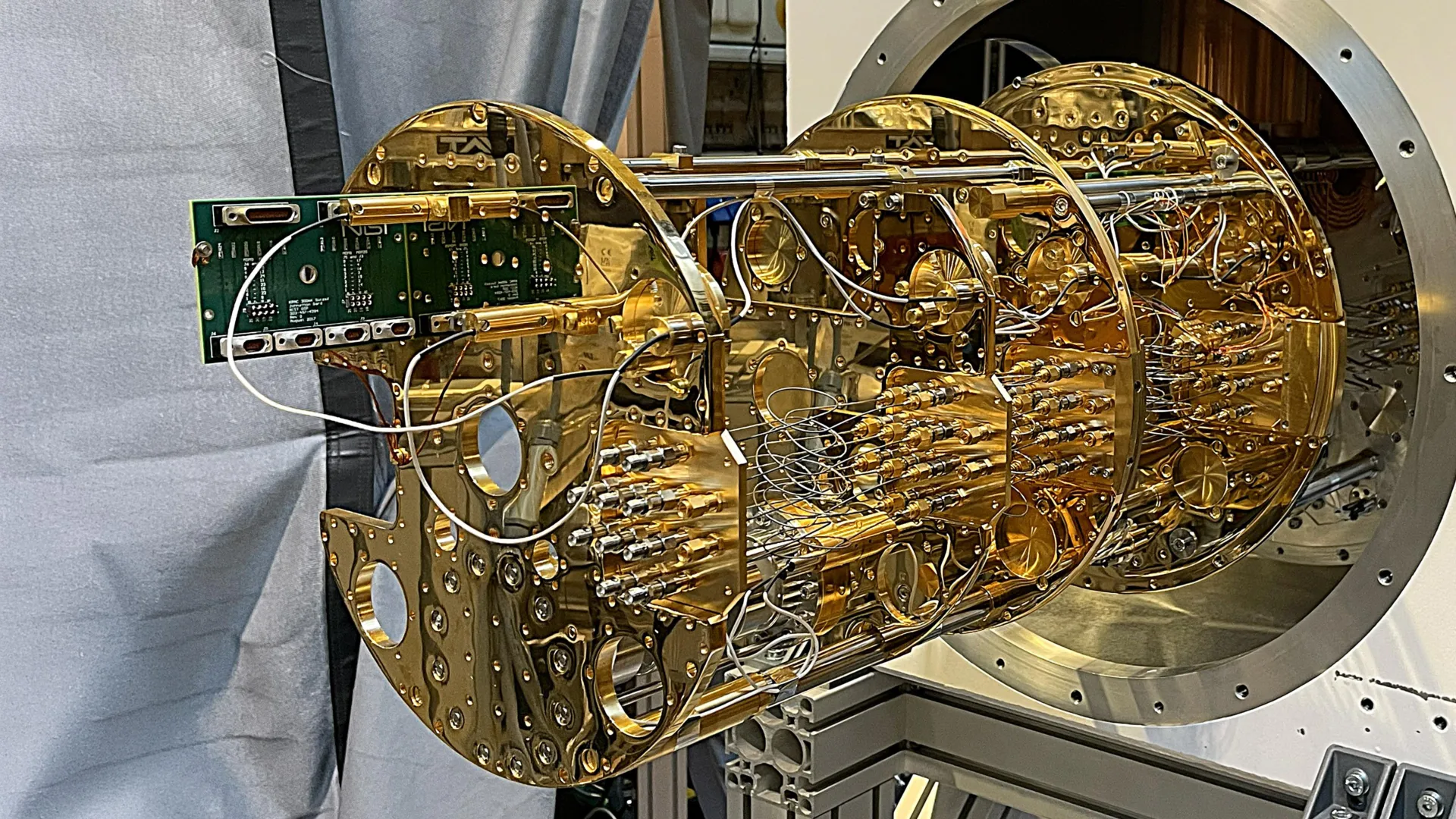
A superconducting X-ray spectrometer has begun operating at BESSY II, giving European synchrotron users access to a detector technology that Helmholtz-Zentrum Berlin says was previously available at only a few X-ray facilities worldwide. HZB says the Transition Edge Sensor array can detect photons 100 to 1,000 times more efficiently than conventional wavelength-dispersive X-ray emission spectrometers.
The instrument was developed by HZB with the Max Planck Institute for Chemical Energy Conversion in Mülheim an der Ruhr and the National Institute of Standards and Technology in Boulder, Colorado, according to HZB. The team describes the system in a 2026 paper in Review of Scientific Instruments.
Why the detector matters
Synchrotron facilities such as BESSY II produce bright X-rays that researchers use to probe materials, HZB said. Some methods, including X-ray emission spectroscopy and resonant inelastic X-ray scattering, depend on collecting photons released by a sample, so weak signals can limit what scientists can measure.
HZB said those methods have often favored bulk materials or samples with relatively high concentrations. The new detector is intended to make experiments practical on atomically thin systems, nanostructures and samples with very low amounts of the atoms or molecules being studied.
According to HZB scientist Régis Decker, who is responsible for the instrument, the added sensitivity could support work in molecular chemistry, molecular biology and quantum materials. HZB said the instrument may also shorten some X-ray emission and scattering measurements from hours to minutes.
How the system works
The spectrometer uses 248 superconducting sensors cooled to 25 milli-Kelvin, HZB said. The cooling is provided by a helium-4 and helium-3 dilution refrigerator of the kind also used in some quantum computing systems.
When a sample emits an X-ray photon, the photon lands on one of the sensors and causes a small temperature rise, according to HZB. That pulse changes the sensor’s superconducting state and increases its electrical resistance, and the signal is read with electronics based on Superconducting Quantum Interference Devices, or SQUIDs.
HZB said the instrument is installed at the BESSY II UE52-SGM beamline, which provides full polarization control. The detector is paired with a custom ultra-high-vacuum sample chamber for transferring, preparing and measuring samples, with temperature control from 10 Kelvin to room temperature.
Plans for users and upgrades
HZB said it is seeking research proposals from the user community. Planned additions include expanded sample preparation options and measurements in magnetic fields for X-ray magnetic circular dichroism in absorption and emission studies.
Transition Edge Sensor spectrometers were first developed for astrophysics, where very faint photon signals must be measured, according to HZB. Before the BESSY II installation, HZB said five such spectrometers were operating at X-ray facilities: four in the United States and one in Japan.
The journal paper lists Decker and colleagues from HZB, NIST, MPI-CEC and other institutions as authors. The study is titled “A superconducting transition edge sensor array for synchrotron soft x-ray emission spectroscopies of low-dimensional and impurity-level concentration systems.”
This story draws on original reporting from ScienceDaily.