
Electron cooling of highly charged ions demonstrated in Penning trap
A team at TU Darmstadt and GSI reported a cooling advance that could prepare slow heavy ions for precision experiments.
By Lucas Ferreira · Science & Environment Writer
2 min read
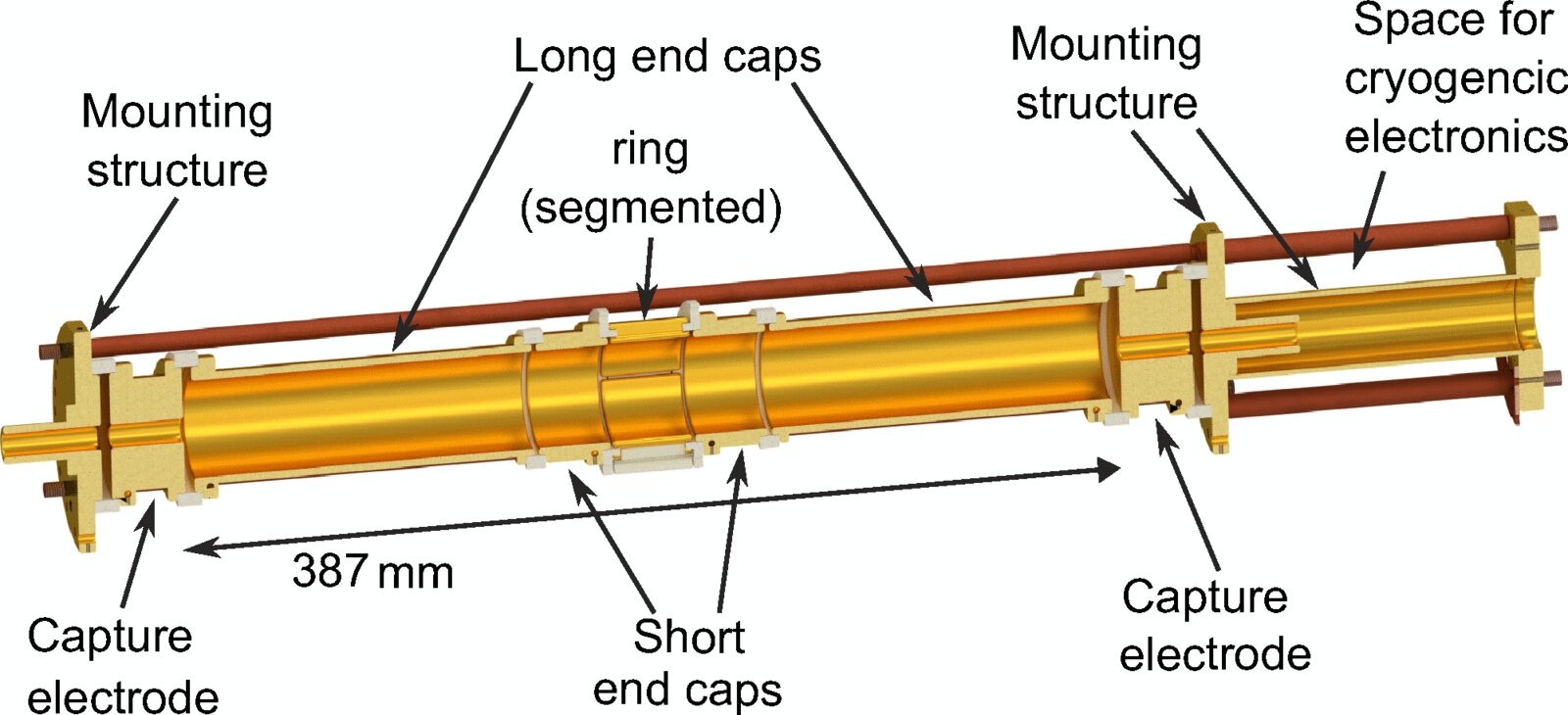
Electron cooling highly charged ions in a Penning trap has been demonstrated by researchers at Technische Universität Darmstadt and the GSI Helmholtz Centre for Heavy Ion Research, according to a paper published July 29 in Physical Review X. The result is one part of a broader HITRAP advance intended to make heavy ions slow and controlled enough for precision studies.
The research team, whose affiliations also include Goethe University Frankfurt, reported two connected achievements: it decelerated accelerator-produced ions and trapped them, while separately observing electron cooling of highly charged ions in the trap. The distinction matters because the paper says the cooling observation came during commissioning with ions from a local electron-beam ion source.
What did the HITRAP experiment demonstrate?
The accelerator result used fully ionized argon—argon atoms stripped of all their electrons, leaving bare nuclei. TU Darmstadt said the ions began at about 30% of the speed of light and had their kinetic energy cut by roughly a factor of 10,000 before being held in the HITRAP Cooling Trap for several seconds.
That marked a demonstration of the full route from accelerator production through deceleration to storage in a Penning trap, according to the university. Many atomic, nuclear and fundamental-physics experiments need ions at low energy, even though highly charged ions are typically produced at high energy.
The second achievement was the first reported electron cooling of highly charged ions in a Penning trap. Cooling lowers the ions’ kinetic energy, reducing their motion and helping prepare them for high-precision measurements. It does not mean this was the first use of electron cooling in any Penning trap: a 1996 experiment reported cooling trapped protons with trapped electrons. The new first applies specifically to highly charged ions.
How does electron cooling work at HITRAP?
HITRAP’s Cooling Trap is a nested Penning trap designed to hold highly charged ions and a cold electron plasma at the same time, the Physical Review X paper says. In broad terms, the cold electrons serve as a cooling medium that takes energy from the hotter ions.
The researchers did not report that the accelerator-produced argon ions themselves completed that cooling step in the same run. Instead, the paper says local-source ions were used to commission the trap, producing the electron-cooling observation. Together, the results show the facility’s separate deceleration, trapping and cooling capabilities.
The authors describe the work as a step toward experiments on fundamental interactions using trapped, heavy highly charged ions. TU Darmstadt said HITRAP has already hosted a first user experiment in which slow highly charged gold ions were used for materials-science research.
This story draws on original reporting from Phys.org.