
Drought crop production hotspots mapped in global study
University of Delaware researchers mapped where drought poses the greatest risk to major rainfed crops, including parts of the U.S., Brazil, Spain and India.
By Priya Raghavan · Science Reporter
3 min read
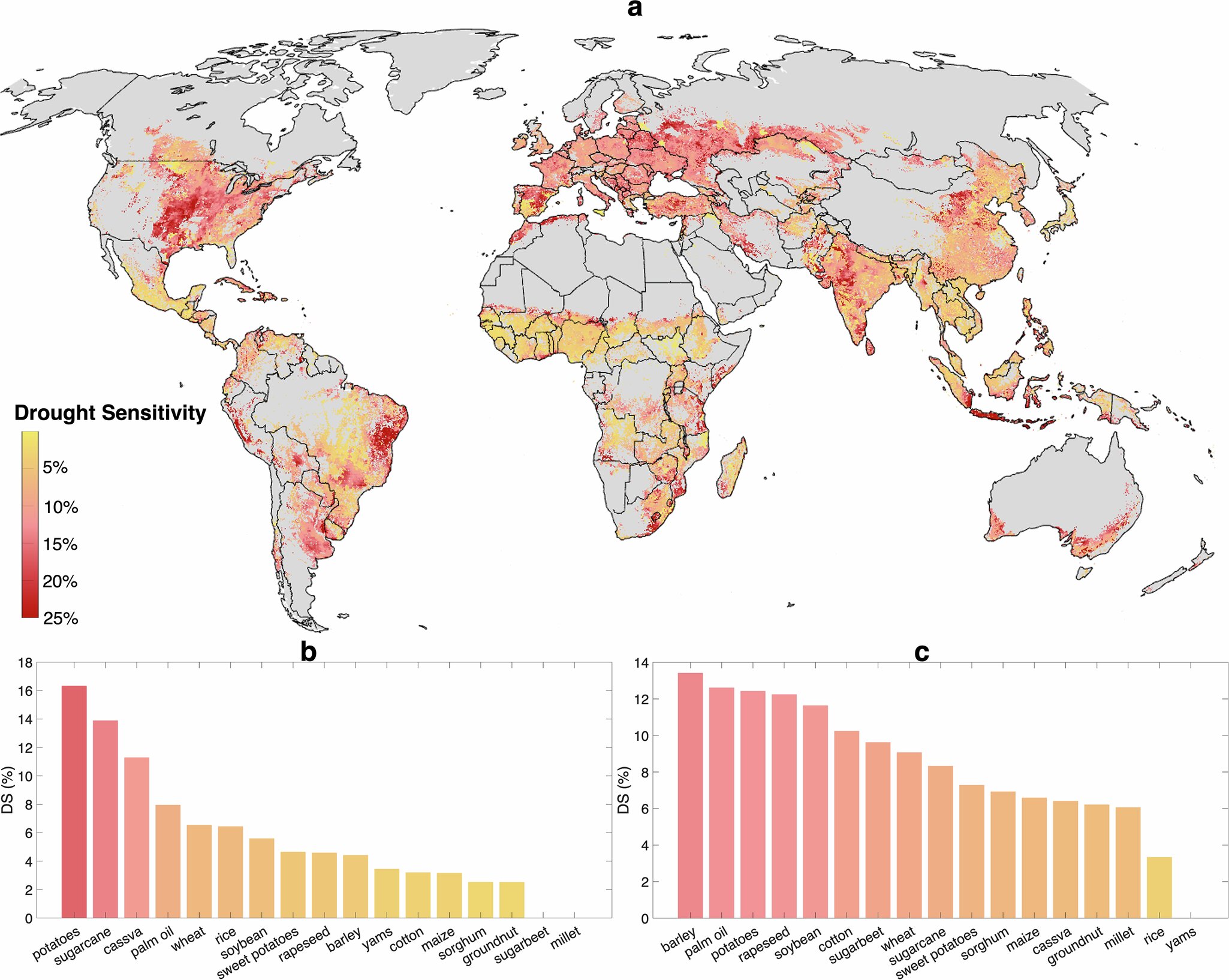
Researchers have mapped drought crop production hotspots around the world, identifying places where major crops are most vulnerable when water is scarce. The University of Delaware said the study is aimed at showing where drought could do the greatest damage to food production as temperature and rainfall patterns affect harvests.
The analysis, published in Nature Communications, measured drought sensitivity and drought-linked production losses for 17 major crops. The University of Delaware said those crops include rice, corn, wheat and soybeans and together account for three-quarters of global food production.
Kyle Davis, a University of Delaware associate professor with appointments in geography and spatial sciences and plant and soil sciences, said the researchers wanted metrics that could gauge how resilient or sensitive different crops are to drought. Marta Tuninetti, an assistant professor at Politecnico di Torino in Italy, served as co-lead author, according to the university.
Where are drought crop production hotspots?
The study identified drought-sensitive areas in several regions, according to the University of Delaware. The hotspots include parts of the Midwestern United States, eastern Brazil, eastern Spain, and central and northern India, among others.
The paper focused on both rainfed and irrigated production, a distinction that shaped the findings. According to the University of Delaware, rainfed crops showed greater sensitivity to climatic conditions than irrigated crops.
Rainfed crops rely on precipitation rather than water supplied through irrigation systems. Irrigated crops can continue receiving water through sprinklers, canals or hoses during dry periods, which can help yields remain stable or, in some cases, increase, according to the university’s summary of the research.
What did the researchers measure?
The researchers quantified crop-specific drought sensitivity at a global scale, separating rainfed and irrigated systems, according to the study description from the University of Delaware. They also assessed production losses associated with drought for each of the 17 crops.
The crop list cited by the university includes several of the world’s core staples. Rice, corn, wheat and soybeans were among the crops examined, making the findings relevant to regions that depend heavily on those harvests for food supplies and farm income.
The study appears under the title “Addressing global hotspots of drought-related crop production losses” in Nature Communications. The journal article is listed with the DOI 10.1038/s41467-026-72715-y.
Davis is also a resident faculty member in the University of Delaware’s Data Science Institute, according to the university. Tuninetti works in the Department of Environment, Land and Infrastructure Engineering at Politecnico di Torino.
The University of Delaware framed the work as a way to locate vulnerability before drought damage occurs. By comparing crops and production systems, the research provides a map of where drought sensitivity is concentrated across major food-producing regions.
This story draws on original reporting from Phys.org.