
Cyanobacteria calcium signaling study links protein to cell connections
A study of living multicellular cyanobacteria ties a calcium-binding protein to cell connections, with implications for their evolutionary history.
By Lucas Ferreira · Science & Environment Writer
2 min read
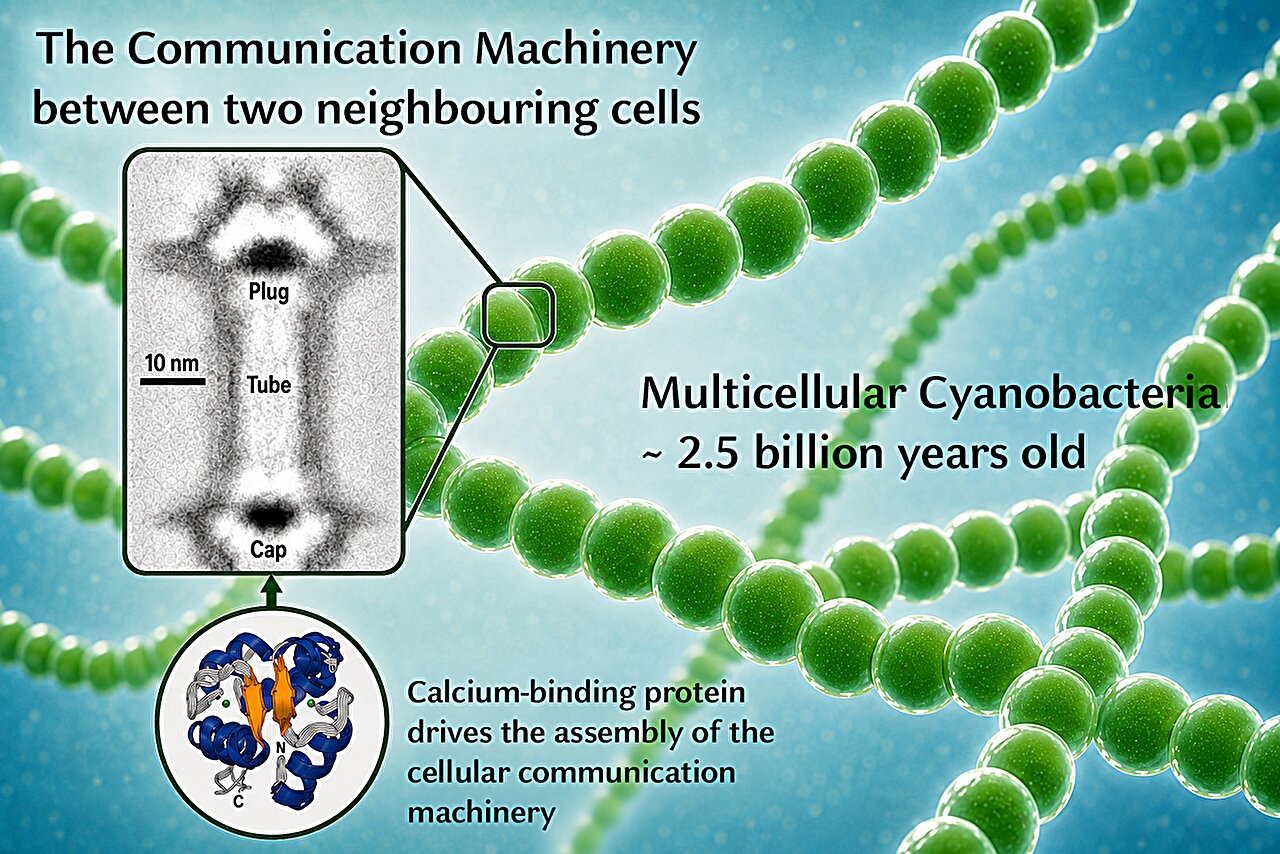
A study of cyanobacteria calcium signaling has found that a calcium-binding protein is tied to the number of connections between cells in living multicellular bacteria. The result does not examine ancient bacteria directly, but the researchers say it may point to an early origin for some principles of cell-to-cell communication.
The international team, led by Heinrich Heine University Düsseldorf and including researchers at the University of Tübingen, reported the work in The EMBO Journal. The paper, by Teresa A. Müller and colleagues, was published on August 13, 2026, according to a university-supplied EurekAlert release.
How do cyanobacteria communicate between cells?
The study focused on multicellular cyanobacteria, which use cell-spanning connections called septum junctions to coordinate communication between neighboring cells. The researchers describe those connections as analogous to gap junctions in eukaryotic cells, such as human cells; the study does not say they are the same structures.
In animals and other eukaryotes, cells with nuclei, calcium ions help regulate communication through connections between neighboring cells. Cyanobacteria are prokaryotes, meaning their cells lack nuclei. The team reported that calcium signaling also has a central role in their cell-to-cell communication.
What did the CSE experiments find?
The researchers identified a protein called CSE that they reported occurs only in multicellular cyanobacteria. Nuclear magnetic resonance spectroscopy showed the structure of CSE when bound to calcium, and the team concluded that the protein acts as a calcium buffer.
Using cryo-electron microscopy, the researchers compared mutant bacterial cells that lacked CSE with other cells. The CSE-deficient mutants had significantly fewer connecting structures, according to Heinrich Heine University Düsseldorf. The finding links CSE-dependent calcium signaling to the abundance of these connections and supports the researchers' view that calcium is involved in regulating bacterial cell communication.
The authors said the signals behind septum-junction formation and cell-to-cell communication had previously been largely unknown. Their experiments narrow that gap by associating the calcium-binding protein with both calcium signaling and the presence of the bacterial connections.
What does the finding mean for evolution?
The evolutionary conclusion remains an interpretation rather than a direct observation of billion-year-old cells. Khaled Selim, who leads the Düsseldorf research group, said the findings suggest that functional principles found in more complex organisms may have existed in tissue-like multicellular bacteria before eukaryotic and prokaryotic lineages diverged.
That claim concerns the possible age of underlying functional principles, not proof that bacteria possessed human gap junctions or that all bacteria use CSE. The evidence reported in the study is limited to the living multicellular cyanobacteria and the CSE-lacking mutants examined by the team.
This story draws on original reporting from Phys.org.