
CapuchinAI tests cognition in wild capuchins with facial recognition
Emory and Georgia Tech researchers report a field prototype that identifies capuchins and assigns touchscreen tasks in Costa Rica.
By Priya Raghavan · Science Reporter
3 min read
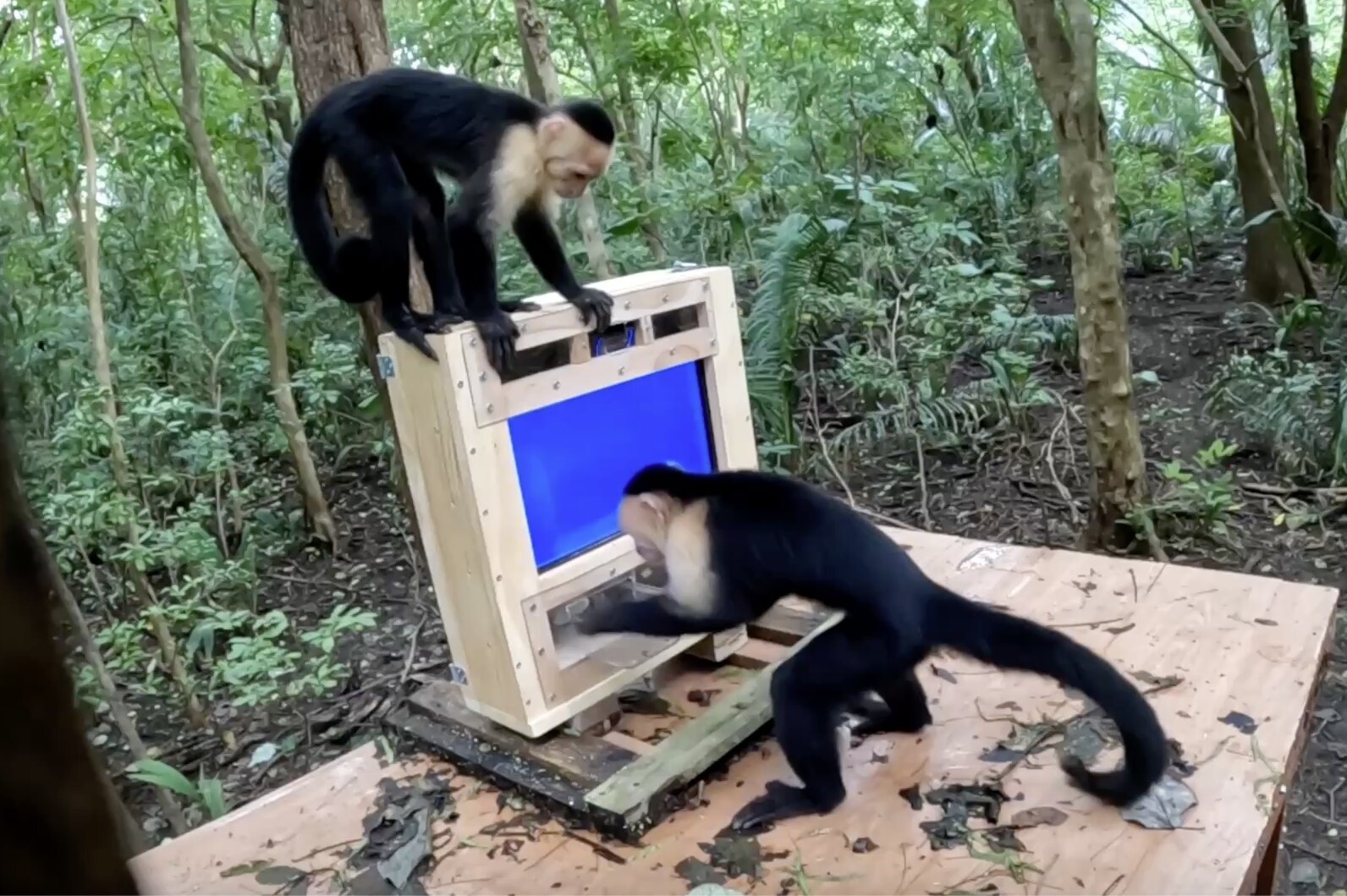
CapuchinAI wild primates research has produced a field-tested prototype that identifies individual capuchin monkeys, gives them touchscreen learning tasks and records rewarded responses. Emory University says the proof-of-concept, developed with Georgia Institute of Technology researchers and published in the American Journal of Primatology, could give scientists a more structured way to study cognition outside laboratories.
The system was tested with wild white-faced capuchins at Costa Rica’s Taboga Forest Reserve. Its reported 97% identification rate applies to a facial-recognition model trained on images and video of six monkeys, not to all animals at the site or to other primate species.
How does CapuchinAI test wild primates?
According to Emory, CapuchinAI combines a compact battery-powered computer with a field research platform. When a monkey approaches, the system identifies it, places an individual-specific learning task on a touchscreen and dispenses a food reward if the animal answers correctly.
That sequence links identification to testing: machine vision can shift the touchscreen test to another recognized monkey during a session, allowing more than one animal to take part, Emory reported. The researchers said the capuchins became accustomed to the equipment and learned the association between touching the screen and receiving a reward.
Facial recognition does not itself measure an animal’s cognitive ability. It is the part of the setup that lets researchers connect a particular animal with the task it receives and the response data it produces.
Why run cognitive tests in the forest?
Marcela Benítez, an Emory anthropology professor and the paper’s senior author, said primate cognition is difficult to test in the wild because researchers must maintain experimental control in unpredictable conditions. Laboratory studies can control the conditions around an animal, while studies in natural settings can capture social and ecological circumstances that are harder to reproduce in a lab, Emory said.
The team trained its recognition model with GoPro footage of six capuchins using testing platforms. Students at Emory and Georgia Tech labeled thousands of images and videos with the monkeys’ identities, and the researchers used the open-source YOLO software to build a model that can run on a laptop, according to Emory and Phys.org.
The initial scale remains limited. First author Federico Sánchez Vargas told Emory that the model performed well with six monkeys, while the Costa Rica field site has about 100 capuchins. The reported accuracy therefore demonstrates a proof of concept rather than broad deployment across the population.
The paper includes open-source coding guidance and a design for a lower-cost field platform, Emory said. The authors hope researchers can adapt the method for other wild-primate species and settings, but that expansion remains a future goal rather than a result established by the Taboga tests.
This story draws on original reporting from Phys.org.