
Automated daphnia heartbeat system flags early pollutant toxicity
KRISS says its high-throughput platform measures water flea heart rates to detect low-level toxic effects from nanomaterials and pollutants.
By Tom Brennan · Health & Medicine Correspondent
3 min read
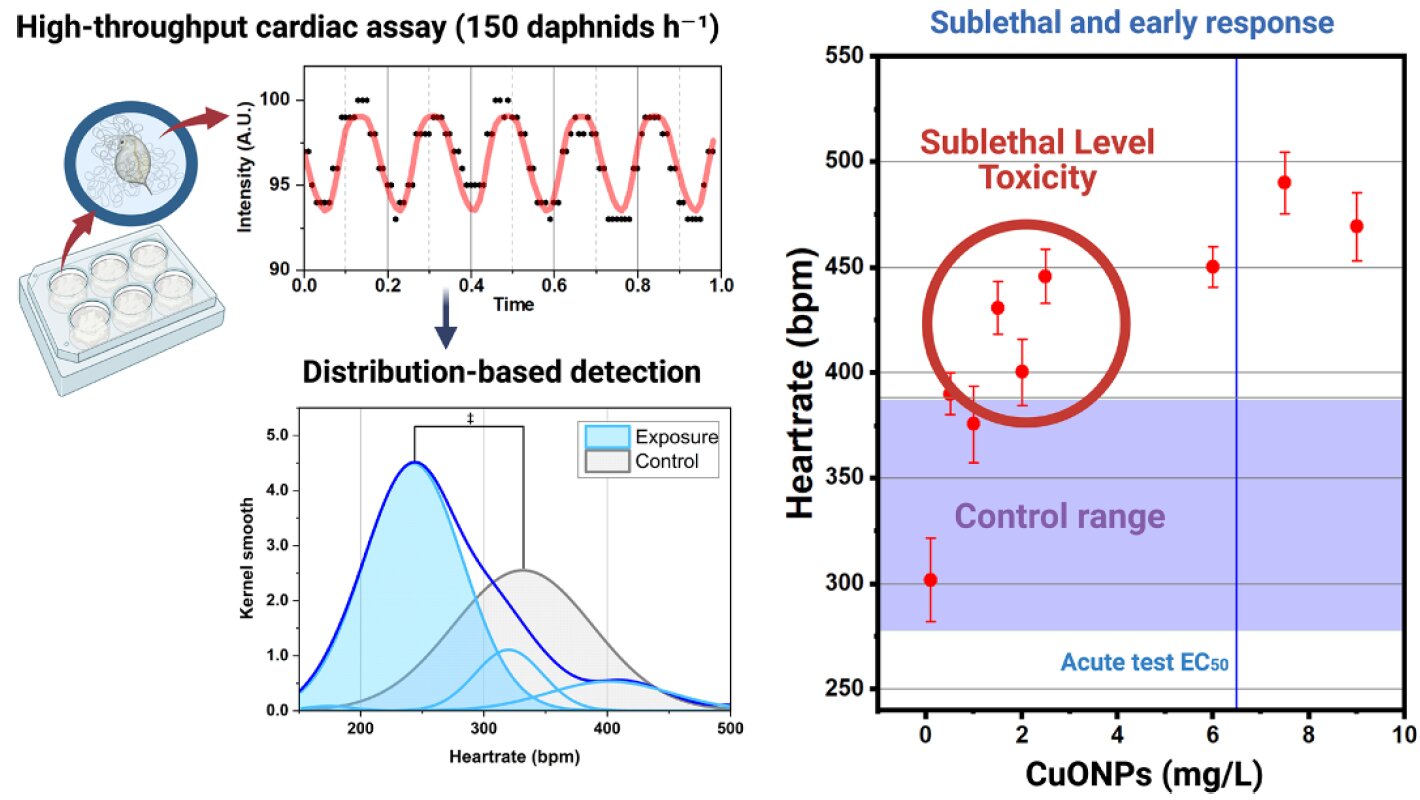
The Korea Research Institute of Standards and Science says it has developed an automated system that uses the heartbeat of Daphnia magna, a small aquatic crustacean, to assess toxicity from nanomaterials and other pollutants. The institute says the approach could reveal harmful effects at low concentrations before organisms show more obvious damage.
KRISS said the platform can measure and analyze heart-rate data from about 150 daphnia per hour. By collecting data from many individuals, the researchers said, the system can spot response patterns that may be missed when tests rely on averages from a small sample.
How the system works
Daphnia magna is commonly used in aquatic toxicity testing because it is easy to grow, produces reproducible test results and has a see-through body that allows researchers to observe internal organs, according to KRISS. The organism’s heart beats roughly six to eight times each second, which makes manual heart-rate measurement difficult.
The current international standard cited by KRISS, OECD Test No. 202, evaluates acute toxicity by visually checking whether daphnia can still swim normally. KRISS said that method can vary with the observer’s judgment, and that heart rate offers a more quantitative measure to supplement it.
The KRISS system immobilizes daphnia on cotton fabric and records high-speed images of the heart area. It then tracks repeated changes in light intensity in the images and calculates heart rate automatically, producing measurements in real time for later toxicity analysis, according to the institute.
In tests, the KRISS team exposed daphnia to toxic substances and analyzed heart-rate changes at high throughput. The institute said the larger dataset allowed researchers to examine differences among individual animals and improve precision in detecting toxic responses.
Focus on subtle effects
KRISS said the system can identify sublethal effects at low concentrations, including subtle differences among individual daphnia that conventional approaches may struggle to detect. The institute said the equipment design is intended to be straightforward and scalable for different research settings and test materials.
The work was carried out jointly by KRISS and KIST Europe, according to the National Research Council of Science and Technology. KRISS led development of the platform, and KIST Europe installed it for nanomaterial toxicity experiments and data validation.
Dr. Kwon Ik Hwan, a senior research scientist in the Nanobio Measurement Group at KRISS, said the platform improves precision in aquatic ecotoxicity testing and that the team plans to adapt the technology for nanomaterial studies and human-like models such as cardiac organoids. Dr. Lee Tae Geol, a principal research scientist at KRISS, said the system is being used at KIST Europe for CHIASMA, a Horizon Europe project, and that KRISS plans technology transfer to Korean equipment developers to broaden use among cardiotoxicity researchers.
The study, “High-throughput heart rate monitoring in Daphnia magna for sublethal ecotoxicological assessment,” was published in the Journal of Hazardous Materials. The paper lists Ik Hwan Kwon and colleagues as authors and carries the DOI 10.1016/j.jhazmat.2026.141474.
This story draws on original reporting from Phys.org.