
Scientists use AI to study quake signals, water and black holes
Recent studies used machine learning and gravitational-wave data to examine earthquake precursors, liquid water’s structure and black hole physics.
By Priya Raghavan · Science Reporter
3 min read
Researchers reported progress on three hard problems in science: whether large earthquakes show early warning patterns, why water behaves so unusually, and what gravitational waves can reveal about black holes. The work matters because each study uses large data sets to test ideas that have been difficult to observe directly.
Phys.org reported the findings in a weekly science roundup published June 27, 2026. The report also noted separate research finding that moose are native to Colorado, a digital model of a two-year-old child’s brain showed neural signatures linked to autism, and an experimental gel restored mobility in lab animals with severed spinal cords.
Machine learning searches for quake patterns
A team at the GFZ Helmholtz Center for Geosciences in Germany, working with international partners, developed a data-driven method to look for shifts in seismic activity before major earthquakes, according to Phys.org. The study gained added relevance after a recent dual earthquake event in Venezuela.
The researchers used machine learning to study hidden patterns in earthquake catalogs. According to Phys.org, they focused on several major historical earthquakes and found distinct foreshock patterns that appeared weeks or months before the larger events recorded in the data.
The team used two strategies. In one, researchers applied pattern-recognition algorithms and unsupervised machine learning to let patterns emerge from the data instead of looking only for known warning signs. In the other, they analyzed groups of related seismic events close together in time, location and magnitude rather than treating each earthquake separately.
GFZ professor Marco Bohnhoff said earthquakes affect one another, and that this influence grows as a rupture event nears. He said studying the collective behavior of earthquakes can help researchers better see how stress builds in the crust before large events.
Evidence supports two structures in liquid water
Researchers in Hong Kong reported molecular-level evidence for a theory that liquid water exists as a changing mixture of two structural states, according to Phys.org. The theory holds that one state is dense and disordered, while the other is less dense and more ordered.
Phys.org reported that the two-state idea has been used to explain water’s unusual traits, including that it reaches maximum density at 39 degrees Fahrenheit and becomes easier to compress as it cools. Researchers had not found direct molecular-level evidence of two liquid states, according to City University of Hong Kong professor Xiao Cheng Zeng.
The Hong Kong team used deep learning to search for patterns in data that had not been identified before. Phys.org reported that the model was trained on 74 million local configurations of water molecules and identified two local structures, labeled A and B.
The researchers found Structure A to be dense and disordered and Structure B to be less dense and more ordered, according to Phys.org. The change between the two remains hard to identify because the structures vary across different phases of water.
Gravitational waves point near event horizons
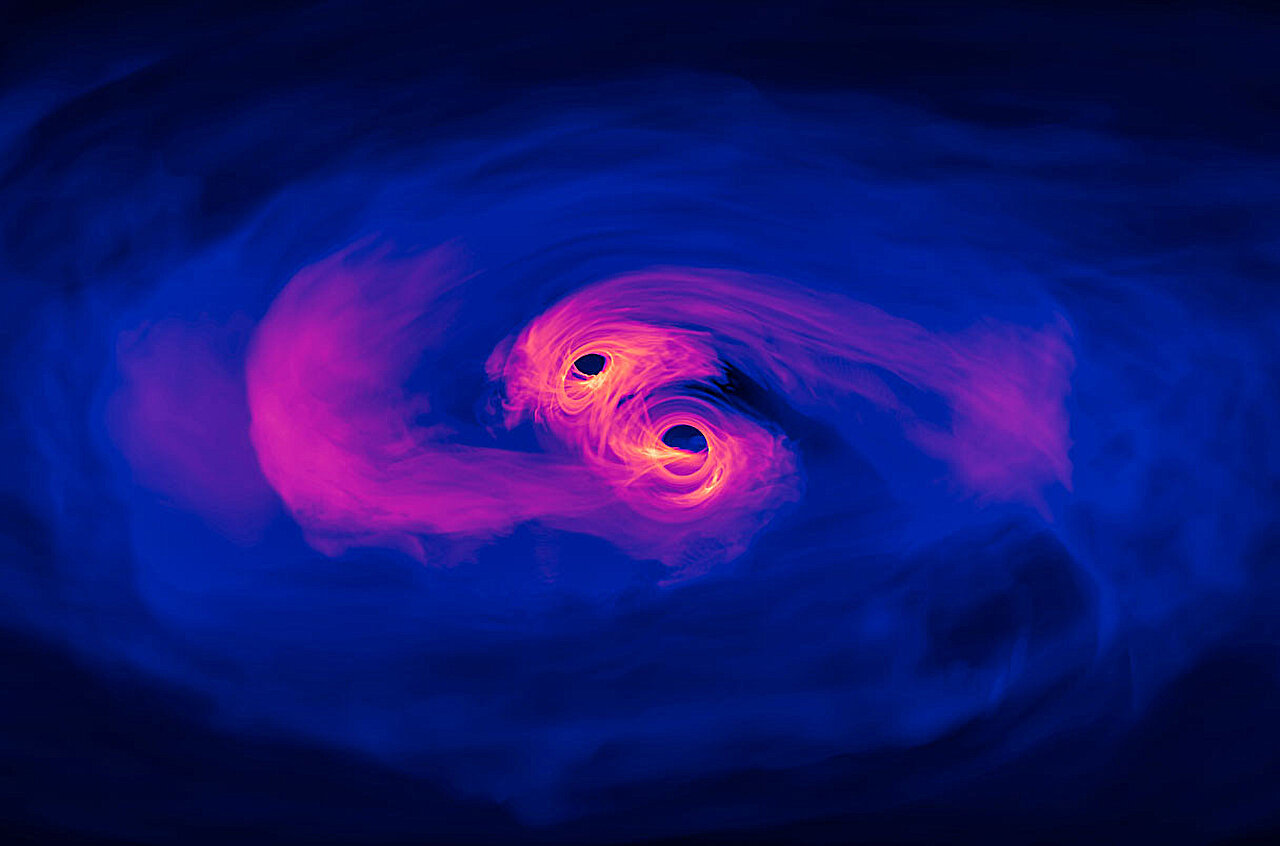
A separate group analyzed data from the strongest gravitational wave ever recorded, a 2025 detection by the LIGO observatory, according to Phys.org. The researchers isolated the final burst of waves and extracted information from a region close to the event horizon of merging black holes.
Phys.org reported that the burst came from a swirl in space that produced observable gravitational waves. If such waves form near enough to an event horizon, they can carry information about physics in that region.
The analysis revealed details about frame-dragging, the effect in which black holes twist space around them, according to Phys.org. Columbia University astronomer Maximiliano Isi compared the process to pushing a glass into a table and turning it so the tablecloth winds around it.
This story draws on original reporting from Phys.org.