
AI helps compare models of supercooled water’s structure
University of Osaka researchers used a neural network to rank 16 ways of describing molecular patterns in supercooled water.
By Priya Raghavan · Science Reporter
3 min read
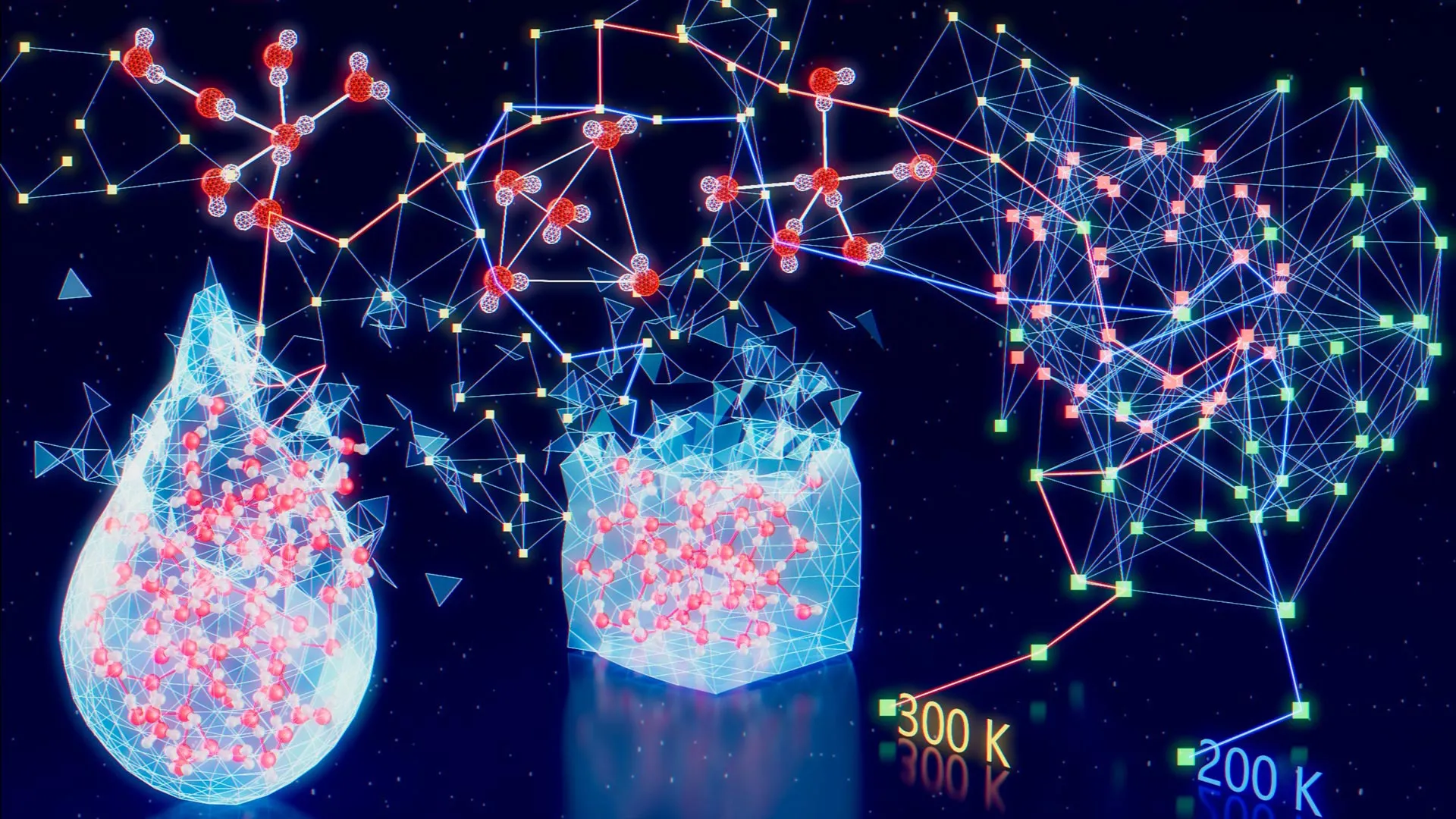
Researchers at the University of Osaka used artificial intelligence to compare competing ways of describing the molecular structure of supercooled water, the university said. The work matters because scientists have long linked water’s unusual behavior to microscopic structural changes but have lacked a common basis for judging which measurements capture those changes best.
The study, published in Communications Chemistry, examined 16 structural descriptors used to characterize water at the molecular level. According to the university, the neural network helped identify which descriptors most effectively distinguish between two proposed liquid forms of water: high-density liquid and low-density liquid.
Why supercooled water is difficult to describe
Water behaves differently from many liquids, including by expanding as it freezes, the University of Osaka said. Researchers have connected such behavior to how water molecules arrange themselves as temperature and pressure change.
Supercooled water adds another challenge. The university said water can remain liquid below its usual freezing point when it lacks nucleation sites, such as tiny impurities or small scratches on a container surface, where ice crystals can begin to form.
Under those conditions, researchers believe water’s unusual properties become more pronounced. The University of Osaka said scientists study those properties through a balance between high-density liquid structures, which are more compact, and low-density liquid structures, which are more open.
At the molecular scale, water molecules repeatedly form and break hydrogen-bond networks. The university said higher temperatures are associated with a greater share of the compact high-density structures compared with the more open low-density arrangements.
Neural network tested 16 descriptors
Scientists have developed many descriptors to express how nearby water molecules are arranged, including measures such as tetrahedral bond order and local density, according to the University of Osaka. Because those measures were created separately, they differ in scale, dimension and the type of structural information they use.
That mismatch has made direct comparison difficult. The Osaka team trained a neural network on structural data produced by molecular dynamics simulations of supercooled water, the university said.
Corresponding author Kang Kim said previous work had shown that machine learning can help classify and interpret structural data. Kim said the team wanted to use a neural network to assess how well the descriptors captured important structural information in a way comparable to human cognition.
After training, the network evaluated how the 16 descriptors separated low-density and high-density liquid structures across different temperatures. Senior author Nobuyuki Matubayasi said the approach allowed the researchers to determine the most efficient descriptors.
A framework for future water studies
The University of Osaka said the result offers a clearer way to compare molecular descriptions of supercooled water. The researchers say the framework may help connect microscopic structural shifts to water’s thermodynamic behavior.
The study was authored by Kohei Yoshikawa, Kokoro Shikata, Kang Kim and Nobuyuki Matubayasi. According to the journal reference, the paper is titled “Machine learning evaluation of structural descriptors for supercooled water” and appears in volume 9, issue 1 of Communications Chemistry.
This story draws on original reporting from ScienceDaily.