
Mars rover instrument passes test for detecting possible ancient life clues
Researchers say ExoMars’ Rosalind Franklin rover can distinguish molecular mirror images that may help identify past biology on Mars.
By Priya Raghavan · Science Reporter
4 min read
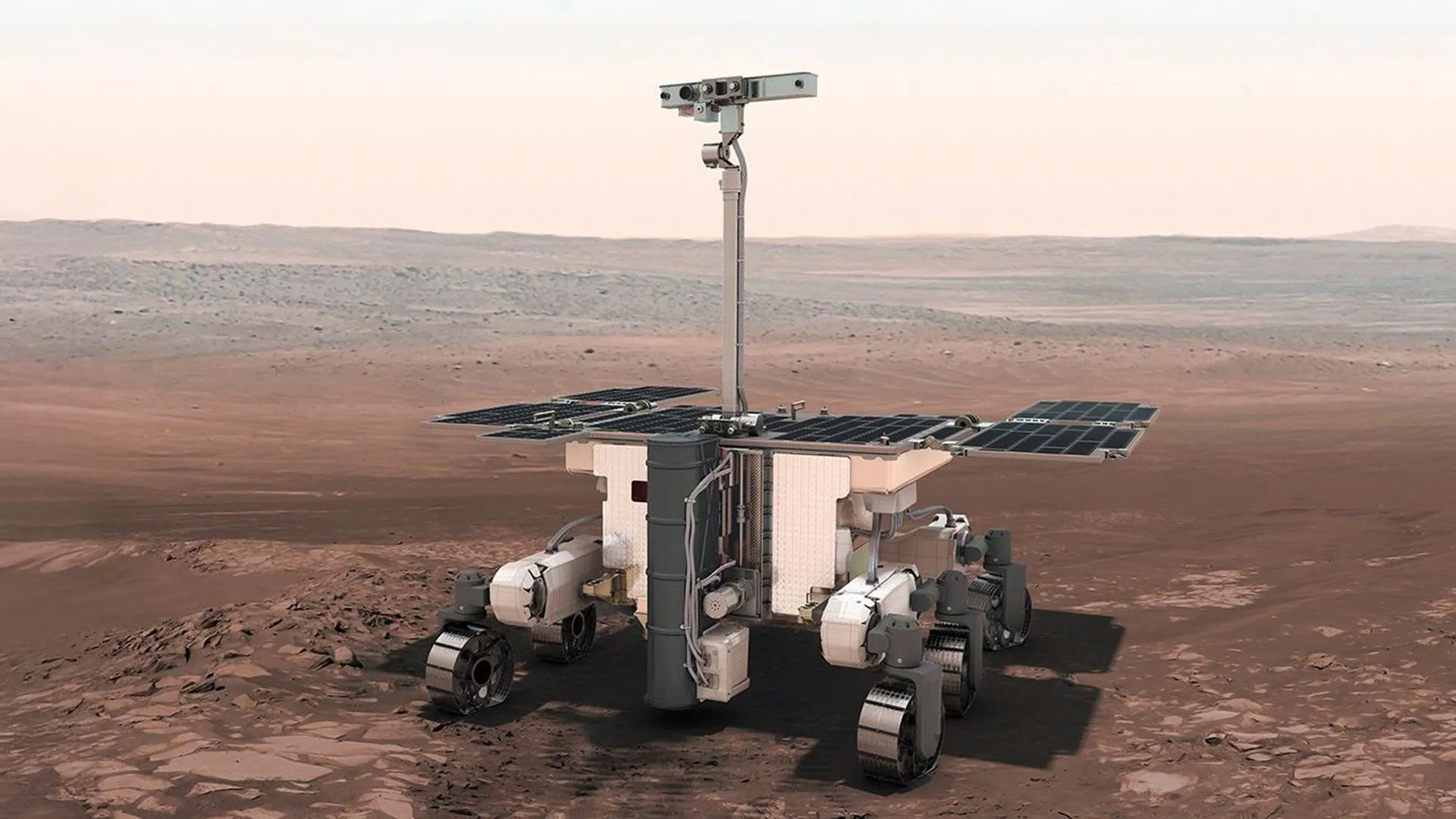
A key instrument planned for Europe’s Rosalind Franklin rover has shown it can detect tiny chemical differences that may help scientists look for evidence of ancient life on Mars. The result matters because organic molecules alone do not prove biology; researchers need ways to separate possible life-made chemistry from compounds formed without organisms.
The work, reported by the Max Planck Institute for Solar System Research and published in Earth and Planetary Science Letters, tested a method designed for the Mars Organic Molecule Analyzer, or MOMA. The rover, part of the European Space Agency’s ExoMars mission, is scheduled to begin searching the Martian surface in 2030, according to the institute.
Scientists have long viewed early Mars as a place that may once have been warmer, wetter and protected by a denser atmosphere than the planet has today. NASA rovers have already found organic molecules in Martian rocks, but the Max Planck institute said those findings cannot, by themselves, establish that life was ever present.
Testing molecular handedness
The new study focused on pristane and phytane, two stable hydrocarbons that are associated with living organisms and occur in petroleum on Earth, according to the research team. Because such molecules can persist for very long periods under suitable conditions, they are considered possible targets in the search for ancient biosignatures.
The researchers also examined a feature called chirality. Chiral molecules come in two mirror-image forms, known as enantiomers, with the same atoms arranged in opposite orientations. Living systems on Earth tend to produce one form far more than the other, while nonbiological chemistry is expected to produce a roughly even mix, according to the scientists.
Guillaume Leseigneur of the Max Planck Institute for Solar System Research, the study’s lead author, said molecules such as pristane and phytane would be meaningful biosignature candidates if life once existed on Mars. Co-author Uwe Meierhenrich of Côte d’Azur University described chirality as a useful tool for investigating possible past life beyond Earth.
MOMA is designed to heat rock samples, release volatile compounds and examine them with a gas chromatograph and mass spectrometer, along with small furnaces and an excitation laser. In the gas chromatograph, compounds move through coated capillary tubes; the two mirror-image forms can travel at different speeds because they interact differently with the coating.
Using replicas of MOMA’s capillary tubes, the team separated the enantiomers of pristane and phytane for the first time, according to the Max Planck institute. Fatma Yesil Sahan, a MOMA team member at the institute, said the test showed the instrument has the sensitivity and accuracy needed for that separation.
Murchison meteorite points to Earth contamination
The researchers used material from the Murchison meteorite, which fell in Australia in 1969, rather than Martian rock. The meteorite contains varied organic compounds, some believed to date from its formation and others suspected to come from contamination after it reached Earth, according to the institute.
The team initially considered whether pristane and phytane in the meteorite might reflect biological contamination at the landing site. Instead, the analysis found equal amounts of the mirror-image versions of both molecules, a pattern that did not fit that explanation, the researchers reported.
The study concluded that the molecules likely came from petroleum-based aerosols the meteorite encountered while passing through Earth’s atmosphere. The researchers compared the results with pristane and phytane in oil shales, rocks that contain petroleum precursors altered over millions of years under heat and pressure.
Manuel Reinhardt of the University of Göttingen said petroleum forms in such rocks over long periods at depth under heat and pressure. The researchers said those conditions can erase the original imbalance between mirror-image molecules, producing the even proportions seen in the meteorite samples.
The Max Planck institute said the findings both support MOMA’s readiness for the Mars mission and raise questions about how meteorites acquire organic contamination on Earth. The work also points to petroleum-related atmospheric pollution as a factor future meteorite studies may need to consider.
This story draws on original reporting from ScienceDaily.