
2D magnonic crystals band gaps widened with inverse design
Tokyo University of Science researchers used topology optimization to find 2D magnonic crystal layouts with larger spin-wave band gaps.
By Priya Raghavan · Science Reporter
3 min read
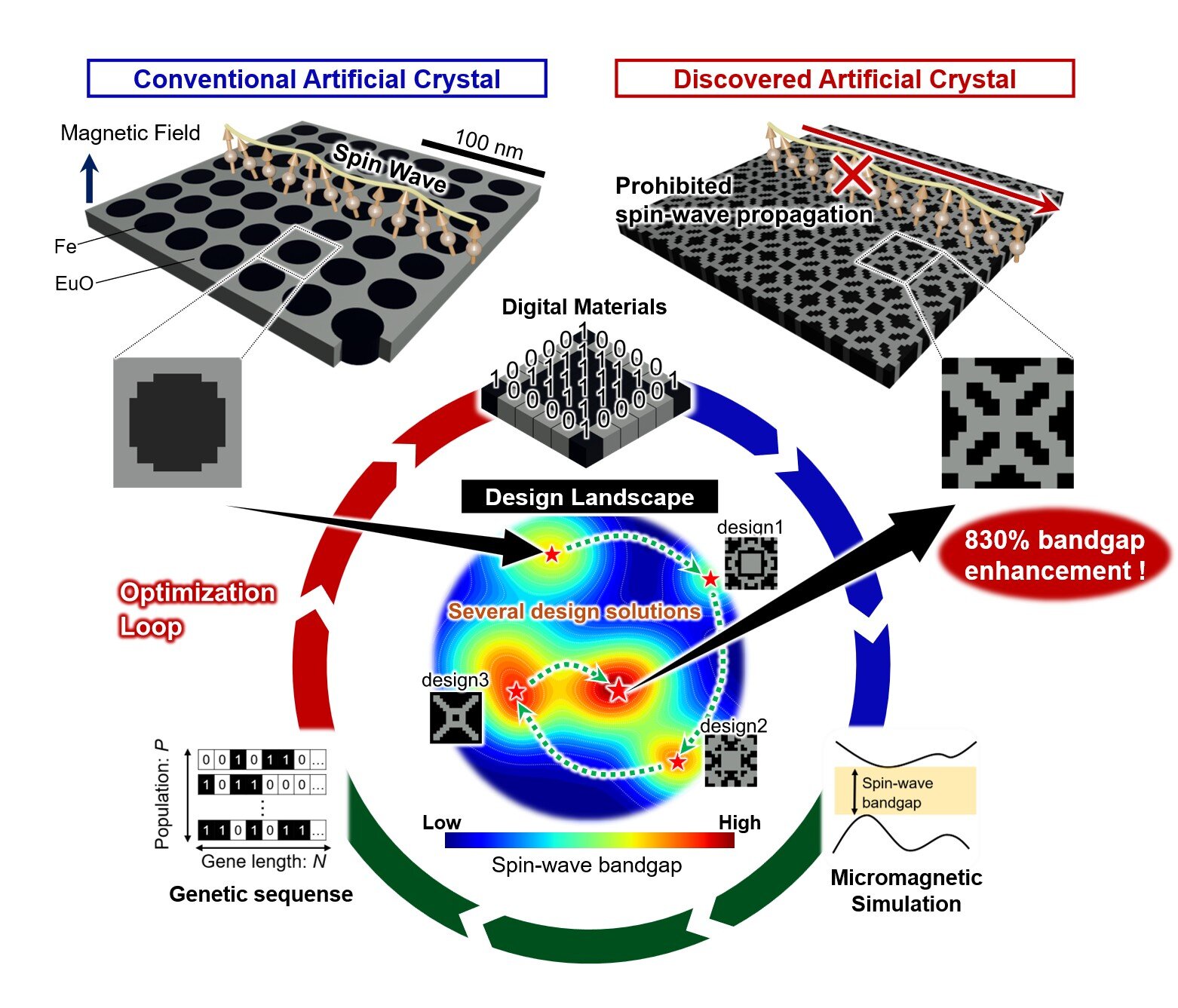
Researchers at Tokyo University of Science say they have used inverse design to widen 2D magnonic crystals band gaps, a result that could help engineers control spin waves in computing hardware. The work matters because spin waves, also called magnons, are being studied as information carriers for logic circuits, memory devices and physical neural networks.
The team was led by Masato Kotsugi, a professor at Tokyo University of Science, with second-year doctoral student Ryunosuke Nagaoka in the university’s Department of Materials Science and Technology. Their study was published July 28, 2026, in Small Structures.
What are 2D magnonic crystals?
Magnonic crystals are engineered magnetic materials whose repeating structures are used to control how magnons move. Like semiconductor crystals shape the movement of electrons, these patterned magnetic materials can create band structures and frequency ranges where spin waves cannot pass.
Those blocked frequency ranges are called magnonic band gaps. Tokyo University of Science said they are major design targets because they can be tuned and measured more readily than many other magnonic properties.
How the inverse design method worked
The researchers set out to find two-dimensional magnonic crystal designs with the widest complete magnonic band gaps, according to Tokyo University of Science. They combined frequency-domain micromagnetic simulations based on the frequency-domain Landau-Lifshitz-Gilbert equation with a genetic algorithm, a search method used for global optimization.
The Landau-Lifshitz-Gilbert equation describes magnetization dynamics at nanometer scales. The university said the frequency-domain approach can evaluate magnonic band structures more efficiently than conventional time-domain simulations, which is useful when many candidate structures must be tested.
In the study, the material layout inside one unit cell of a two-component magnonic crystal made from europium oxide and iron was represented as a binary vector for the genetic algorithm. The simulation calculated the resulting band gaps, then the algorithm generated a new population of candidate layouts for another round of testing.
That loop was repeated until the unit-cell structure shifted toward designs with larger gaps. Tokyo University of Science said the optimized layouts departed from standard geometric designs and produced larger complete magnonic band gaps than conventional structures.
Why higher-order bands are harder to design
Earlier work has often centered on lower-order bands because higher-order bands respond more strongly to geometry changes, making them harder to predict and control, according to the university. In this study, the design optimized for the gap between the fourth and fifth bands produced the largest band gap.
The researchers also used a modified version of a previously developed explainable machine-learning framework to map the design options. Their analysis showed that higher-order bands create a more nonconvex design map, suggesting that more than one workable design solution may exist.
Kotsugi said inverse design can search a wider range of structures by defining a desired property as an objective function and optimizing the design region through machine learning or mathematical methods. He said the framework could be applied to experimentally accessible materials and device sizes, helping researchers build design rules for magnonic crystals.
Tokyo University of Science said the findings may support energy-efficient spintronic devices, green computing, future data-center hardware, multifrequency signal processing and faster spin-wave communication.
This story draws on original reporting from Phys.org.