
PJM data center electricity costs rise as capacity auction hits price cap
PJM’s latest capacity auction hit its price ceiling, and Moody’s says current rules spread new power costs across customers.
By Daniel Okafor · Business Editor
3 min read
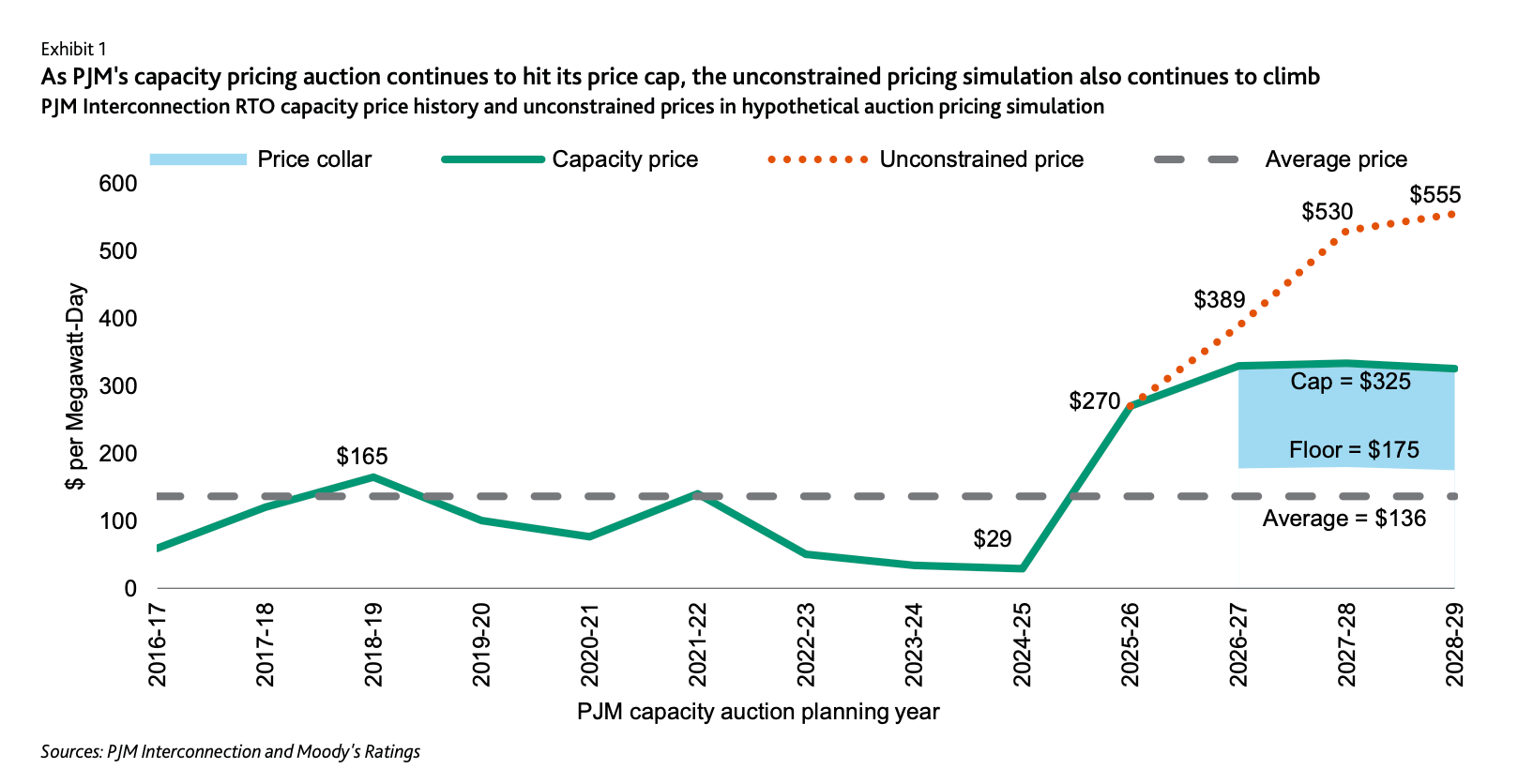
PJM data center electricity costs are drawing new scrutiny after the grid operator’s latest capacity auction cleared at the maximum price allowed. PJM Interconnection said its 2028-29 auction cleared at $325 per megawatt-day, while available supply came in about 6.8 gigawatts short of what the system needs for reliability.
PJM, the largest grid operator in the United States, serves about 67 million people across a 13-state region from Illinois to Virginia and Washington, D.C. Its July 14 auction result marked the third straight auction in which prices reached the cap, according to the reported auction data.
Moody’s Ratings said in a July 22 sector report that PJM’s current setup does not adequately make new large power users pay for the new supply they require. Instead, Moody’s said, the costs of new generation are spread across customers more broadly.
Why are data centers affecting electric bills?
Data centers use large amounts of electricity, and PJM’s market monitor, Monitoring Analytics, has identified them as the main driver of recent demand growth in the region. When demand rises faster than new generation enters the market, capacity prices can increase for all customers served by the grid.
PJM’s capacity auction sets payments for power resources that commit to being available in a future delivery year. Higher auction prices can flow through to utilities and then to households and businesses, depending on state rules and utility rate structures.
Monitoring Analytics found that data center demand accounted for about $6.3 billion of the $16.4 billion in total capacity charges from the latest auction, according to reporting cited by The Hill. The same reporting said data center demand has accounted for $29.4 billion over the past four PJM capacity auctions combined.
Syso Technologies’ analysis said only 525 megawatts of new generation cleared the latest auction, roughly half the amount that cleared six months earlier. PJM also recorded peak electricity demand of 168.2 gigawatts on July 2, nearly 3 gigawatts above a record set almost two decades earlier, according to the same analysis.
How high could PJM capacity prices have gone?
PJM’s own simulation showed the unconstrained capacity price would have reached $554.72 per megawatt-day without the price cap. In the Chicago-area zone served by Exelon’s ComEd utility, the simulated price was $776.69 per megawatt-day, according to PJM’s auction report.
Consumer Reports has also documented customer-level effects from rising electricity costs, including an Ohio resident whose January bill reached $281. Reuters, citing projections from consulting and technology services firm ICF, reported that households and businesses in PJM territory could see rate increases of up to 60% over the next five years as major technology companies expand data center construction.
Harvard Law School’s Electricity Law Initiative has described two ways data centers can raise costs for other customers: utilities can spread infrastructure expenses across all ratepayers, and wholesale capacity prices can rise when supply does not keep up with demand. Both issues are reflected in PJM’s recent auction results, according to the initiative’s analysis.
Moody’s noted that some other U.S. power markets require new large-load customers to arrange direct supply contracts that recover the cost of new generation and related infrastructure over time. Analysts have also discussed requiring hyperscale data center operators to sign long-term contracts for new power supply, according to Latitude Media’s coverage of a Mid-Atlantic governors’ proposal, though critics cited there warned the approach may not solve the shortfall quickly and could affect the broader market.
PJM has asked the Federal Energy Regulatory Commission to approve an emergency backstop capacity auction in September. That request signals concern that the regular market process is not bringing on enough new power fast enough to meet rising demand.
This story draws on original reporting from Fortune.