
Greenspan death renews focus on his Ford White House years
Alan Greenspan died at 100 after a long Fed career, but economists say his work for Gerald Ford helped define his public service.
By Maya Lindqvist · Senior Technology Correspondent
3 min read
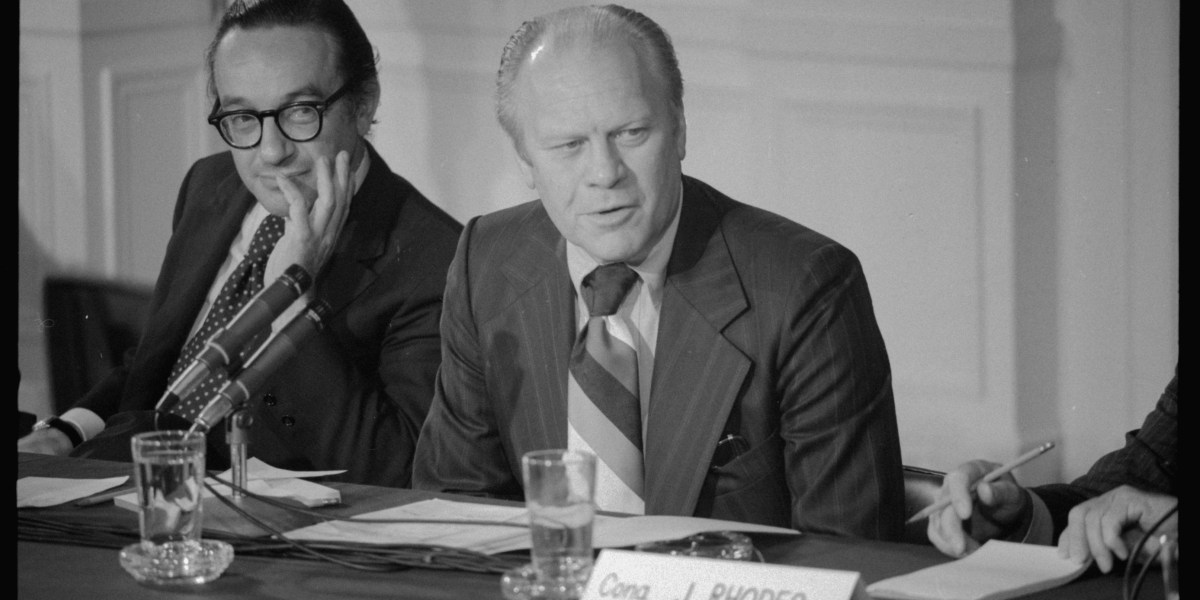
Alan Greenspan, the former Federal Reserve chair, died on June 22 at age 100, The Wall Street Journal reported. His death has brought new attention to a less familiar chapter in his career: his three years as President Gerald Ford’s top economic adviser.
Federal Reserve History says Greenspan led the central bank for 18 years, serving under Ronald Reagan, George H.W. Bush, Bill Clinton and George W. Bush. Simon Bowmaker and Paul Wachtel, economics professors at New York University, wrote in The Conversation that Greenspan later viewed his Ford administration post as more engaging than his long Fed tenure.
From music to economics
Bowmaker and Wachtel wrote that Greenspan’s early career did not point straight to central banking. They said he studied clarinet at Juilliard, played professionally and attended New York University in the late 1940s.
According to Bowmaker and Wachtel, Greenspan’s brief marriage to art historian Joan Mitchell also connected him with Ayn Rand, the libertarian writer whose circle stressed individualism and laissez-faire capitalism. They wrote that Greenspan was later criticized for that association, but described his economic style as practical and rooted in data rather than ideology.
After earning his undergraduate degree at NYU, Greenspan studied at Columbia University before leaving academia in 1954 for consulting, Bowmaker and Wachtel wrote. They said he built a reputation as a U.S. economic forecaster and produced academic work, including research they said anticipated James Tobin’s Q theory of investment.
The Ford years
Greenspan first considered a government role in 1974, according to Bowmaker and Wachtel. They wrote that Arthur Burns, then Fed chair and a close adviser to President Richard Nixon, urged him to join the administration.
Greenspan had concerns about some Nixon policies, including 1971 wage and price controls, Bowmaker and Wachtel wrote. Nixon resigned before Greenspan began the job, and Greenspan instead became chair of the Council of Economic Advisers under Ford from 1974 to 1977.
Bowmaker and Wachtel said that period cemented Greenspan’s interest in public service. In a 2016 interview for Bowmaker’s book on public service, Greenspan said he met Ford one-on-one several times a week and had a strong working relationship with him.
Greenspan also described Ford as an unusually respectful president, according to Bowmaker and Wachtel. They wrote that Greenspan considered that experience more interesting than his later 18-and-a-half years at the Federal Reserve.
A Fed career and its reckoning
Federal Reserve History says Greenspan became Fed chair in 1987. Bowmaker and Wachtel wrote that his tenure coincided with rising U.S. prosperity, wider acceptance of free markets, deregulation and trade, and a period when central banks gained more influence over economic policy.
Greenspan became known for guarded public remarks and high-profile appearances before Congress, according to Bowmaker and Wachtel. In the 2016 interview, they wrote, he said he could hold his own on Capitol Hill but did not enjoy the political side of the job.
Bowmaker and Wachtel wrote that Greenspan favored light regulation, especially in financial markets. They also noted that many scholars later tied Fed policy before the 2008 financial crisis to conditions that helped produce the crash, even though the crisis erupted after Greenspan had left office.
In the 2016 interview, Greenspan acknowledged limits in the models used by policymakers, Bowmaker and Wachtel wrote. He said the Fed’s sophisticated framework failed to capture the vulnerabilities that led to the 2008 crisis.
Bowmaker and Wachtel said Greenspan was often accused of overconfidence, but they pointed to his own description of himself as an introvert and a former band sideman. Their account presents the Ford years as the point when a private forecaster became a lasting figure in public economic policy.
This story draws on original reporting from Fortune.