
CXMT IPO sends shares up 466% in Shanghai debut
CXMT raised at least $8.6 billion as AI demand lifts China’s top memory chipmaker and sharpens focus on U.S. export limits.
By Daniel Okafor · Business Editor
3 min read
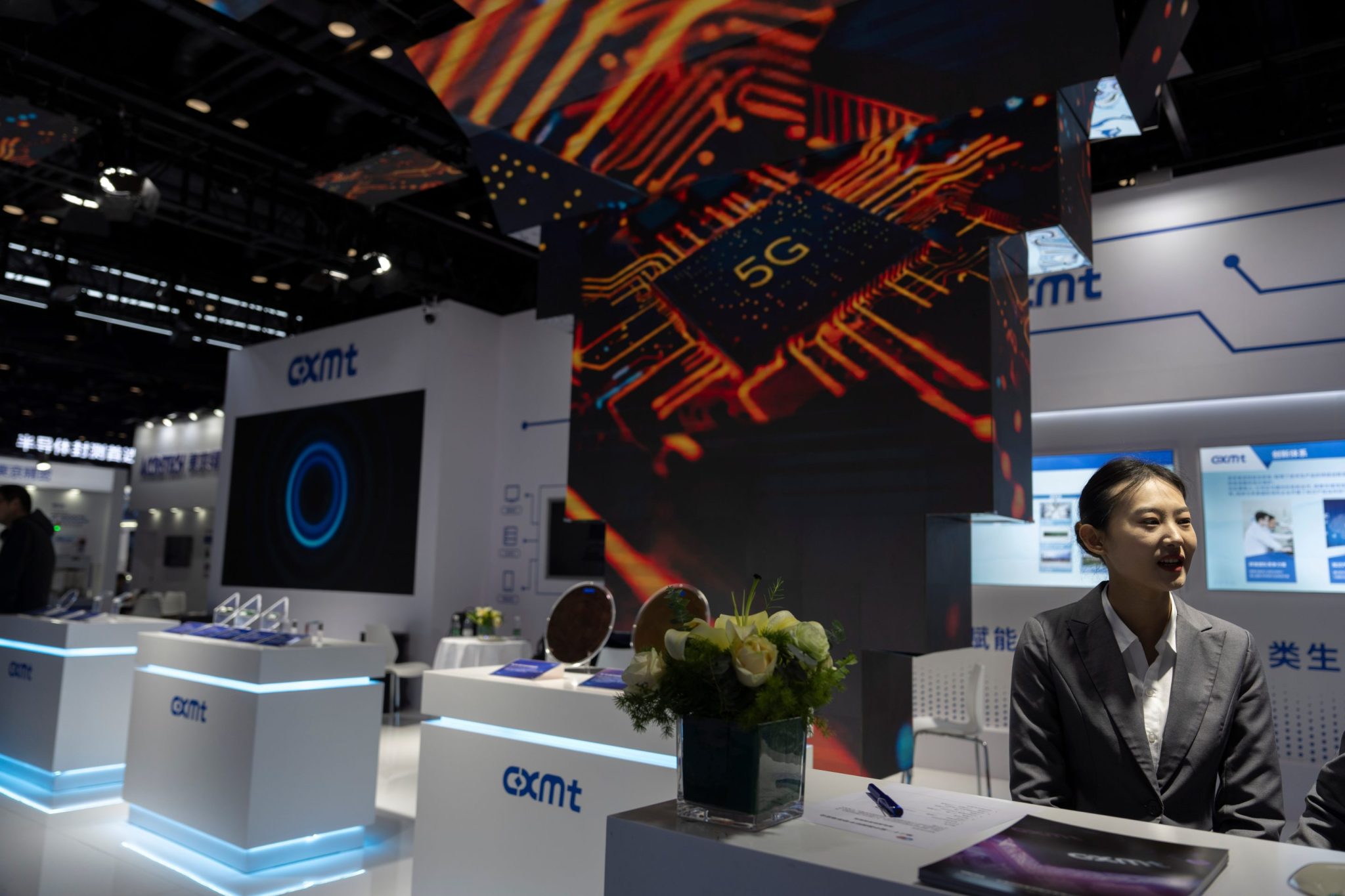
The CXMT IPO gave China’s largest memory-chip producer a dramatic market debut Monday, with its shares climbing 466% on their first day of trading in Shanghai. The listing matters because ChangXin Memory Technologies has become central to China’s effort to build more of the advanced chips needed for artificial intelligence at home.
The Associated Press reported that CXMT’s offering raised at least $8.6 billion, with shares sold at 8.66 yuan, or about $1.30, each. The company listed on the Shanghai Stock Exchange’s STAR Market, the city’s board for science and technology companies.
The debut valued CXMT at an estimated 3.3 trillion yuan, or more than $487 billion, according to the Associated Press. That made it the most valuable company traded on a mainland Chinese exchange, though still below major memory-chip rivals including Samsung Electronics, SK Hynix and Micron Technology.
The deal ranks as mainland China’s second-biggest IPO, behind Agricultural Bank of China’s $22.1 billion listing in Shanghai and Hong Kong in 2010, according to the Associated Press.
What is CXMT?
CXMT, short for ChangXin Memory Technologies, was founded in 2016 in Hefei, a city in eastern China. The company is one of the world’s biggest producers of DRAM, or dynamic random access memory, a type of semiconductor used in AI servers, cars, smartphones and personal computers.
DRAM is temporary memory that helps devices and servers process data quickly while they are running. High-bandwidth memory, or HBM, is a faster and more advanced form of DRAM that is especially important for AI systems.
Kyle Chan, a fellow at the Brookings Institution who studies China’s technology policy, told the Associated Press that CXMT has an important role in China’s AI ambitions as U.S. export controls limit China’s access to advanced chips and chipmaking equipment. Those restrictions have also blocked China from importing powerful HBM chips, the Associated Press reported.
CXMT’s growth has accelerated with AI demand. The company’s revenue rose to 50.8 billion yuan, or about $7.5 billion, in the first quarter of 2026, up more than 700% from a year earlier, according to the Associated Press.
The rapid expansion of AI has contributed to a global shortage of memory chips, pushing up prices for some computers and smartphones. Chan told the Associated Press one question for the industry is whether CXMT can ease that broader shortage.
Counterpoint Research said CXMT was the world’s fourth-largest DRAM maker by shipments in 2025, with about 8% of the global market. Samsung Electronics had 36%, SK Hynix had 29% and Micron had about 24%, according to the research firm.
Counterpoint estimated that CXMT’s share rose to about 9% of global shipments in the first quarter of 2026 and could reach about 11% by 2028. The firm said CXMT would likely need at least 15% global share to be competitive over the long term.
MS Hwang, a Counterpoint research director focused on memory semiconductors, told the Associated Press that trade limits on chipmaking tools remain CXMT’s main obstacle. The company faces supply-chain bottlenecks as it tries to expand production while relying more heavily on Chinese equipment makers, the Associated Press reported.
Some U.S. lawmakers have urged President Donald Trump’s administration to stop American companies from buying CXMT memory chips, citing national and economic security concerns, according to the Associated Press. The Pentagon has identified CXMT among Chinese companies it says have links to China’s military; Beijing has rejected such designations in most cases.
CXMT’s listing came after a $26.5 billion IPO by South Korea’s SK Hynix on Nasdaq earlier this month, according to the Associated Press.
This story draws on original reporting from Fortune.