
Venezuela earthquake recovery faces funding gap after deadly June quakes
More than 5,000 people are dead, and the World Bank says rebuilding Venezuela after June’s earthquakes could cost up to $50bn.
By Daniel Okafor · Business Editor
3 min read
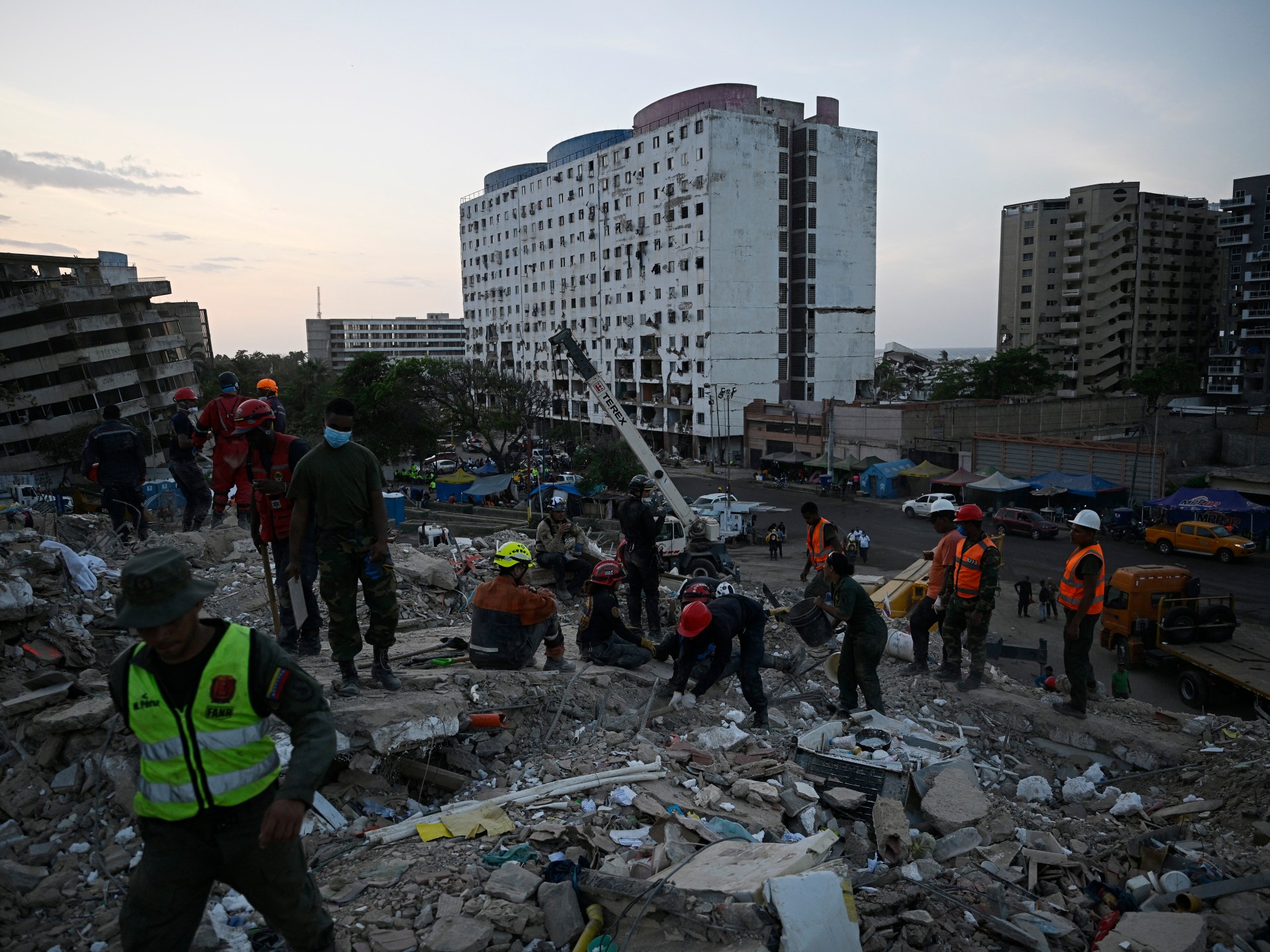
Venezuela earthquake recovery efforts are shifting from rescue to reconstruction more than a month after two powerful June 24 quakes killed more than 5,000 people, according to authorities. The scale of the damage has left the country facing a multibillion-dollar rebuilding bill while families continue searching through rubble for the missing.
Authorities have reported more than 17,000 injuries after the magnitude 7.2 and 7.5 earthquakes. The World Bank has estimated that 18,000 people remain homeless, while NASA has said more than 58,000 buildings were damaged or destroyed.
The United Nations Office for the Coordination of Humanitarian Affairs said on July 8 that 6,462 people had been rescued. Aid groups often describe the first 72 hours after a major earthquake as the critical window for finding survivors trapped under debris, and recovery work has now largely turned toward locating bodies.
The Venezuelan government has not issued an official figure for the missing, according to Al Jazeera and Reuters. The UN has estimated the number could be as high as 51,000.
How much will Venezuela earthquake recovery cost?
The World Bank put the physical damage from the earthquakes at nearly $20bn. It said the cost of physical recovery could rise to $50bn if the rebuilding effort includes stronger construction standards and work such as clearing debris.
The UN had earlier given a preliminary recovery estimate of $37bn. The World Bank also warned that without higher public and private investment, Venezuela’s gross domestic product could remain below its pre-quake level until 2036.
The UN humanitarian relief agency has said 1.3 million people will need help over the next six months. The World Bank also expects the country’s labor supply to fall by 1 percent this year.
Where could rebuilding money come from?
Foreign governments and international institutions have pledged support since the disaster. The United States said it would provide $300m in financial aid, while Interim President Delcy Rodriguez said Venezuela had secured $346m in emergency financing from the International Monetary Fund for humanitarian needs.
The UN has reported $36.5m from the European Commission, $17m from the UN Central Emergency Response Fund and $9m from Germany. The Development Bank of Latin America and the Caribbean has also said it is working to bring in recovery funding, including from the private sector.
Those commitments remain well short of the UN’s 2026 humanitarian response plan for Venezuela. According to the UN, the plan needs $931m, but only 39 percent has been funded, leaving a gap of about $566m.
What could slow the recovery?
The US role is under scrutiny because of Washington’s influence in Venezuela since the Trump administration abducted former President Nicolas Maduro in January, according to Al Jazeera and Reuters. The Trump administration said after the earthquakes that it would ease some sanctions to help assistance reach Venezuela, but some US lawmakers have urged broader steps.
Democratic Representative Chuy Garcia called this month for the administration to lift Venezuelan sanctions and restore access to frozen assets to support relief and recovery. Some experts have warned that remaining US sanctions could make it harder to move money and aid into the country, according to Al Jazeera and Reuters.
Civil society groups have also pointed to poverty, information controls and pressure on humanitarian organizations as risks to the recovery effort. Beatriz Borges, director of the Centre of Justice and Peace, told a US Congress Human Rights Commission hearing, according to the Washington Office on Latin America, that the quakes “did not create Venezuela’s crisis” but exposed it.
This story draws on original reporting from Al Jazeera.