
Perseverance Mars rover self-driving system nears off-world distance record
NASA’s Perseverance was expected to pass Opportunity’s distance mark, aided by AutoNav and a separate AI route-planning test.
By James Whitfield · Staff Writer
3 min read
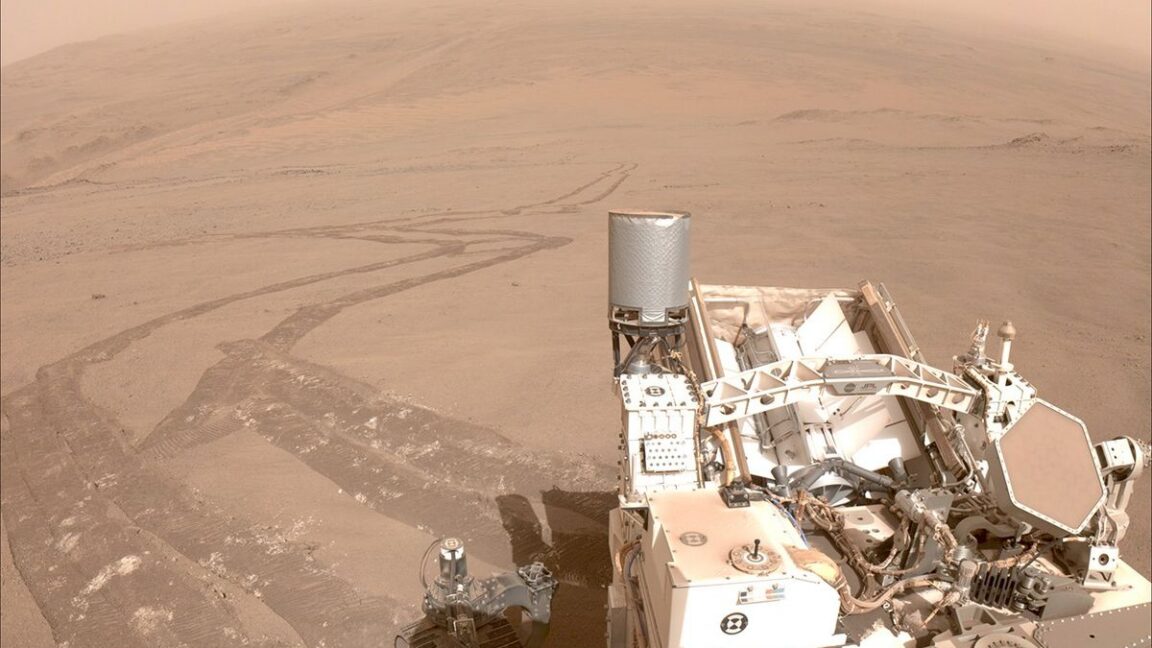
NASA’s Perseverance Mars rover self-driving system has helped the mission cover ground quickly in Jezero Crater. Ars Technica reported that the rover was expected to surpass Opportunity’s 45.16-kilometer, or 28.06-mile, overall distance record for a vehicle on another world, though the milestone had not been independently confirmed in the available reporting.
Perseverance landed in February 2021. Steven Lee, the rover’s project manager at NASA’s Jet Propulsion Laboratory, told Ars Technica that autonomous navigation has been central to its driving performance.
How does Perseverance drive itself on Mars?
Earth-based rover drivers still select intended stops, but Perseverance can determine how to reach them. NASA JPL says its AutoNav system builds three-dimensional maps from onboard camera images, spots hazards and chooses a path around obstacles without waiting for additional directions from controllers.
That capability matters because real-time driving from Earth is not possible. Mars is, on average, about 225 million kilometers away, creating a communications delay that prevents operators from steering the rover as events unfold, according to JPL. Human-planned routes have generally used waypoints no more than 100 meters apart to limit risk.
Ars Technica reported that about 90% of Perseverance’s driven distance has been autonomous, compared with roughly 10% for Curiosity. The report attributed the gap to Perseverance’s newer onboard computing hardware, which can process terrain information while the rover is moving; its top wheel speed is about 150 meters an hour.
AutoNav and AI route planning are different systems
Perseverance’s established AutoNav capability should be distinguished from a later demonstration that used generative AI to plan a route before commands were sent to Mars. In January, NASA JPL said the rover had completed two drives, on Dec. 8 and Dec. 10, 2025, using AI-generated waypoint sequences.
For that test, vision-language models analyzed orbital images and terrain-slope data to identify features including boulder fields and sand ripples, then produced a continuous route. Engineers checked the commands with a digital replica of the rover and reviewed more than 500,000 telemetry variables before transmission, JPL said.
The rover traveled 210 meters in the first AI-planned drive and 246 meters in the second. JPL said the work was carried out with Anthropic’s Claude models, but the rover still executed the received instructions on Mars rather than being remotely controlled in real time.
The faster travel supports Perseverance’s scientific work across geographically spread-out targets in Jezero Crater. NASA JPL says the mission is searching for signs of ancient life and collecting rock and soil samples for a planned return to Earth.
Lee told Ars Technica that Perseverance’s wheel actuators, initially life-tested for 20 kilometers, were being certified for at least 100 kilometers. He said the rover could continue driving for years, an outlook that remains an assessment rather than a demonstrated lifetime.
This story draws on original reporting from Ars Technica.