
New Jersey robotaxi bill would require more than cameras
A proposed state pilot program could keep Tesla’s camera-only robotaxis out unless the company changes its hardware.
By Hana Yoshida · Markets Reporter
4 min read
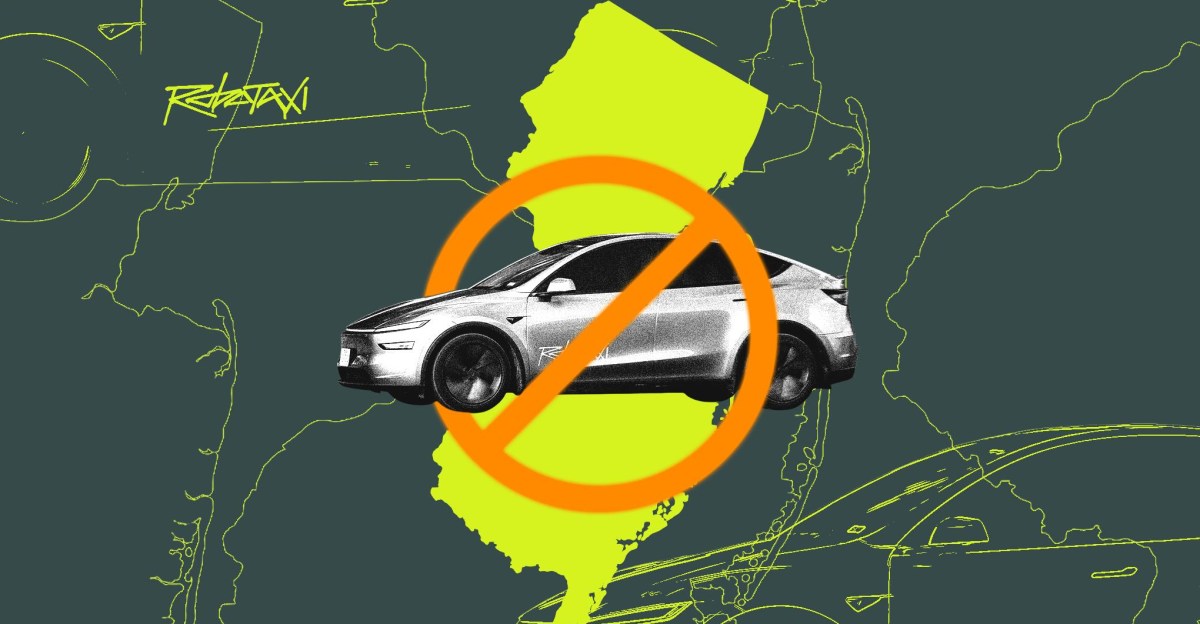
New Jersey lawmakers are considering a robotaxi bill that would require fully driverless vehicles to use cameras plus two other sensing technologies. The Verge reported that the proposal could bar Tesla’s camera-only Robotaxi system from operating in the state unless Tesla changes its vehicles.
The bill, expected to come up for a vote later this year, would create a three-year pilot program for testing and deploying fully autonomous vehicles in New Jersey, according to The Verge. Companies would need state authorization before running commercial driverless services, would have to report certain crashes and would need to complete at least 50,000 miles of supervised testing in New Jersey without a major incident before removing a human safety driver.
The sensor rule is the provision with the clearest effect on Tesla, The Verge reported. Tesla has built its autonomy strategy around cameras and artificial intelligence, while rivals such as Waymo and Zoox use cameras, lidar and radar together.
Democratic state Sen. Andrew Zwicker, the bill’s main sponsor, told The Verge that he supports autonomous vehicles but wants a cautious rollout in the nation’s most densely populated state. Zwicker, a physicist at the Princeton Plasma Physics Laboratory, said a ride in a Waymo robotaxi in Phoenix persuaded him that the technology could improve transportation, but he said he has not seen enough evidence that a single-sensor approach can handle the same range of situations as human drivers.
If enacted, New Jersey would be the first state to put a hardware requirement for autonomous vehicles into law, according to The Verge. A similar proposal is pending in New York.
The fight over sensors
Tesla CEO Elon Musk has argued that cameras and AI are the right path for autonomy and that adding lidar or radar can create conflicts in vehicle software, The Verge reported, citing Musk’s past comments on X. Tesla has also said removing those sensors lowers vehicle costs, which could make robotaxi service easier to expand.
Other autonomous vehicle developers argue that multiple sensors add redundancy, according to The Verge. Cameras can read signs, colors, lane markings and pedestrians, while radar can perform better in rain or fog and measure speed and distance. Lidar uses lasers to build a three-dimensional view of nearby objects.
Philip Koopman, a Carnegie Mellon University electrical and computer engineering professor who studies autonomous vehicle safety, told The Verge that camera-only systems may improve over time but are not ready for broad deployment today. Koopman said he supports New Jersey’s proposal and would prefer additional limits, including conventional controls such as steering wheels and pedals so first responders could move disabled vehicles.
The Verge reported that Tesla has only a small number of unsupervised robotaxis on the road, mostly in Texas, citing Robotaxi Tracker. Musk previously predicted that Tesla would have hundreds of thousands of fully self-driving Teslas operating by the end of 2026, according to The Verge, which said Tesla did not respond to requests for comment.
Lobbying and regulation
Zwicker told The Verge that Tesla has lobbied against the New Jersey legislation and argued that AI advances make extra sensors unnecessary. Tesla also sent a message to New Jersey owners saying the bill would block its autonomous vehicle technology from operating legally in the state and urged them to contact lawmakers, according to The Verge.
Zwicker disputed Tesla’s framing, The Verge reported. He said the bill applies to fully autonomous vehicles in the proposed pilot program, not driver-assistance systems that require a licensed driver behind the wheel.
Shua Sanchez, national campaign director for the nonprofit SAVE-US, told The Verge that his group supports redundant sensing systems and stricter autonomous vehicle rules. Sanchez said federal lawmakers have not passed a national framework while states have adopted differing levels of oversight.
The Verge reported that California requires testing permits and public reporting for autonomous vehicles but does not mandate specific hardware, while Texas lets automakers self-certify that their vehicles are road-ready. Zwicker told The Verge his goal is to start driverless vehicle deployment in New Jersey with safety rules that build public trust.
This story draws on original reporting from The Verge.