
BYOK writing device pares drafting down to text and a keyboard
The $199 writing gadget uses a low-resolution LCD and lets users attach their preferred wired or Bluetooth keyboard.
By Maya Lindqvist · Senior Technology Correspondent
3 min read
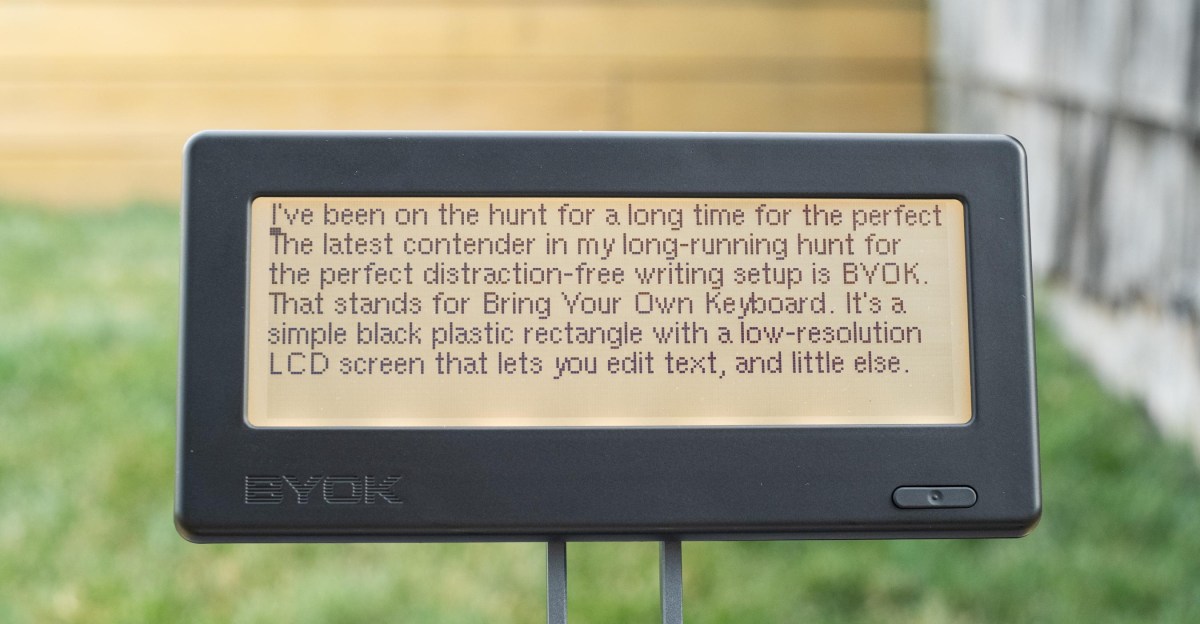
BYOK, a $199 writing device built around plain text and an external keyboard, aims to cut the distractions that come with laptops and tablets. In a June 25 review, The Verge’s Terrence O’Brien found that the small LCD-equipped box works best as a drafting tool for writers who want fewer apps, tabs and settings in the way.
O’Brien described BYOK, short for Bring Your Own Keyboard, as a black plastic rectangle with a low-resolution screen and basic text-editing features. Unlike dedicated writing devices from Freewrite or Pomera, according to The Verge, BYOK does not include a built-in keyboard and is not designed around a typewriter-style body.
The device instead relies on the user’s preferred wired or Bluetooth keyboard. The Verge said that flexibility was one of its main strengths, especially for users who already care about typing feel.
A simple text system
According to The Verge, BYOK organizes writing into projects and files and supports familiar editor shortcuts such as copy, paste and document search. It can also show a status bar with word count and battery information.
The device supports basic structured entries through typed commands, The Verge reported. Starting a line with markers such as “::note” can create notes or tasks, while other commands work with cards, wikis, story grids and manuscripts when paired with BYOK Studio.
The Verge said the core writing experience stays deliberately narrow. BYOK does not support links, bold text or italics on the device, leaving users with plain text rather than a full word processor.
Hardware strengths and limits
O’Brien wrote that the rear MagSafe-compatible ring gives BYOK more mounting options than many dedicated writing machines. The Verge tested it with several stands and mostly used a folding tripod stand from Ulanzi, which O’Brien said struck a workable balance between portability and screen height.
The Verge found that BYOK worked with a range of keyboards, from very small Bluetooth models to heavier mechanical options. O’Brien said he returned most often to a NuPhy keyboard because a more premium aluminum keyboard was less convenient to carry.
Battery life is listed at 20 hours, or five hours with the backlight at full brightness, according to The Verge. O’Brien said his testing suggested that estimate may be conservative, with intermittent use lasting more than two weeks before a recharge.
The review also identified several drawbacks. The Verge cited uneven backlighting, Bluetooth that did not always reconnect automatically, and rear navigation buttons that felt awkward, though O’Brien said those buttons matter less after a keyboard is connected.
Sync and pricing
Files are stored as plain .txt documents on a microSD card, and The Verge said users can transfer them by removing the card or plugging BYOK into a computer over USB-C. BYOK Studio adds cloud sync and can back up to Google Drive, but O’Brien found manual syncing more reliable than waiting for automatic sync at shutdown.
The premium BYOK Studio subscription costs $9.99 a month or $83.88 a year, according to The Verge. O’Brien said its extra formats are more useful in the web or mobile app than on BYOK’s low-resolution screen, but he also found the app interface crowded and sometimes hard to use.
The Verge noted that BYOK recently rose in price from $179 to $199. That still puts it below the $349 Freewrite Alpha and $549 Pomera cited in the review, although buyers must supply their own keyboard and stand.
The Verge gave BYOK a score of 7 out of 10. O’Brien concluded that it suits first drafts, fiction and focused writing sessions better than research-heavy work or extensive editing, where moving text into Google Docs or another editor made more sense.
This story draws on original reporting from The Verge.