
Asteroid barrage may have melted Earth’s first crust, study says
Models led by Curtin University researchers suggest early impacts supplied enough heat to delay plate tectonics and help continents form later.
By James Whitfield · Staff Writer
3 min read
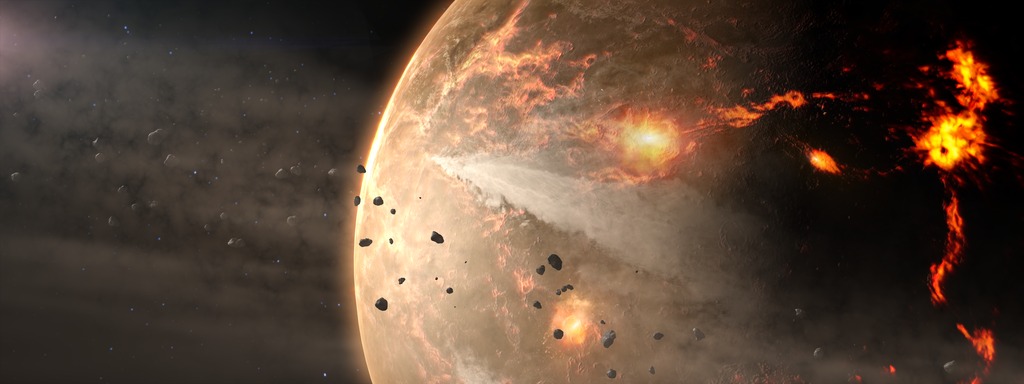
A long period of asteroid impacts may have kept Earth’s first crust hot, thin and partly molten, according to research published in Science. The work offers a possible explanation for why the oldest known continental rocks appear about 4 billion years ago, roughly 500 million years after Earth formed.
Tim Johnson, a geologist at Curtin University in Perth, Australia, and his colleagues argue that heat from space impacts has been undercounted in models of early Earth. Johnson said geologists have long debated how Earth developed buoyant, silica-rich continents because so little rock survives from the planet’s earliest era.
A sparse rock record
According to the researchers, the oldest known rocks with a continental character crystallized about 4.03 billion years ago, near the end of the Hadean eon. Rare basaltic rocks date to about 4.2 billion years ago, while zircon crystals extend parts of the record to about 4.4 billion years ago.
Johnson said that limited evidence has left room for competing ideas. One view holds that plate tectonics was already operating during the Hadean, making continental crust above subduction zones. Another proposes that Earth was too hot for rigid plates and that crust formed over mantle plumes rising from deeper inside the planet.
The team said both explanations have struggled with Earth’s heat budget. Previous models emphasized heat left from planet formation, core formation and radioactive decay. Johnson’s group added energy delivered by frequent impacts in the young solar system.
Moon craters as a guide
Because Earth continually recycles its surface through plate tectonics, Johnson’s team used the Moon as a record of early bombardment. The researchers said lunar crater counts, checked against dated Moon samples, can be scaled to Earth’s larger size and stronger gravity.
That scaling led the team to estimate that Earth was struck by thousands of bodies more than 10 kilometers wide. The researchers then calculated how much of each impact’s kinetic energy would have become heat in the crust and upper mantle.
According to the study, large impacts did more than melt rock at the collision site. Much of the energy would have spread downward, warming the upper mantle and promoting basaltic volcanism for long periods after the impact itself.
The researchers found that impact heating exceeded heat from radioactive decay and the core for much of the Hadean by about a factor of 10. In their simulations, that extra energy left the crust less than 5 kilometers thick, with partial melting beginning only 2 to 3 kilometers below the surface.
At roughly 5 kilometers depth, the models produced melt fractions above 30% by volume. Johnson said conditions like that would not allow a strong lithosphere to move and subduct in the way required for plate tectonics.
Cooling toward continents
The team’s simulations also showed large impacts driving crustal material back into the mantle, in some cases to depths of at least 600 kilometers. Johnson’s group said that process could help explain why little Hadean crust remains and why shock-deformed Hadean zircons are scarce.
The impact rate later fell sharply, the researchers said. Between 3.9 billion and 3.5 billion years ago, internal heat sources became dominant again, the upper mantle cooled and the basaltic crust thickened.
By the early Archean, the study’s models put crustal thickness near 30 kilometers. Johnson’s team said that thicker, cooler crust could support plate tectonics and begin building continents, matching the time when the first continental rocks appear in the geologic record.
The authors acknowledge that the case rests heavily on physics-based modeling because ancient rocks are rare. Johnson pointed to the Nuvvuagittuq Greenstone Belt in Canada, where researchers have dated a dark mafic rock to 4.2 billion years ago, and said other possible ancient finds may soon add evidence.
The study was published in Science with DOI 10.1126/science.aeb5402.
This story draws on original reporting from Ars Technica.