
Amazon Leo reaches orbit count needed for early internet service
Amazon says 396 low-Earth orbit satellites are enough to begin continuous service across initial latitudes, but early performance may lag Starlink.
By James Whitfield · Staff Writer
3 min read
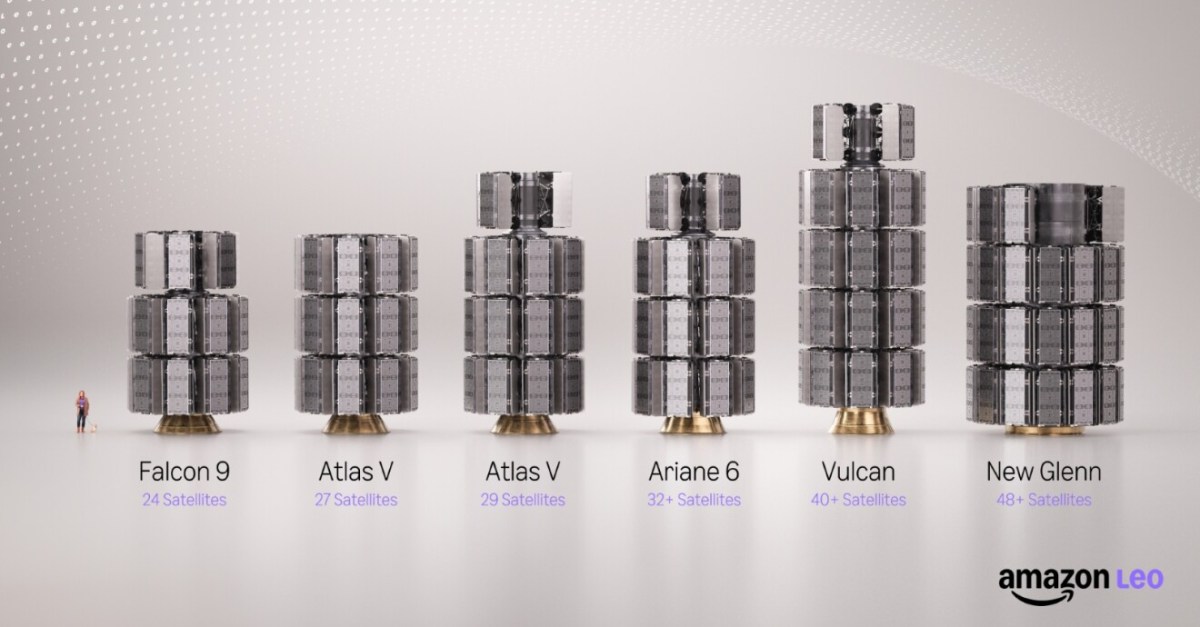
Amazon says its Leo satellite network now has enough spacecraft in low-Earth orbit to support the first phase of its internet service. The milestone moves Amazon closer to launching a commercial rival to SpaceX’s Starlink, though early users should expect limits while the constellation grows.
The company has deployed 396 Leo satellites after a launch on Wednesday night, according to Amazon. Chris Weber, the Amazon Leo vice president who leads business and product, said the count is sufficient for continuous service across the network’s first latitudes.
Weber said in a post on X that recent launches brought Amazon Leo past 390 deployed satellites. He also said more work remains, including raising newly launched satellites to their assigned orbital altitude.
The Verge reported that the new satellite count keeps Amazon on course for its stated mid-2026 target for commercial availability. Amazon has not yet reached anything close to the scale of Starlink, so initial availability and performance are expected to be more limited than the service Amazon wants to offer later.
Early service may look familiar
The comparison point is Starlink’s own early rollout. SpaceX opened its “Better than nothing beta” in 2020 with nearly 900 satellites in low-Earth orbit, according to The Verge.
At first, Starlink served a limited group of customers in the northern United States and Canada, The Verge reported. Users reported frequent dropouts and problems when trees or other obstacles blocked the signal, with download speeds between 50Mbps and 150Mbps and latency between 20ms and 40ms.
The Verge reported that Starlink’s coverage and service quality had improved by 2022 as SpaceX added more satellites and expanded the system. Amazon Leo’s early customers may see a similar pattern, with launches adding coverage, capacity and better performance over time.
Starlink remains far ahead
SpaceX currently operates more than 10,000 Starlink satellites, according to The Verge. The service now provides internet connectivity on land, at sea and in the air in more than 160 countries.
Performance still depends on the equipment, service tier, time of day and user location, The Verge reported. Current Starlink figures cited by The Verge include median download speeds around 200Mbps, uploads from 10Mbps to 40Mbps and latency near 25ms.
Amazon plans a Leo constellation of 3,232 satellites, according to The Verge. That means the company has launched only a fraction of the network it intends to build.
The Verge reported that Amazon is behind schedule in part because Blue Origin’s reusable New Glenn launch vehicle has not entered regular operation. Until Amazon can launch many more satellites, Leo’s first commercial service is likely to be judged less against Starlink’s current network than against how quickly Amazon can expand its own.
This story draws on original reporting from The Verge.