
New Glenn setback raises questions for NASA’s Artemis IV Moon plan
Space analysts said Blue Origin’s larger New Glenn variant may face delays, putting more pressure on SpaceX’s Starship role in Artemis.
By James Whitfield · Staff Writer
3 min read
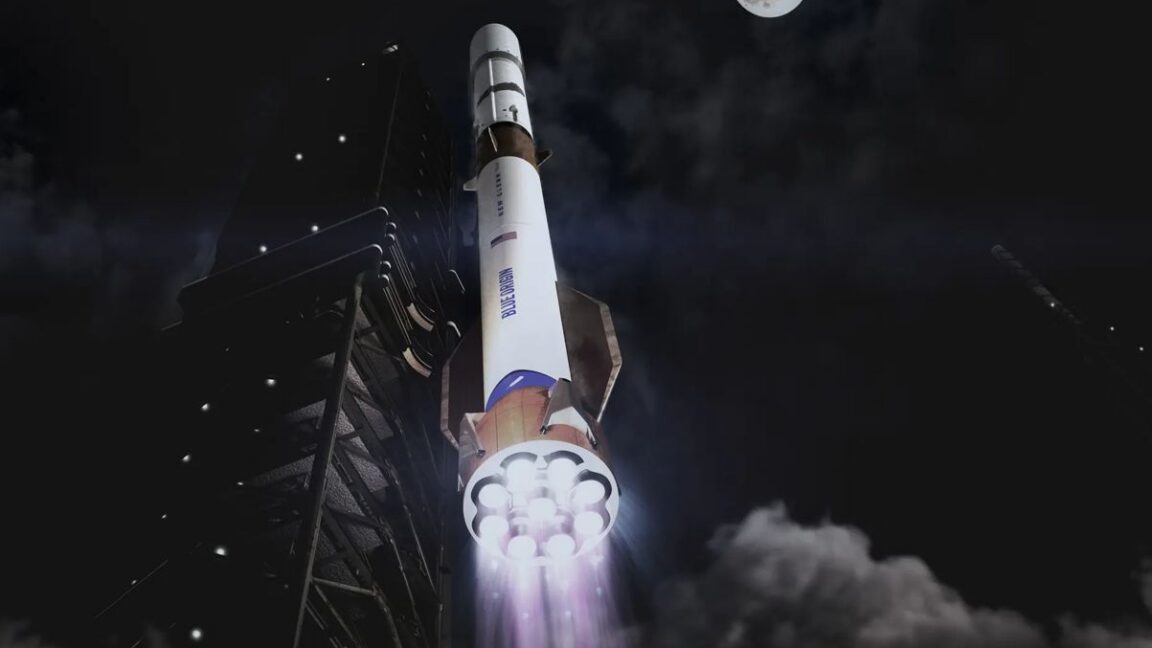
Blue Origin’s New Glenn failure has sharpened doubts about whether NASA will have the rockets it needs for a crewed Artemis IV Moon landing on its current schedule. In an Ars Technica live discussion, space analysts said the accident could put more weight on SpaceX’s Starship as NASA looks for a workable path to the lunar surface.
Ars Technica Space Editor Eric Berger discussed the late-May explosion of Blue Origin’s New Glenn rocket with Caleb Henry, director of research at Quilty Space, and Anthony Colangelo, host of the Main Engine Cut Off podcast. The conversation focused on what the failure could mean for NASA’s Artemis plans, where both Blue Origin and SpaceX are developing lunar landers and the launch systems meant to support them.
A larger New Glenn is central to Blue Origin’s plan
Berger reported that Blue Origin’s current concept for a human lunar mission would require four launches of a more powerful New Glenn variant known as 9×4. The name refers to a configuration with nine engines on the first stage and four engines on the upper stage.
That vehicle would be a step up from the 7×2 version that exploded a little more than a month earlier, according to Berger. Blue Origin has not publicly set a first-flight date for the 9×4 version, though Berger said some sources have indicated the company is aiming for late 2027 or early 2028.
The timing is now under greater scrutiny because the accident also destroyed Launch Complex 36A, according to the discussion. Henry said he was skeptical that Blue Origin could meet the implied schedule, citing the difficulty space companies have had in delivering new rockets on announced timelines.
Henry pointed to Blue Origin’s earlier decision, around mid-2018, to change New Glenn from a three-stage vehicle to a two-stage design, along with other revisions meant to speed its path to launch. The rocket still had not made a first flight at that point, he said, and he argued that adding engines for the 9×4 version is likely to add complexity rather than reduce it.
Henry said he did not know where the final schedule would land, but suggested that a delay factor of about 1.5 is often a useful guide. Colangelo went further, saying it would not surprise him if development of the 9×4 New Glenn moved into the 2030s.
Starship seen as the more likely near-term option
If Blue Origin’s larger rocket is not ready in time, Colangelo said he sees no clear alternative for NASA other than relying heavily on Starship for the next four or five years. He cited SpaceX’s demonstrated ability to increase launch cadence quickly, along with its plans to fly Starship from Florida and its two pads in Texas.
Colangelo said SpaceX already has much of the needed launch infrastructure in place, making that path more credible to him than building new facilities and combining multiple vehicles in a more complicated architecture. He contrasted that with a scenario involving a different lander, a modified launch pad and orbital rendezvous steps that could add schedule risk.
Colangelo also noted that SpaceX can already fly about 160 missions a year with its current operations, and argued that flying a new vehicle dozens of times annually was a more believable route than adding new layers to NASA’s near-term lunar plan.
The panel also took viewer questions in a rapid-fire segment near the end of the discussion. The central issue remained unresolved: whether NASA can keep a crewed Moon landing on track this decade if one of its two commercial lunar transportation providers faces a long recovery and development cycle.
This story draws on original reporting from Ars Technica.