
Study finds wind shifts are steering tropical rainfall trends
Research in Nature Communications says changing wind patterns, not moisture alone, are reshaping rainfall across the tropics.
By Priya Raghavan · Science Reporter
3 min read
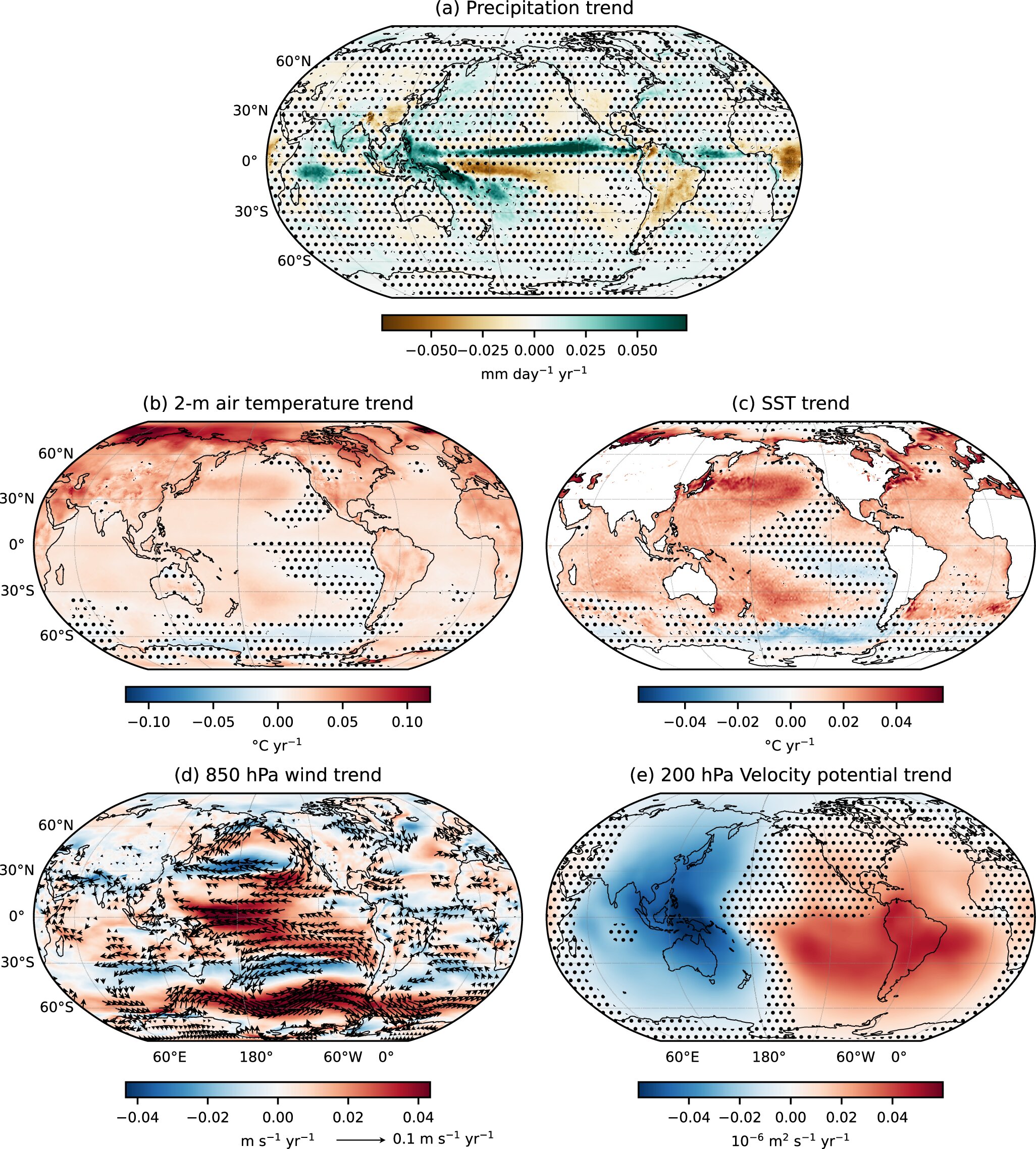
Changing wind patterns are playing a central role in recent tropical rainfall trends, according to a new study in Nature Communications. The finding matters because rainfall shifts affect water supplies, farming and flood risk across regions that include Africa, Southeast Asia, India, Central and South America, and Australia.
The research was led by Ligin Joseph, a postgraduate researcher in physical oceanography at the University of Southampton, with Pascal Terray and Sebastien Masson of Sorbonne University and K P Sooraj of the Centre for Climate Change Research at the Indian Institute of Tropical Meteorology.
According to the University of Southampton, the team used 45 years of satellite and reanalysis data, covering 1979 to 2024, and ran climate model experiments to examine how tropical rainfall has changed in recent decades. The study concludes that observed rainfall trends do not match the common “wet-gets-wetter” expectation, in which warming amplifies existing rain and dry patterns.
Instead, Joseph said the data point to atmospheric circulation as a main control on where rain increases or decreases. In the study’s framing, rainfall changes are tied closely to where winds meet and help produce rain, rather than only to the capacity of warmer air to hold more water.
Land warming and warm ocean waters
The researchers found that stronger warming over land is helping reshape tropical winds, the University of Southampton said. The study highlights deserts in the Northern Hemisphere, including the Sahara in Africa and the Thar Desert in India and Pakistan, as areas where warming is part of the wider shift.
The team also identified warming and expansion of the Indo-Pacific Warm Pool as a factor. The warm pool is described by the researchers as the planet’s largest and warmest area of tropical surface waters, spanning the western Pacific Ocean and eastern Indian Ocean.
According to the study, these land and ocean changes alter temperature contrasts around the globe. Those contrasts then influence wind patterns, which redistribute rainfall across tropical regions.
The researchers identified three main forces behind circulation changes linked to rainfall trends:
- Land areas warming faster than the oceans.
- Continued warming and expansion of the Indo-Pacific Warm Pool.
- Greater warming and desertification in the Northern Hemisphere.
Questions for climate projections
Terray said the connection between carbon dioxide and temperature is more direct than the connection between warming and rainfall. Rainfall is harder to assess, he said, because warming can increase flooding in some places and drought in others, while natural climate patterns such as El Niño and La Niña can obscure longer-term trends.
The University of Southampton said the findings raise concerns about current climate models used to project future tropical rainfall. Terray said many models have difficulty reproducing today’s observed rainfall patterns for reasons that remain uncertain.
According to Terray, model results for recent rainfall trends tend to resemble El Niño-related patterns, similar to those seen in future projections, while observations from recent decades show a different pattern. The researchers said that mismatch could affect estimates of future drought and flood risks.
Joseph said understanding the mechanisms behind rainfall change is important because tropical rain supports water resources and agriculture for billions of people, particularly in Asia and Africa. The study, “Tropical precipitation response to anthropogenic climate change in recent decades,” was published in Nature Communications.
This story draws on original reporting from Phys.org.