
Researchers develop air-stable palladium precatalyst
University of Tsukuba researchers report a palladium precatalyst that can be stored in air and activated cleanly for cross-coupling chemistry.
By Priya Raghavan · Science Reporter
2 min read
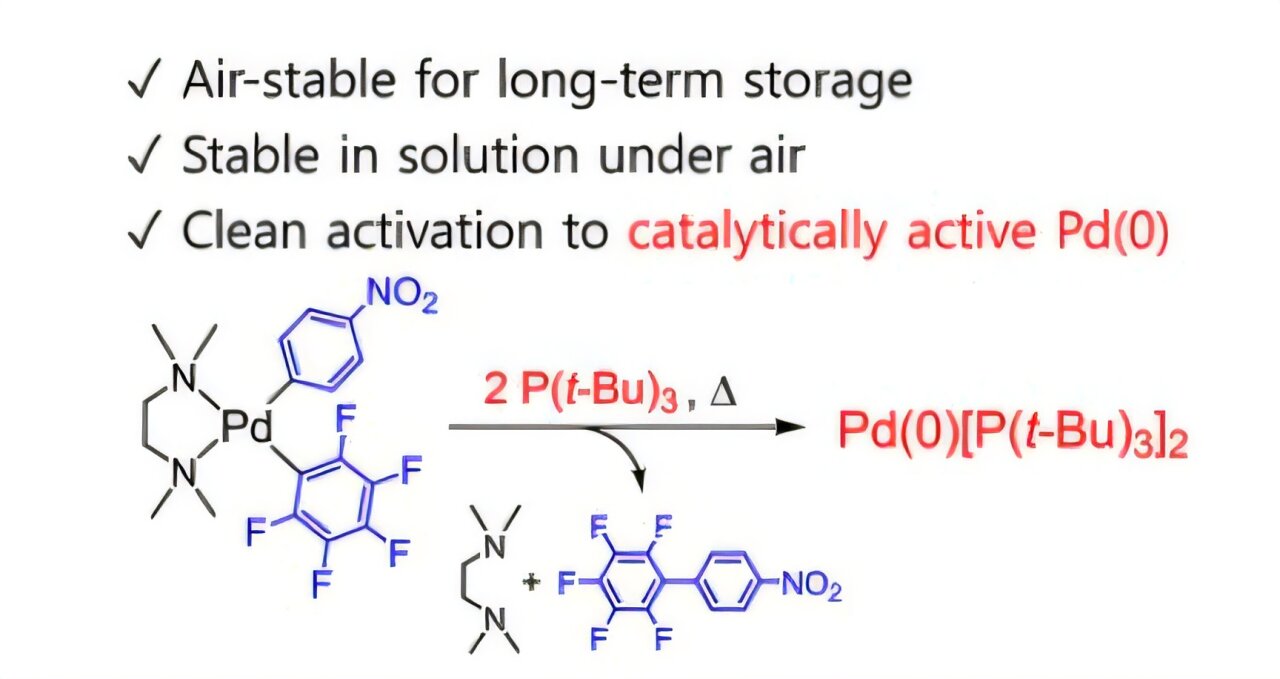
University of Tsukuba researchers have reported a palladium precatalyst designed to stay stable in air while still forming an active catalyst when needed. The advance could help chemists run cleaner reactions used to make pharmaceuticals, organic electronics materials and other functional compounds, according to the university.
The work, by Weiqi Li and colleagues, was published in Inorganic Chemistry Frontiers, the university said. The study focuses on a palladium(II) biaryl precatalyst that can generate catalytically active palladium(0) species after heating in the presence of phosphine ligands.
Palladium catalysts are widely used in cross-coupling reactions, a class of chemistry recognized by the 2010 Nobel Prize in Chemistry. Those reactions help build carbon-based molecules and are important in the synthesis of drug compounds, organic light-emitting diode materials and other products, according to the University of Tsukuba.
One challenge is that common palladium(0) catalysts can degrade in air, making storage and handling harder. Palladium(II) precatalysts can address some handling issues, but they usually need an activation step before they form the active palladium(0) catalyst. The university said that step can cause unwanted reactions, including ligand oxidation and byproduct formation.
The Tsukuba team designed the new compound by controlling its molecular structure. According to the researchers, the precatalyst combines a chelating ligand with an electron-poor aryl group, a pairing intended to provide both storage stability and controlled activation.
Tests reported by the team showed that the material remained stable under ambient conditions in both solid form and solution, the university said. When heated with phosphine ligands, it produced the active palladium(0) species without significant side reactions, allowing the catalytic process to proceed more cleanly.
The researchers describe the balance between storage stability and reactivity as the key feature of the design. In practical terms, a precatalyst that can be kept under ordinary conditions and activated on demand could reduce handling problems for laboratories and manufacturers that rely on palladium chemistry.
The University of Tsukuba said the findings may support more efficient production of pharmaceuticals and functional materials. The university also said the approach could improve cost efficiency and reduce environmental impact in industrial chemical production, though the report did not provide commercial-scale performance data.
The paper, titled “Balancing stability and reactivity: a robust Pd(II) biaryl precatalyst for rapid generation of catalytically active Pd(0) species,” appears in Inorganic Chemistry Frontiers. The journal lists the DOI as 10.1039/d6qi00664g.
This story draws on original reporting from Phys.org.