
ALMA spots neutral star-making gas in galaxies near cosmic dawn
Researchers say ALMA detected neutral oxygen emission in four galaxies seen 700 million to 800 million years after the Big Bang.
By Priya Raghavan · Science Reporter
3 min read
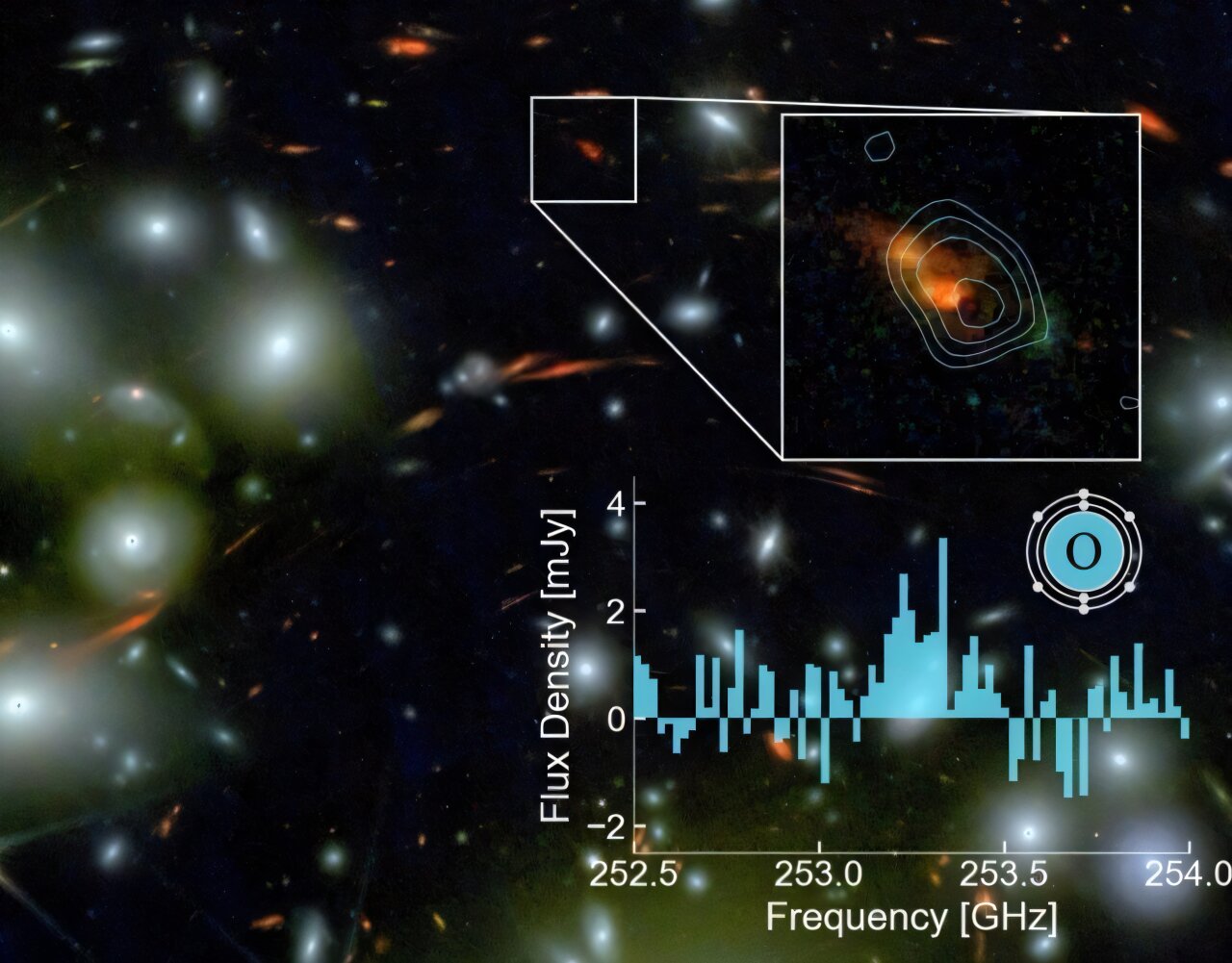
Scientists using the Atacama Large Millimeter/submillimeter Array have directly detected neutral gas tied to star formation in four distant galaxies, according to a Chiba University-led study. The finding matters because that gas is the raw material for building stars, yet it has been difficult to measure in galaxies from the early universe.
The research, published in the Astrophysical Journal, focused on galaxies seen as they were 700 million to 800 million years after the Big Bang. Chiba University said the team used ALMA to detect the oxygen emission line known as [O I] 145 micrometers in all four galaxies.
Assistant Professor Yoshinobu Fudamoto and Professor Masamune Oguri of Chiba University led the international team. Researchers from Waseda University, Hiroshima University and the University of Tsukuba also took part, according to Chiba University.
Why the signal matters
Telescopes including the James Webb Space Telescope and the Hubble Space Telescope can observe stars and hot gas in remote galaxies, Chiba University said. The neutral gas that supplies star formation is harder to detect directly at such distances.
The team targeted [O I] 145 micrometer emission because it comes from neutral oxygen atoms and can trace neutral gas more directly than some other signals. Chiba University said the widely used [C II] emission line can come from both neutral and ionized gas, which makes its origin harder to separate.
To test the interpretation, the researchers also examined the [N II] 205 micrometer emission line, which traces ionized gas. Chiba University said the [N II] signal was weak or absent, supporting the conclusion that most of the detected emission in the studied galaxies came from neutral gas.
“Our results represent the most distant direct detection of neutral gas in typical star-forming galaxies to date,” Fudamoto said. He said the work also helps astronomers use existing [C II] observations to study neutral gas in the early universe.
Dense gas, moderate radiation
The researchers combined the ALMA measurements with James Webb Space Telescope data to study the physical and chemical conditions in the galaxies, according to Chiba University. They used the [O I] and [C II] detections together to model the neutral gas.
The study found very high gas densities, comparable to those seen in starburst galaxies, according to Chiba University. The radiation field, however, was moderately lower than in starburst systems, leading the team to describe the early galaxies as compact, dense sites of star formation.
Akio K. Inoue of Waseda University said the work establishes the [O I] line as a useful way to study a hard-to-observe component of early galaxies. Fudamoto said the group plans to expand the observations to a larger set of galaxies and combine ALMA, JWST and other facilities to study galaxy formation from cosmic dawn to the present.
This story draws on original reporting from Phys.org.