
Tree planting’s water impacts shift with warming level, study finds
Researchers report that large-scale reforestation may aid water supplies in a cooler future but reduce them under higher warming.
By Priya Raghavan · Science Reporter
3 min read
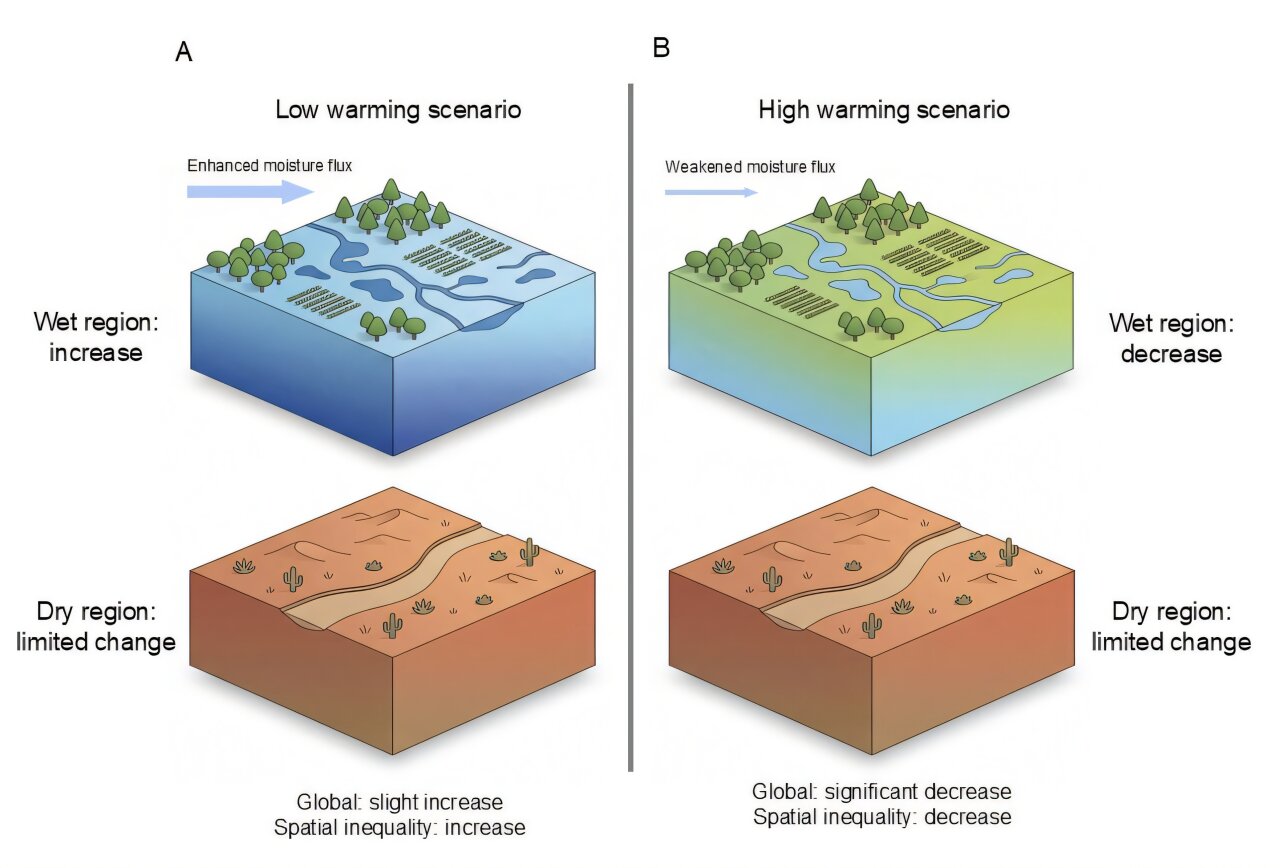
Large-scale tree planting can push water resources in different directions depending on how much the planet warms, according to a new study led by the Institute of Atmospheric Physics at the Chinese Academy of Sciences. The finding matters for climate policy because reforestation is often treated as a broadly useful tool for cutting carbon, while its effects on water may vary sharply by future climate conditions.
The study, published in One Earth, used Earth system model simulations from the CMIP6 project to test the hydrological effects of the same large-scale reforestation effort under two emissions pathways. Researchers compared a lower-warming scenario, SSP1-2.6, with a higher-warming scenario, SSP3-7.0.
The team focused on land water availability, defined as the balance between precipitation and evaporation. That measure is central to ecosystems, farming and human water use, the Chinese Academy of Sciences said.
Different warming paths, different water outcomes
Under the lower-warming pathway, the researchers found that reforestation produced a small increase in global land water availability. At the same time, it widened differences between wetter and drier regions, with wet areas gaining more water relative to dry areas, according to the study.
Under the higher-warming pathway, the result changed. Reforestation lowered overall land water availability, but the distribution of water across regions became more even, the researchers reported.
Tao Tang, the study’s lead author, said the work shows that comparable tree-planting efforts can lead to contrasting hydrological outcomes when the background climate is different. The study identifies warming level as a key factor in whether reforestation increases water availability overall or reduces it.
The researchers also looked at water availability per person. The Chinese Academy of Sciences said population assumptions intensified the contrast between the two scenarios, because SSP3-7.0 includes a much larger global population than SSP1-2.6. Under the hotter pathway, that made per-capita water losses in wet regions more severe.
Atmospheric circulation drives the split
To examine why the results diverged, the team carried out a moisture budget analysis. The analysis linked the different water responses to changes in atmospheric circulation, especially the way moisture converges over wet regions under different warming levels.
The authors said more work is needed to explain why circulation responds differently in the low- and high-warming cases. The current results point to a mechanism, but do not give a full account of the underlying atmospheric changes.
The findings may help reconcile earlier research that reached different conclusions about reforestation and water. The study suggests that reports of both increases and decreases in water availability can be consistent if they are tied to different climate states.
Junji Cao, a co-author of the study, said policymakers should consider the timing and location of tree planting as well as the scale. According to the Chinese Academy of Sciences, the same reforestation effort may support water resources in a low-emissions future while reducing them in a hotter one.
This story draws on original reporting from Phys.org.