
Webb data shows unequal dawn and dusk on ultra-hot exoplanet
Astronomers say JWST observations of WASP-121 b reveal hotter evening skies, water breakup and possible mineral clouds on its cooler edge.
By Priya Raghavan · Science Reporter
3 min read
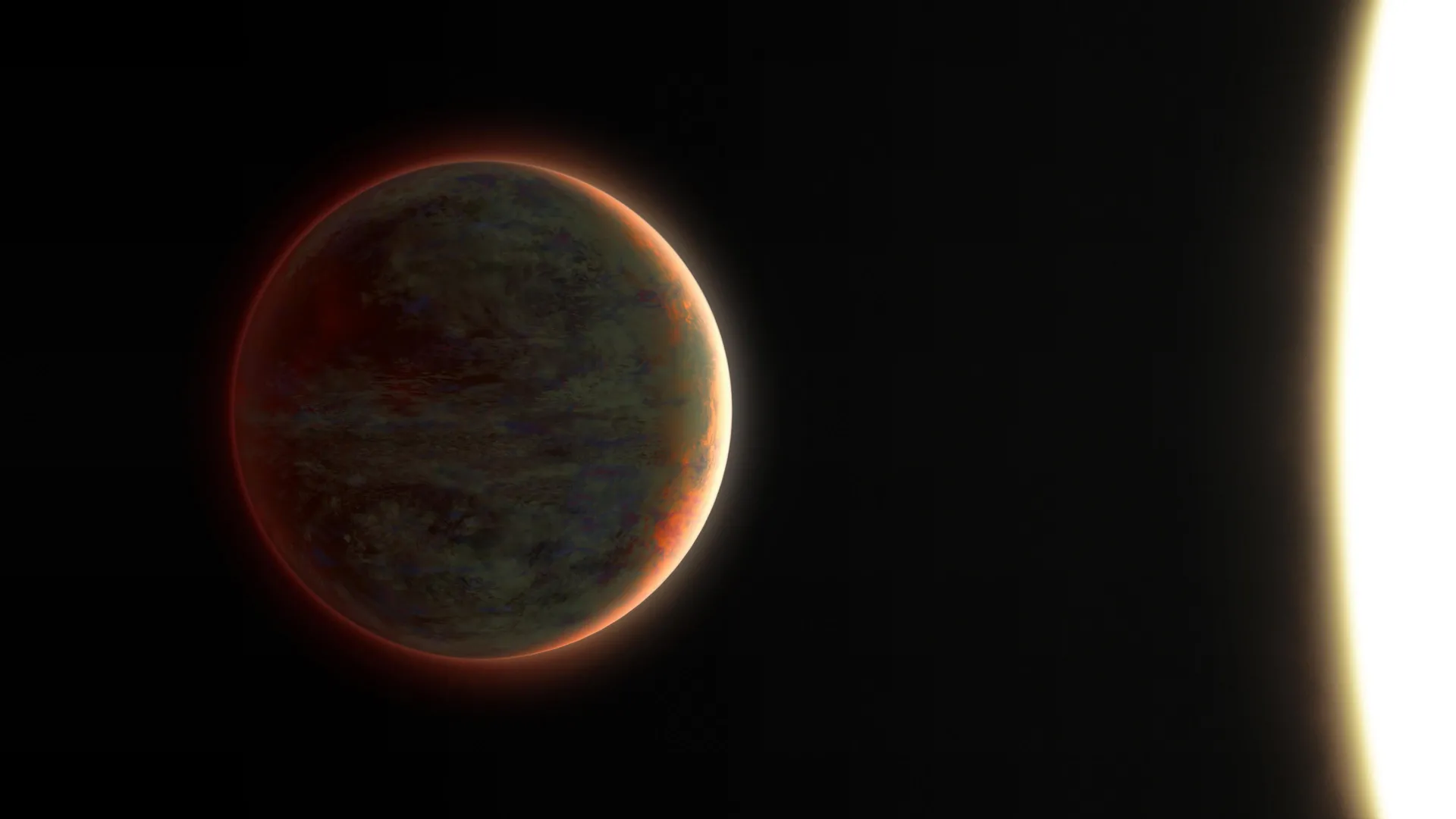
Astronomers using the James Webb Space Telescope have found that dawn and dusk on the ultra-hot exoplanet WASP-121 b are measurably different. The result matters because it gives researchers a sharper way to study weather, chemistry and heat flow on distant planets that cannot be imaged in detail.
The findings, reported by a team led by Cyril Gapp of the Max Planck Institute for Astronomy and published in Nature Astronomy, come from infrared observations taken as WASP-121 b passed in front of its star. The researchers studied starlight filtered through the planet’s atmosphere and found that the signal changed during the transit.
WASP-121 b is a hot Jupiter, a gas giant orbiting close enough to its star that tidal forces have locked one side in permanent daylight and the other in permanent darkness, according to the Max Planck Institute for Astronomy. The boundary between those hemispheres is known as the terminator, with one side corresponding to morning and the other to evening.
The team found that the evening terminator blocked more starlight than the morning terminator. According to the researchers, the pattern fits models in which strong eastward winds carry heat away from the intensely irradiated day side, warming the evening edge more than the morning edge.
Hotter gas expands, giving the atmosphere a larger profile against the star and allowing it to absorb more light, the team said. Tom Evans-Soma of the University of Newcastle, Australia, and MPIA said WASP-121 b has average day-side temperatures around 2,770 Kelvin and night-side temperatures closer to 1,000 Kelvin, or about 2,500 degrees Celsius and 725 degrees Celsius.
JWST’s Near Infrared Spectrograph also detected a stronger carbon monoxide signal late in the transit. The researchers said that shift is best explained by temperature effects, rather than by a higher amount of carbon monoxide in that region.
Water showed a different pattern. The team said water molecules appear to be less common in hotter parts of the atmosphere, likely because extreme temperatures in the upper atmosphere split water into its component elements. The researchers interpreted that as further evidence that winds are heating the evening terminator.
The method relied on a small but useful change during the planet’s transit. As WASP-121 b crossed its star, it rotated by about 30 degrees, enough for astronomers to separate signals from different longitudes, according to the study.
Transit observations are often averaged into one combined atmospheric spectrum. Gapp and colleagues instead allowed the signal to vary over time, and their statistical analysis found that the changing model matched the JWST data better than a single averaged signal.
The team also ran computer simulations of heat movement in the upper atmosphere. Those models reproduced the general dawn-dusk asymmetry but did not fully match the strength of the observed effect, according to MPIA.
One possible missing factor is cloud cover near the cooler morning terminator. The researchers said earlier work has pointed to clouds in those regions, possibly made from minerals such as silicates rather than water droplets. Such clouds could block infrared radiation from warmer layers below, making that part of the atmosphere appear cooler.
When the researchers added a simplified cloud effect to their simulations, the models came closer to the JWST observations. The team said more detailed cloud modeling will be needed before scientists can confirm whether mineral clouds are shaping WASP-121 b’s atmosphere.
The researchers said the same time-resolved transit technique could be applied to other ultra-hot gas giants with suitable temperatures and rotation rates. A larger set of planets could help astronomers compare three-dimensional atmospheric structures across extreme worlds.
This story draws on original reporting from ScienceDaily.