
Simulations trace why water nanodrops spread on hydrophilic surfaces
University of Tokyo researchers link nanoscale wetting to the breakdown of water’s local molecular order at a droplet’s edge.
By Tom Brennan · Health & Medicine Correspondent
3 min read
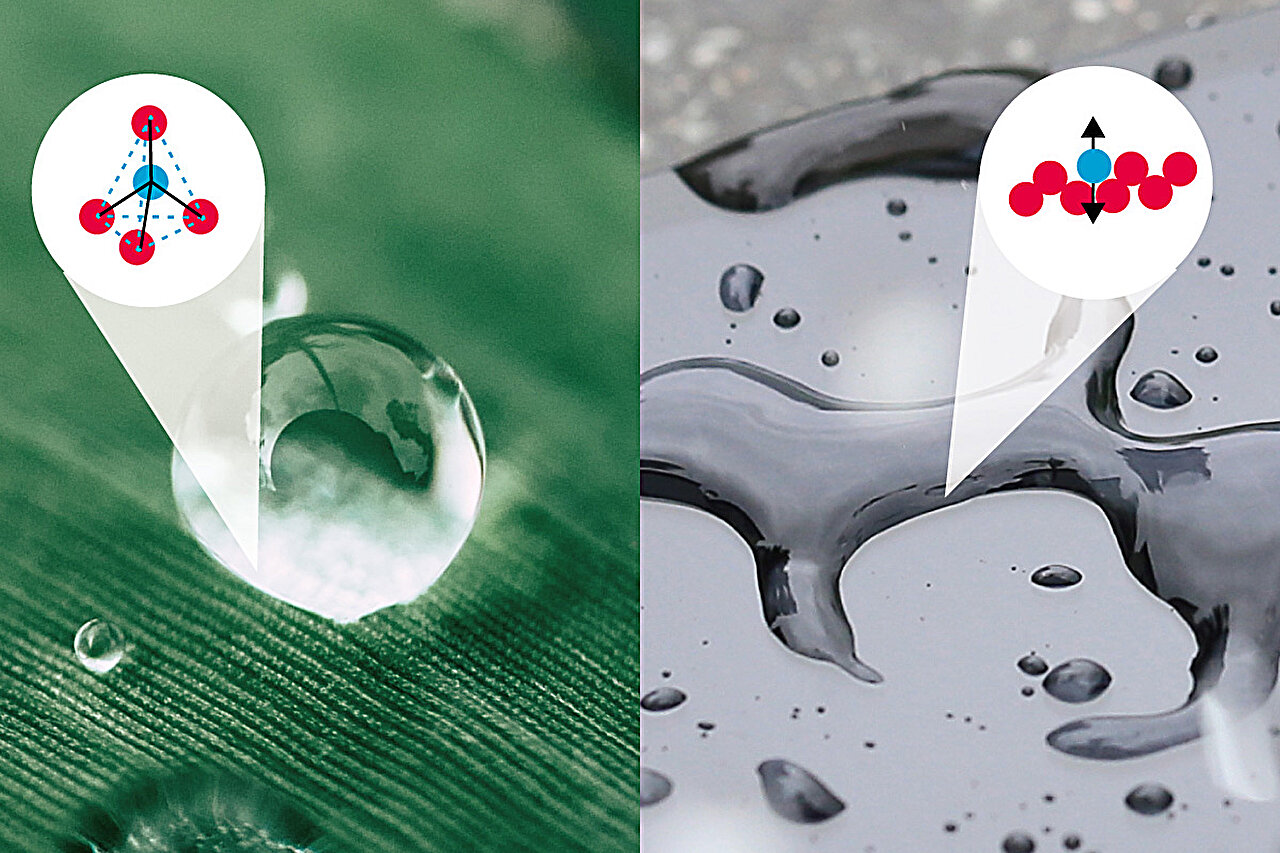
Researchers at the University of Tokyo say molecular simulations have identified why tiny water droplets spread into thin films on hydrophilic surfaces. The study, published in Nature Physics, points to changes in water’s local molecular structure at the edge of a droplet, where standard theories for larger drops fall short.
For millimeter-scale drops, scientists can describe wetting with continuum theory, according to the University of Tokyo. That framework explains why water beads and rolls away on a surface such as Teflon, forms rounded drops on waxy leaves and spreads across clean glass.
At much smaller scales, another factor becomes prominent: line tension. The force acts along the contact line, the narrow region where solid, liquid and air meet. For large drops, line tension is minor compared with interfacial tension, but for nanodroplets the contact line takes up a much larger share of the system, the university said.
The unresolved problem has been why line tension can change sign during complete wetting, when water spreads into a film. According to the research team at the university’s Institute of Industrial Science, that sign reversal cannot be explained by treating the liquid as a smooth continuum.
The team used molecular dynamics simulations to watch how water molecules arrange themselves near surfaces with different wettability. The simulations let the researchers quantify line tension while tracking molecular order during wetting, according to the university.
Lead author Mohd Moid said liquid water tends to form a short-lived tetrahedral arrangement through hydrogen bonding, with each molecule locally organized around a four-neighbor pattern. He said experiments have difficulty observing how that order changes when water fully wets a surface.
The simulations showed that this tetrahedral order breaks down at the contact line during complete wetting, according to the study. The researchers linked that local structural collapse to the reversal of line tension, offering a molecular explanation for the behavior of water nanodroplets on hydrophilic materials.
The team also tested an ice bilayer on a hydrophilic surface in computer experiments. Senior author Hajime Tanaka said the two-layer arrangement of water molecules did not wet the surface, which the researchers interpreted as evidence that local molecular order can outweigh surface chemistry.
The finding suggests that wettability at nanoscale is not determined by surface attraction alone, according to the University of Tokyo. The structure of water at the interface can govern whether the liquid spreads, beads or resists wetting even on a surface that would otherwise favor contact.
The authors said the work could help guide methods for controlling wetting and interfacial mechanics in inorganic and biological systems. The paper is titled “Structural origin of line-tension reversal in nanoscale wetting of water.”
This story draws on original reporting from Phys.org.