
Black hole winds tied to missing stars in giant galaxies
XRISM observations of NGC 4151 suggest outflows from a supermassive black hole can expel gas that galaxies need to form stars.
By Priya Raghavan · Science Reporter
3 min read
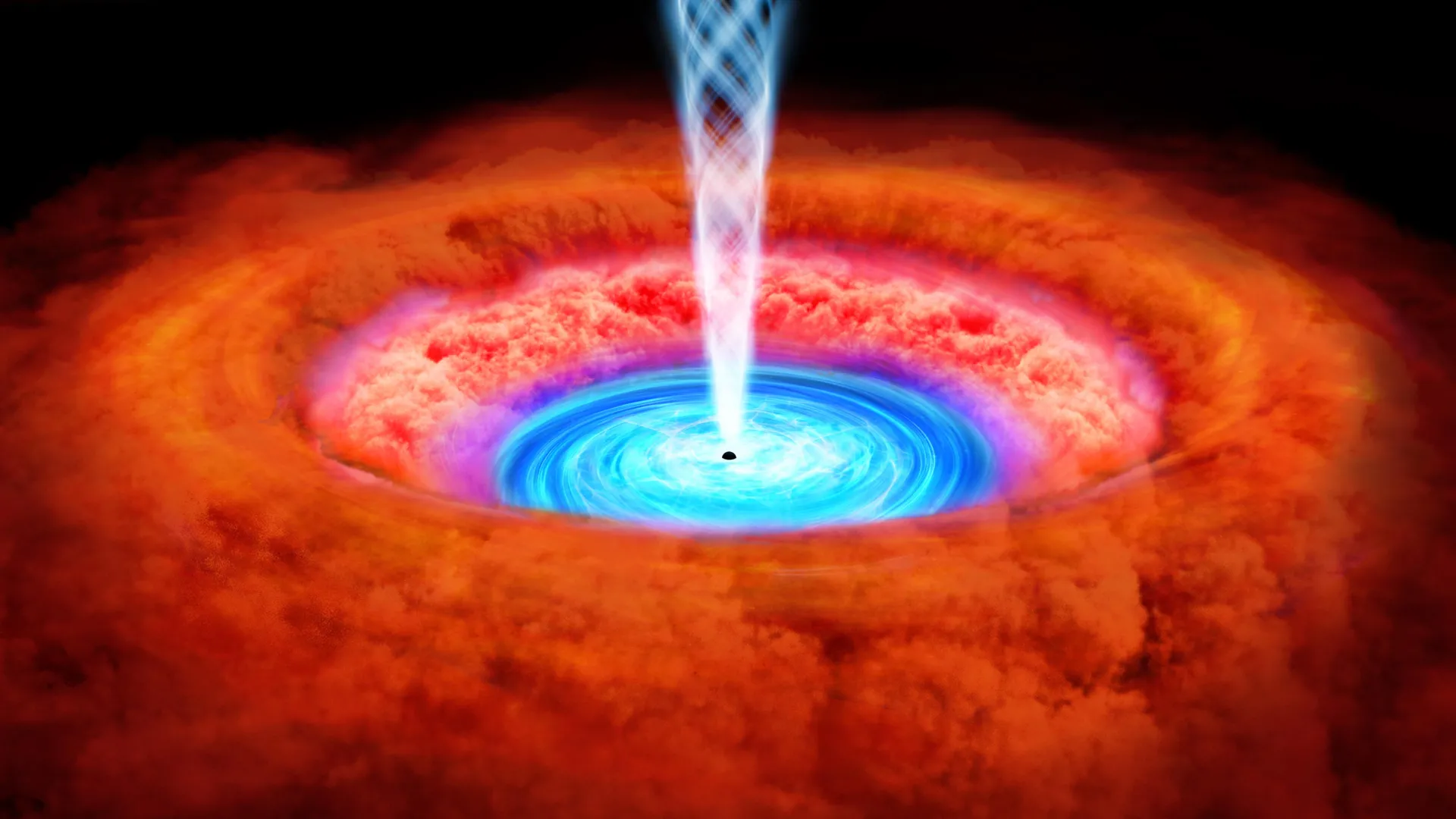
Astronomers using the XRISM X-ray observatory have found new evidence that supermassive black holes can help shut down star formation in large galaxies. The University of Michigan said the finding bears on a long-running mismatch between models predicting how many stars the biggest galaxies should have and what astronomers observe.
The work centers on NGC 4151, a bright galaxy a little more than 50 million light-years from Earth. At its core is an active galactic nucleus, where a supermassive black hole is feeding on surrounding gas and dust and producing intense X-ray emission.
Xin “Cindy” Xiang, a University of Michigan doctoral student, used observations from the X-Ray Imaging and Spectroscopy Mission, or XRISM, to study winds launched from the black hole’s accretion disk. The mission is led by the Japanese Aerospace Exploration Agency with NASA and the European Space Agency as partners, according to the university.
Why black hole winds matter
Galaxies form stars from gas. If powerful outflows remove that gas, a galaxy can lose the material it needs to keep building new stars.
The University of Michigan said current models indicate the most massive galaxies should contain more stellar mass than astronomers see. One possible explanation is that black hole-driven winds push star-forming gas out of galaxies, limiting how much they can grow.
Black holes are known for gravity strong enough to trap light beyond a boundary, but the space around an actively feeding black hole can be extremely bright. As material spirals inward, it forms a hot accretion disk that emits high-energy radiation and can send matter outward in fast-moving flows.
XRISM gives astronomers a sharper view of those regions than earlier instruments. The spacecraft launched in 2023 and began science observations in fall 2024; the University of Michigan said its energy resolution is about 10 times better than that of its predecessor.
Xiang said XRISM allows researchers to see fine structure in the outflows, rather than only broad features. Those details help scientists examine the shape of the winds, how they start and when they appear.
A timing clue in NGC 4151
Xiang, working with University of Michigan astronomy professor Jon Miller and collaborators, had previously found that winds from the accretion disk in NGC 4151 could move fast enough to carry material out of the system. The team also identified magnetocentrifugal driving, a process compared by the university to the mechanism behind solar flares, as the likely cause.
At the 248th meeting of the American Astronomical Society in Pasadena, California, Xiang presented a method for identifying when the strongest winds occur. She examined hundreds of days of XRISM data, tracking X-ray flares and the hours that followed them.
The analysis compared X-ray brightness with whether the radiation was harder or softer, a distinction similar to color in visible light. Xiang combined those measurements into a metric called the color intensity index; Miller suggested the shorter name “cindicity,” according to the university.
The pattern in NGC 4151 was specific: the strongest fast winds appeared when X-rays were hard but relatively dim. They typically came after flares rather than during them, emerging about 10,000 seconds, or just under three hours, later.
The University of Michigan said that timing link offers a new way to study how active black holes affect their host galaxies. If the method works for other galaxies, astronomers could better test whether black hole winds help explain why some giant galaxies have fewer stars than expected.
This story draws on original reporting from ScienceDaily.