
VR viewpoint shift may make group decisions less contentious
A study found that seeing one’s avatar from behind in VR improved consensus and reduced conflict, while weakening emotional connection.
By Priya Raghavan · Science Reporter
3 min read
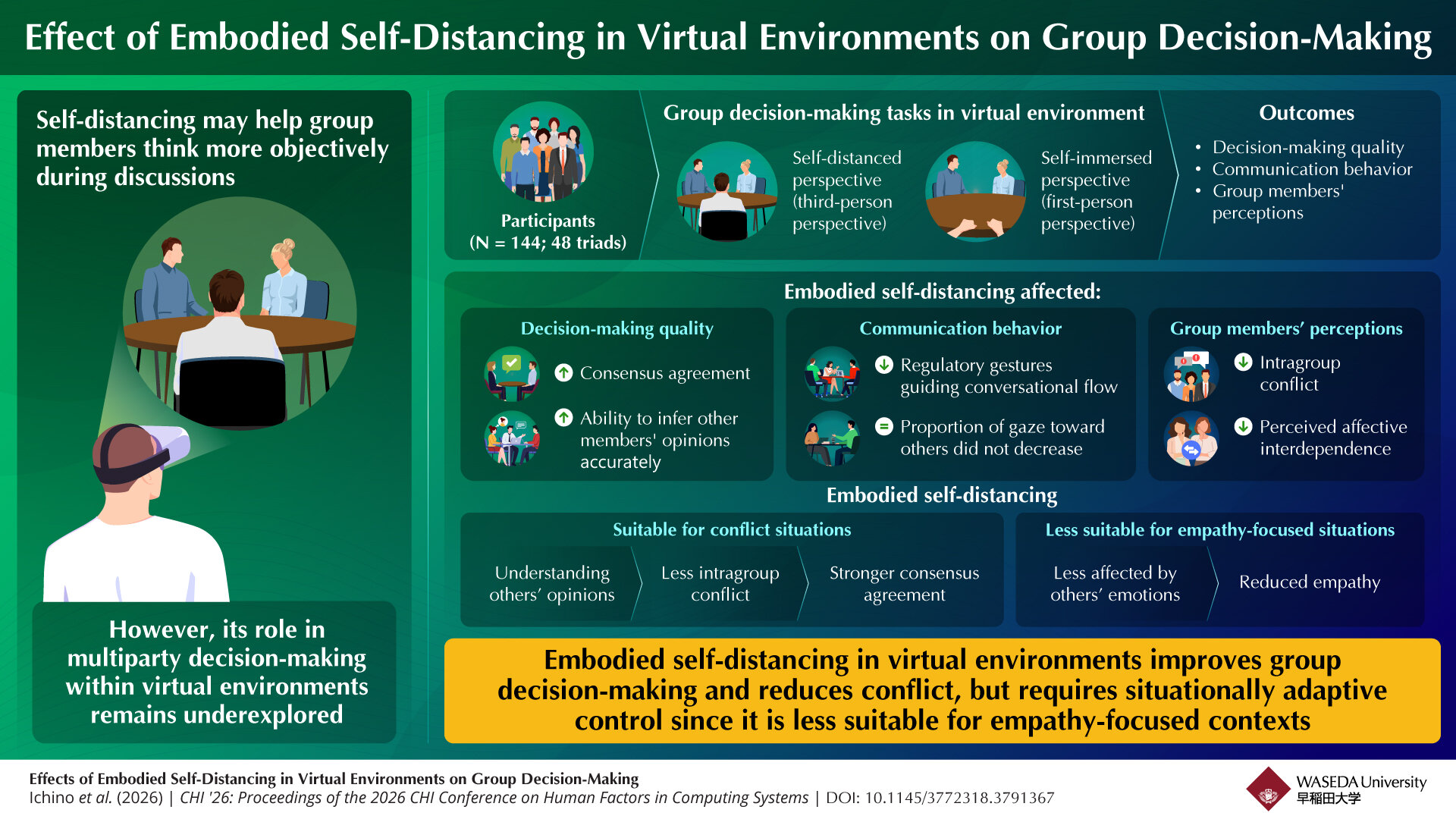
A virtual reality viewpoint that lets people see their own avatars from behind may change how groups reach decisions, according to researchers at Waseda University and partner institutions in Japan. The finding points to a design choice that could affect virtual meetings and metaverse platforms as they become more common.
The study examined whether a third-person perspective in a virtual environment changes multiparty discussion compared with a conventional first-person view. The research was led by Professor Junko Ichino of Waseda University with Masahiro Ide of Tokyo City University, Hitomi Yokoyama of Okayama University of Science, Hirotoshi Asano of Shibaura Institute of Technology, Hideo Miyachi of Tokyo City University and Daisuke Okabe of Tokyo City University.
The findings were published in CHI ’26: Proceedings of the 2026 CHI Conference on Human Factors in Computing Systems.
Researchers tested 144 people ages 20 to 49, dividing them into 48 three-person groups. Each group completed two decision-making tasks in virtual reality.
In one setup, participants viewed the virtual environment through their avatar’s eyes, a standard first-person perspective. In the other, they saw their avatar from behind, giving them the experience of observing themselves from outside their own body.
According to the research team, the third-person setup was linked with stronger agreement around group consensus and better accuracy in understanding other participants’ views. Participants in that condition also reported less conflict within the group and less conflict tied to the task.
The researchers said the results suggest that a degree of psychological distance from oneself may help participants loosen their attachment to their own views. That, in turn, may support calmer discussion and more cooperative decision-making.
The team also found differences in how people gestured during the discussions. Participants using the third-person view showed more regulating gestures, such as movements used to manage turn-taking, pausing or yielding the floor to another speaker.
At the same time, participants in that condition used fewer gestures that stood in for spoken expressions. The researchers said this suggests that viewpoint design may affect not only what participants decide, but also how they coordinate with one another during conversation.
The study also found a drawback. While the third-person view was associated with less conflict and better cooperation, it reduced what the researchers called affective interdependence, meaning participants felt less emotionally connected to one another.
Ichino said previous work on third-person perspectives in virtual environments has mostly centered on individual activities, including single-player games and sports, leaving group decision-making less studied.
Ichino said the work shows that perspective design in virtual environments can shape social behavior and decision-making, not just usability and immersion. She said future virtual reality and metaverse applications should consider what psychological states and communication styles avatar experiences encourage, as well as how realistic the environment appears.
This story draws on original reporting from Phys.org.