
DESI galaxy map points to uneven cosmic structure at vast scales
A Nature study using DESI data reports directional patterns in galaxy clustering that challenge a core assumption in standard cosmology.
By Tom Brennan · Health & Medicine Correspondent
3 min read
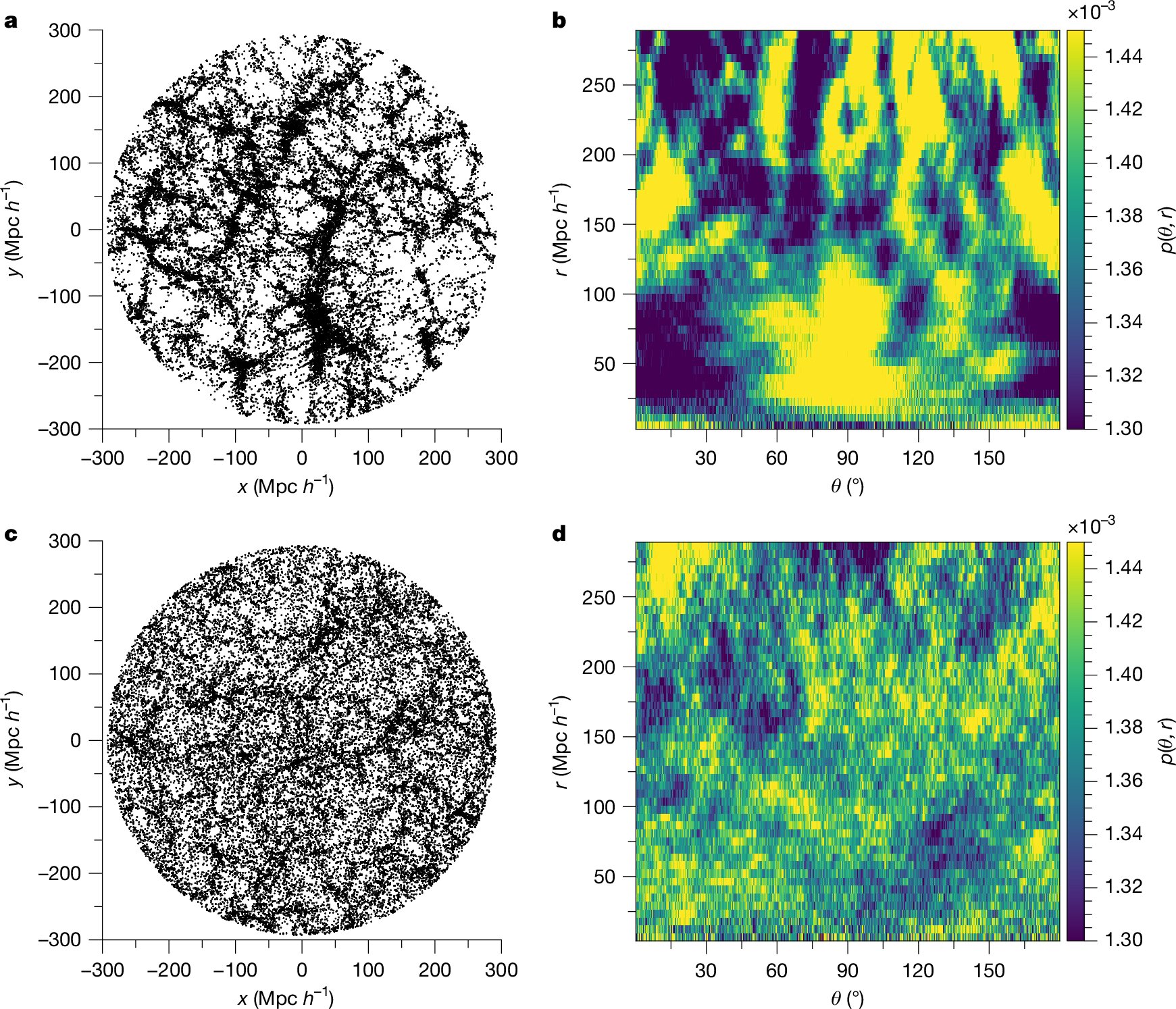
A new analysis of DESI galaxy data suggests the universe may remain uneven in different directions across far larger distances than standard cosmology predicts. The finding matters because many cosmological models assume that, at sufficiently large scales, matter is spread in a statistically uniform way no matter where or how observers look.
Francesco Sylos Labini and Marco Galoppo reported the result in a study published in Nature. Their work uses observations from the Dark Energy Spectroscopic Instrument, which earlier this year completed a map of 47 million galaxies across 11 billion light-years, according to Phys.org.
A test of a basic cosmology assumption
On smaller scales, astronomers already know the universe is not uniform. Galaxies gather in groups and clusters, while other regions contain large voids, creating the network often described as the cosmic web.
The cosmological principle says that this unevenness should fade when viewed over large enough distances. It draws on the Copernican principle, which holds that observers do not occupy a special location in the universe, and it underlies much of the standard framework used to describe cosmic evolution.
Phys.org reported that scientists have debated the scale at which the universe should become isotropic, meaning similar in all directions. Studies of the cosmic background radiation have supported the broad assumption, while other galaxy-survey work has found signs of directional structure across tens to hundreds of megaparsecs, with uncertain statistical weight.
How the DESI data were studied
Sylos Labini and Galoppo said earlier tests often looked for preferred directions rather than broader angular patterns in the distribution of galaxies. To study directional structure more generally, they used a statistic called the Angular Distribution of Pairwise Distances, or ADPD.
According to the study, ADPD measures directional correlations in galaxy positions without relying on fitted parameters. The researchers compared the observed DESI galaxy samples with expectations from a model based on isotropy.
The authors found what they describe as persistent anisotropic structure in the DESI galaxy distribution out to roughly gigaparsec scales. In practical terms, the analysis indicates that galaxies appear to clump directionally across distances about 1,000 times larger than the megaparsec scales discussed in some earlier anisotropy studies, according to Phys.org.
“These results provide direct evidence that directional coherence persists to larger scales than predicted in the standard framework, challenging the assumption of large-scale isotropy,” the study authors wrote.
Limits and possible implications
The study does not identify what physical process would cause the reported anisotropy. Phys.org also noted that the universe could still become isotropic at scales larger than those tested in the new analysis.
Even so, the authors said confirmation of large-scale anisotropy would put pressure on the standard formulation of the cosmological principle. They wrote that their finding conflicts with the version of the principle that assumes statistical homogeneity and isotropy around any point, while still fitting the Copernican requirement that there be no privileged observing location.
The researchers said the result could motivate cosmologists to examine more general solutions to Einstein’s field equations that permit large-scale inhomogeneities. They also pointed to possible work on alternative sources of accelerated structure formation, including self-interaction in dark matter or backreaction effects from inhomogeneities.
The paper is titled “Detection of anisotropic cosmic structures on a gigaparsec scale” and was published in Nature with DOI 10.1038/s41586-026-10702-5.
This story draws on original reporting from Phys.org.