
UV masking turns crystals into selective color-changing materials
Yale chemists report a crystal patterning method that activates thermochromism in chosen areas while preserving the material’s structure.
By Tom Brennan · Health & Medicine Correspondent
3 min read
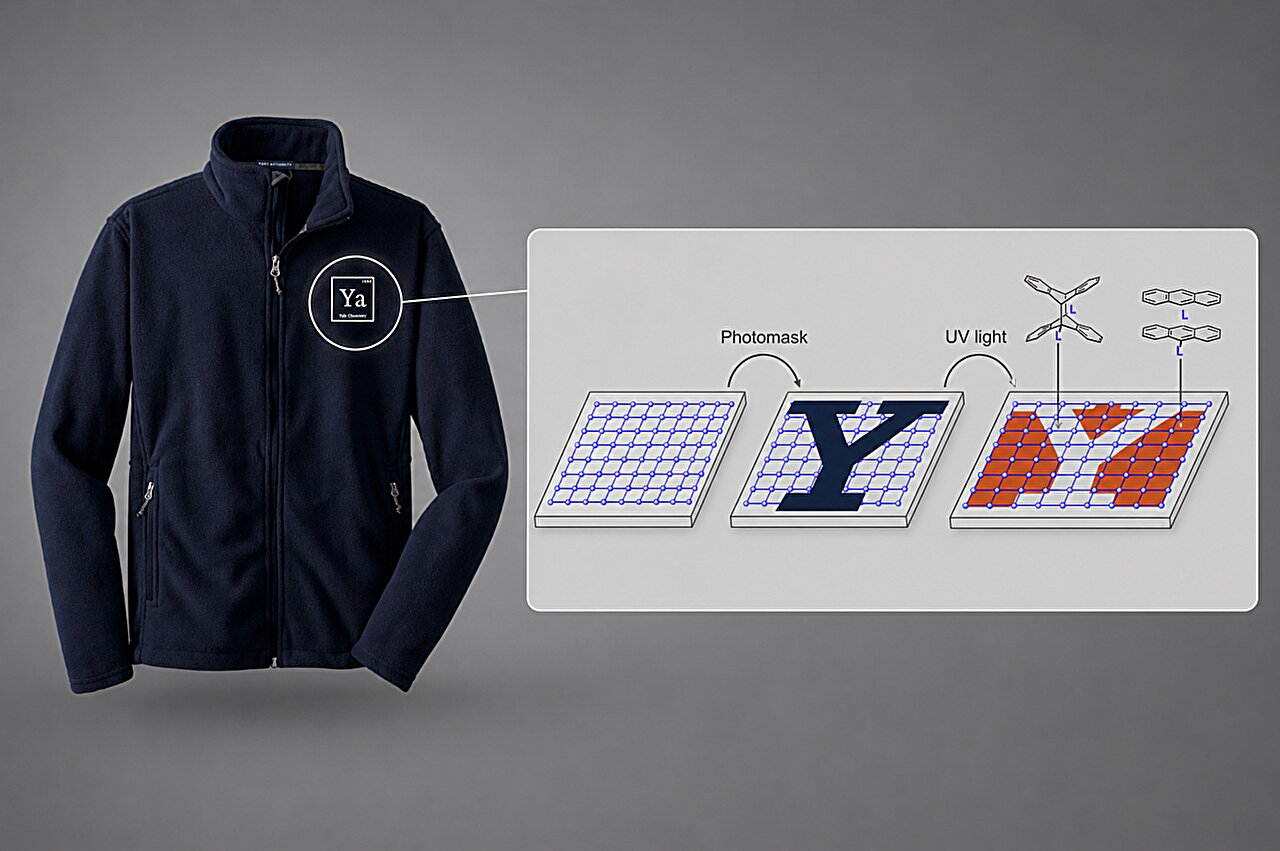
Yale researchers have shown a way to use ultraviolet light to make selected regions of a crystalline material change color with temperature while leaving other regions unchanged. The work matters for smart materials because many light-based patterning methods can alter useful properties but also weaken or damage the solids being patterned.
The study, published in the Journal of the American Chemical Society, was led in Amymarie Bartholomew’s chemistry lab at Yale and carried out by postdoctoral researcher Eric Schreiber, according to Yale University. Bartholomew, the corresponding author, said the team designed a new ligand intended to let materials be transformed without physical degradation.
A light-written temperature response
Thermochromic materials shift color as their temperature changes. Yale cited familiar examples such as mood rings, forehead temperature strips and indicators used in cars, while noting that the same phenomenon is also relevant to smaller-scale technologies including sensors, electronics and computing.
For those uses, researchers need materials that can be patterned into specific designs and still hold together. Yale said existing photopatterning approaches often create that pattern at the cost of the material’s integrity.
The Yale team built its material around a metal-organic framework, or MOF, a crystalline scaffold that can be tuned chemically and structurally. According to Yale, MOFs are useful for this kind of work because they are porous, responsive and can be assembled from molecular linkers and metal connections.
The key linker was an anthracene heterodimer, a molecule made from two different anthracene units joined together. Yale said anthracene-based molecules can respond to light by linking or separating, but earlier anthracene-dimer MOFs often lost framework dimensionality when light split the dimer, making the crystals less stable and less reliable.
Patterning with a mask
To address that problem, Schreiber and Bartholomew used the anthracene heterodimer ligand to form a copper-connected lattice. Yale said the dimer form produced a pale blue solid that did not change color with temperature.
When ultraviolet light split the dimer, the material became thermochromic, according to Yale. In that state, it appeared brown at room temperature and pale green when cold.
The researchers demonstrated spatial control by using a cutout of Yale’s “Y” as a photomask. Schreiber described cutting the letter from paper, placing it over the material and shining shortwave UV light through the uncovered areas; Yale said the masked region stayed in its original state while the exposed region converted into the thermochromic form.
That result allowed the team to create regions with different thermal color behavior within the same solid. Bartholomew said the material kept its dimensionality and physical connections even as its properties changed in a patterned way.
Yale said the approach avoids photoresist steps that are commonly used in photopatterning and can contribute to damage. By using UV exposure through a mask, the method could let manufacturers activate thermochromic behavior only in chosen areas.
The researchers also said the strategy could extend beyond color response. According to Yale, related patterning methods may be useful for controlling magnetic or electrical behavior in materials for energy storage and release, spintronics and quantum information science.
This story draws on original reporting from Phys.org.