
Study finds shared beliefs on how mental abilities develop
Adults in six countries tended to see basic sensations as inborn and reasoning or moral judgment as learned, researchers report.
By Tom Brennan · Health & Medicine Correspondent
3 min read
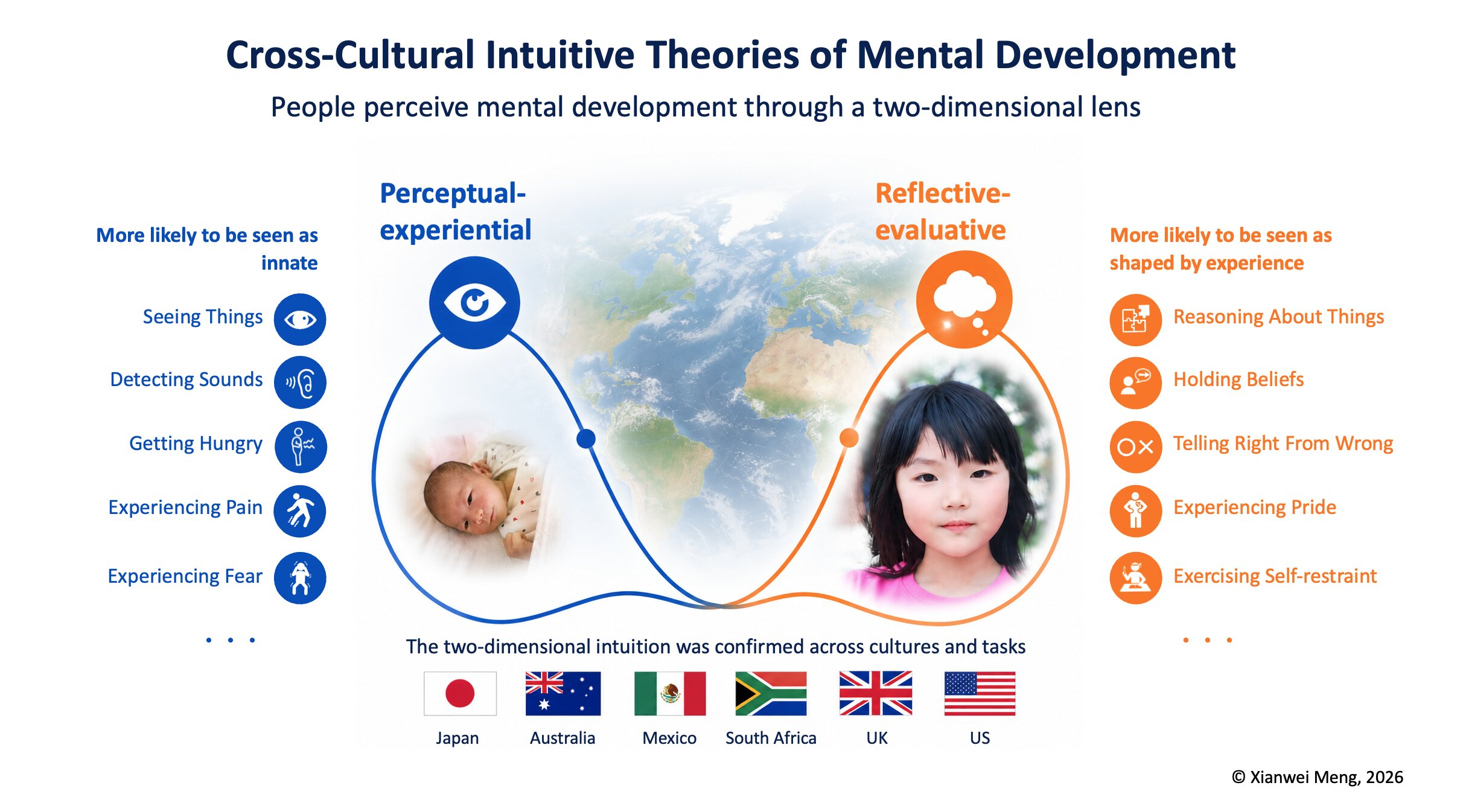
Adults across six countries tend to sort mental abilities into similar developmental categories, according to a study led by researchers at Nagoya University and Rutgers University. The findings matter because assumptions about what children are born able to do, and what they must learn, can shape expectations in parenting, education and public debate, the researchers said.
The study, published in Psychological Science, surveyed adults in Australia, Japan, Mexico, South Africa, the United Kingdom and the United States. Participants were shown 40 mental capacities and asked at what age they thought a person first becomes capable of each one, according to Nagoya University.
Two broad categories
The researchers reported that participants in all six countries grouped mental capacities in a similar way. One cluster covered basic sensory and emotional experiences, including fear and hunger, which participants tended to place early in life.
The study called that cluster the Perceptual–Experiential dimension. A second cluster covered capacities such as reasoning, self-restraint, moral judgment and pride, which participants tended to see as emerging later, according to the researchers.
The study called the second cluster the Reflective–Evaluative dimension. Nagoya University said the researchers did not begin by imposing those categories but identified them from response patterns across cultures, languages and survey formats.
That consistency suggests many adults may share an intuitive framework for thinking about how the mind develops, according to the research team. Rather than treating the mind as a set of unrelated abilities, participants appeared to imagine development as moving from perception and experience toward reflection, evaluation and self-understanding, Nagoya University said.
Born with it or learned
The researchers also asked participants whether they viewed each capacity as mainly rooted in nature, meaning present from birth, or nurture, meaning developed through experience. According to the study, participants generally saw the Perceptual–Experiential capacities as more innate.
By contrast, they tended to see Reflective–Evaluative capacities as more dependent on learning and experience, the researchers reported. The study connects that pattern to the long-running nature-versus-nurture debate in philosophy and science.
Xianwei Meng, the study’s lead author and an associate professor in Nagoya University’s Graduate School of Informatics, said the findings also bear on debates about how people perceive minds. Meng said models that appear to compete may reflect different perspectives: people may organize mental life one way when comparing entities such as humans and robots, and another way when considering development over time.
Jinjing “Jenny” Wang of Rutgers University said the results show that everyday intuitions resemble theoretical debates about the origins of the human mind. Wang also said a shared structure does not mean beliefs about particular mental abilities cannot change, because experience, education and scientific inquiry can alter those views.
The paper is titled “How Does the Mind Grow? Cross-Cultural Intuitive Theories of Mental Development.” Its authors include Xianwei Meng and colleagues, according to the publication details released by Nagoya University.
This story draws on original reporting from Phys.org.