
Light-activated drug candidate targets resistant MRSA enzyme
A PNAS study reports that BIN-3I uses β-lactamase to build up inside resistant bacteria before light exposure kills them.
By Tom Brennan · Health & Medicine Correspondent
3 min read
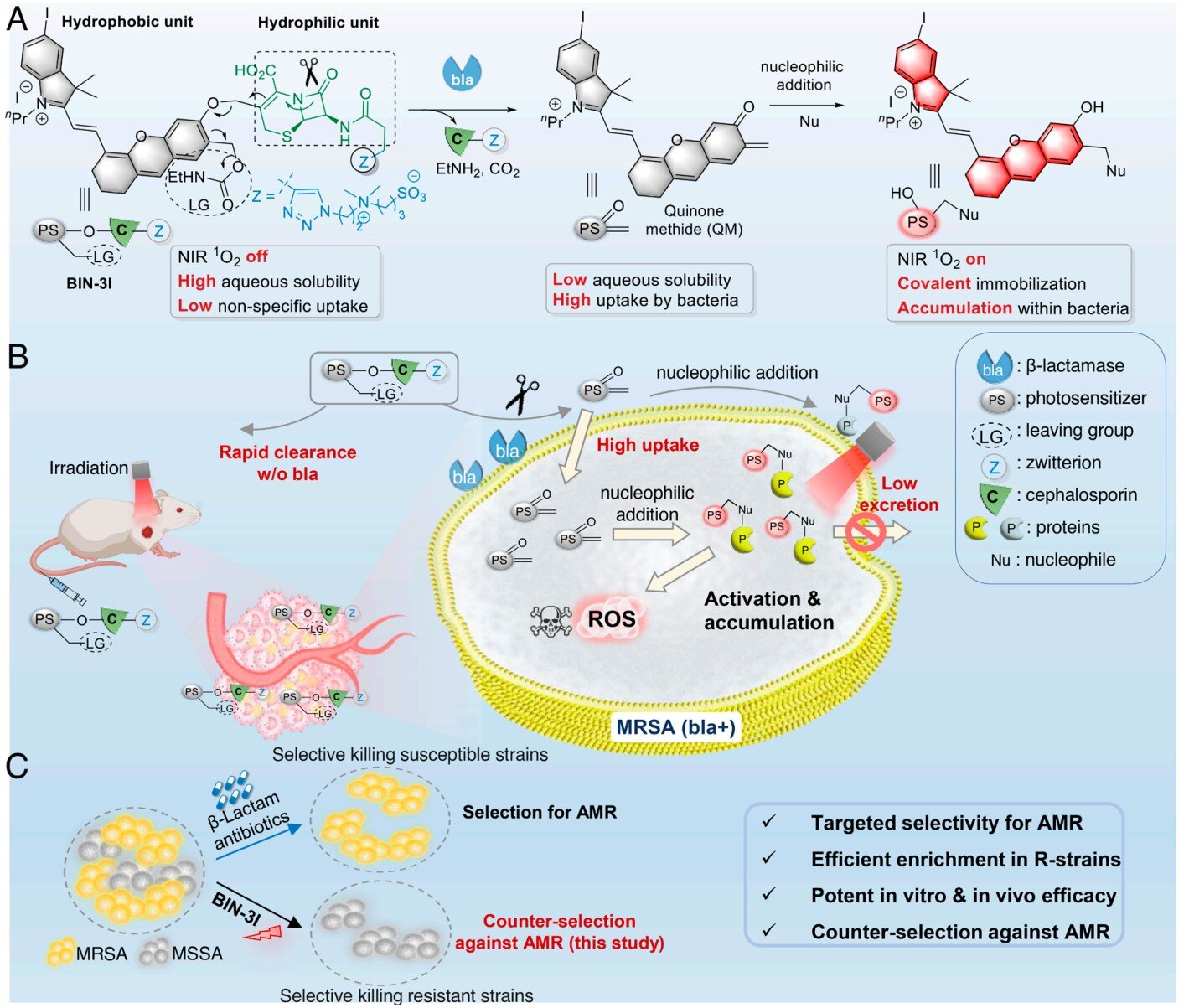
Researchers have developed a light-activated compound that killed β-lactamase-producing MRSA in laboratory and mouse experiments, according to a study published in the Proceedings of the National Academy of Sciences. The work matters because the compound uses a common resistance enzyme, β-lactamase, as the trigger for attacking resistant bacteria.
Fangfang Chen and colleagues report that the compound, called BIN-3I, was designed for photodynamic therapy, a treatment approach that uses light to activate a drug-like molecule. In the study, BIN-3I targeted Gram-positive MRSA strains that produce β-lactamase, an enzyme bacteria use to disable β-lactam antibiotics.
How the compound works
The researchers describe BIN-3I as a photosensitizer that stays largely inactive until β-lactamase acts on it. The molecule includes a β-lactamase recognition unit, a near-infrared photosensitizing dye, a leaving group and water-attracting chemical groups meant to improve solubility and limit unwanted entry into cells.
According to the study, β-lactamase cuts the compound in a way that changes its behavior. The reaction removes hydrophilic groups and creates a more hydrophobic, membrane-permeable intermediate, allowing the activated material to accumulate in resistant bacteria.
The team reports that this design addressed a weakness seen in some earlier β-lactamase-activated photodynamic agents, where active molecules could drift away from the bacteria they were meant to kill. In experiments, BIN-3I reached more than 2,000-fold enrichment compared with the surrounding incubation medium, the researchers report.
Tests against resistant bacteria
In cell experiments, Chen and colleagues found that BIN-3I plus light selectively killed β-lactamase-positive MRSA. The study reports a greater than 99.999% drop in viable cells while β-lactamase-negative strains were spared.
The researchers also tested mixed bacterial populations. They report that BIN-3I preferentially removed resistant bacteria, shifting the population toward β-lactam susceptibility, a result the study describes as counterselection against resistant strains.
The team then evaluated the approach in mice with several MRSA infection models, including muscle infections, abscesses and wounds. According to the study, BIN-3I photodynamic therapy produced strong treatment effects in those models, while light alone, another photodynamic compound and ampicillin did not show comparable antibacterial effects.
The PNAS paper reports that BIN-3I photodynamic therapy reduced bacterial burden from 10^8 colony-forming units to below the detection limit of less than 10^3 colony-forming units. The researchers said that result exceeded the reduction seen with vancomycin in their experiments, where vancomycin produced a 99.9% reduction.
Limits and possible uses
The team also studied catheter-associated biofilm infections, which the paper identifies as difficult infections often linked to antibiotic-resistant bacteria. In experiments outside catheters, BIN-3I with light eradicated biofilms and outperformed vancomycin at the same concentration, according to the researchers.
In medical catheters, the study reports that the treatment reduced biofilm infection to baseline levels. The researchers said that performance was comparable to, or better than, vancomycin in their tests.
The authors say the approach may be useful for drug-resistant wounds, abscesses and other infections that light can reach. They also note clear limits: photodynamic therapy is not suited to deep, hard-to-irradiate or systemic infections, the method applies to β-lactamase-based resistance, and the compound worked less effectively against Gram-negative bacteria.
The researchers propose that the design could be adapted beyond photosensitizers by swapping in other therapeutic cargo while keeping the enzyme-responsive delivery module. The study presents the work as a platform for selectively concentrating treatments in resistant bacteria rather than broadly attacking susceptible and resistant cells alike.
This story draws on original reporting from Phys.org.