
Rice gene tied to drought tolerance and higher yields in field trials
Chonnam National University researchers say OsFeSOD3 protects rice chloroplasts and helped engineered plants outperform wild type under drought.
By Priya Raghavan · Science Reporter
3 min read
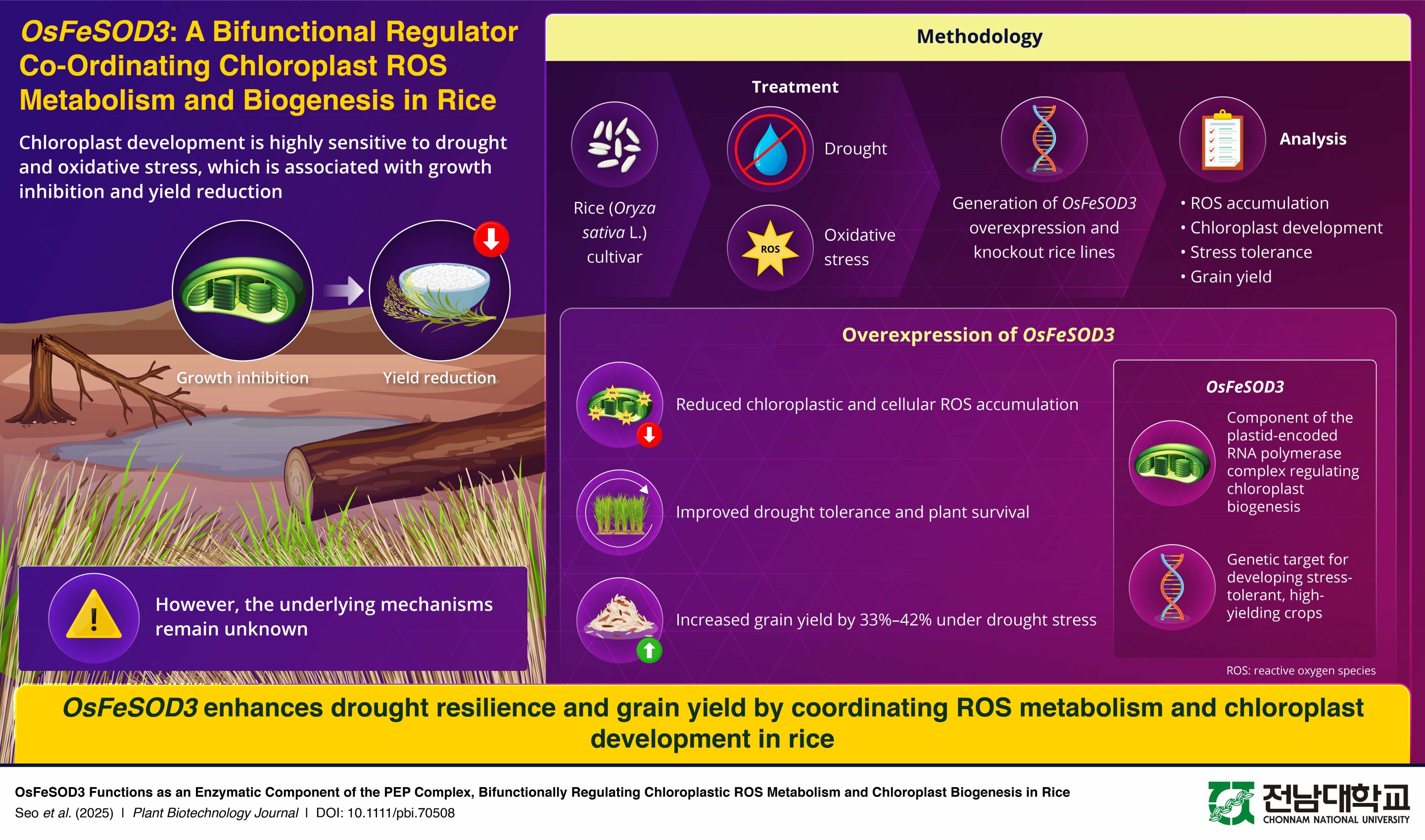
Researchers at Chonnam National University have identified a rice gene that helped plants withstand drought while maintaining yield in field trials. The finding points to a possible breeding target as water stress threatens crop production and photosynthesis.
The team, led by Professor Geupil Jang, reported that the gene, OsFeSOD3, has two connected roles in rice: reducing damaging reactive oxygen species in chloroplasts and supporting chloroplast development. The work was published in the Plant Biotechnology Journal, according to Chonnam National University.
Drought can interfere with chloroplasts, the plant cell structures that drive photosynthesis, and that damage can reduce growth and grain production. The university said the molecular links between chloroplast formation and stress responses have remained poorly understood.
How the gene works
OsFeSOD3 encodes an iron superoxide dismutase located in chloroplasts. That type of enzyme helps detoxify reactive oxygen species, or ROS, which are harmful molecules that build up when plants face stress.
Using time-lapse imaging of ROS activity and genetic analysis, the researchers found that drought-related ROS buildup starts mainly inside chloroplasts before spreading through plant cells, according to the university. Rice plants with increased OsFeSOD3 expression had lower chloroplast ROS levels, less cellular damage and stronger drought tolerance.
Jang said chloroplast development is highly sensitive to stresses such as drought, and that sensitivity is tied to growth inhibition and yield losses under stress conditions.
The study also found that OsFeSOD3 does more than act as an antioxidant. Chonnam National University said the protein functions as part of the plastid-encoded RNA polymerase, or PEP, complex, which is needed for chloroplast gene expression and development.
Through interactions with other PEP complex proteins, OsFeSOD3 helps control chloroplast biogenesis, according to the researchers. That links the gene’s stress-protection role with the plant’s ability to sustain photosynthetic capacity.
Field trial results
To test the agricultural effect, the researchers ran field trials across two growing seasons. Rice engineered to overexpress OsFeSOD3 produced 33% to 42% higher grain yields under drought conditions than wild-type plants, Chonnam National University said.
The yield gains were mainly associated with better grain filling and more grains. By contrast, rice plants in which OsFeSOD3 was removed using CRISPR-Cas9 developed severe chloroplast defects, albino leaves and halted growth, according to the university.
The results suggest the gene is needed for normal plant development while also contributing to drought resilience. The university said that combination could be useful because breeders often face a trade-off between stress tolerance and productivity.
Jang said the findings suggest OsFeSOD3 acts as a bifunctional regulator coordinating chloroplastic ROS metabolism and chloroplast biogenesis in rice.
The publication listed Deok Hyun Seo and colleagues as authors of the study, titled “OsFeSOD3 Functions as an Enzymatic Component of the PEP Complex, Bifunctionally Regulating Chloroplastic ROS Metabolism and Chloroplast Biogenesis in Rice.” Chonnam National University said research on genes such as OsFeSOD3 could help efforts to develop high-yield crops better suited to drought, heat waves and other climate-related stresses.
This story draws on original reporting from Phys.org.