
Researchers create material that can steer and store heat settings
Osaka Metropolitan University says the device can direct thermal radiation, switch modes and keep its state after power is removed.
By Priya Raghavan · Science Reporter
3 min read
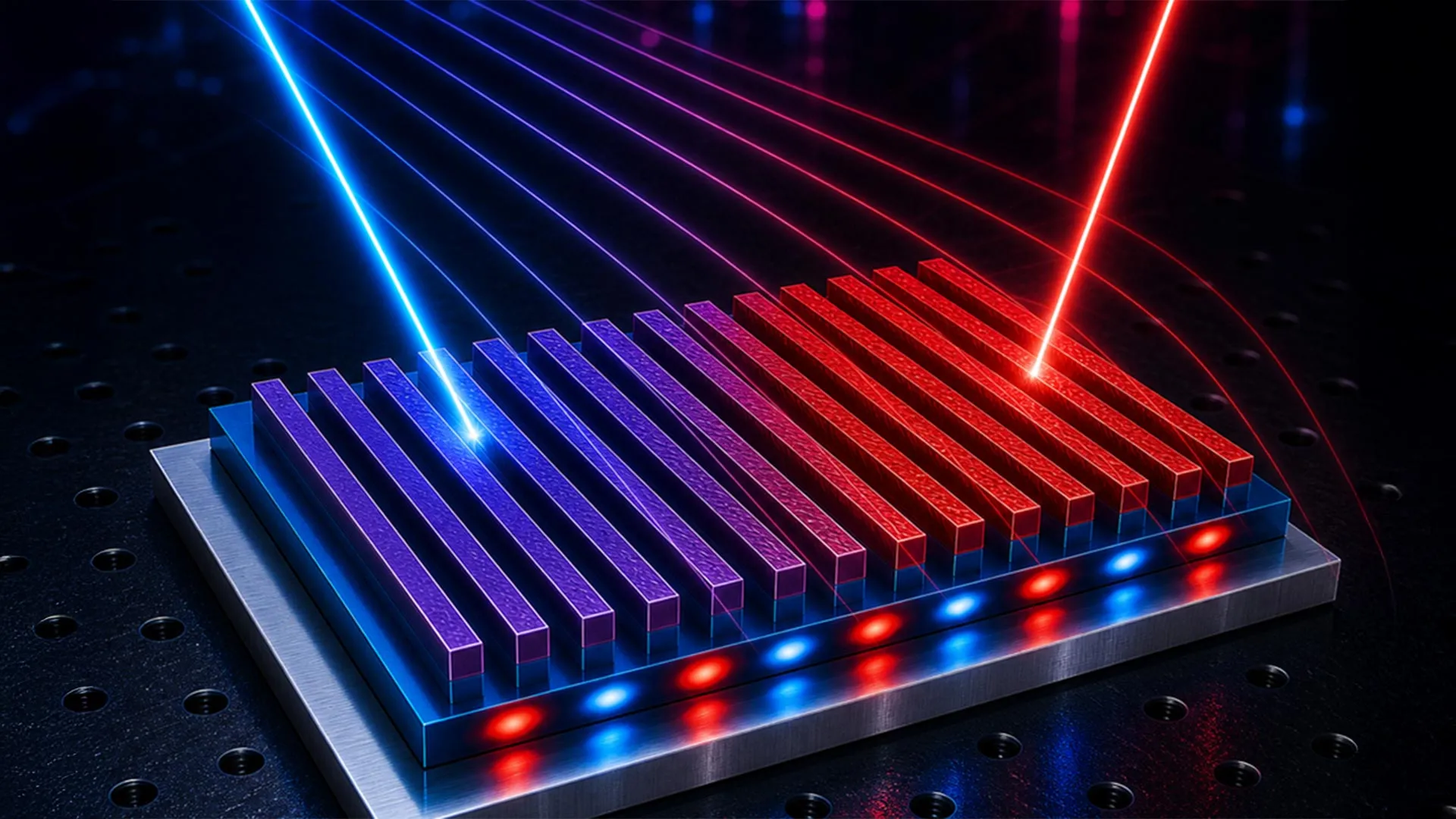
Researchers led by Osaka Metropolitan University have developed a material-based device that can control how heat radiation enters and leaves it. The university says the work could support more precise thermal control in infrared sensors, energy systems and photonic memory devices.
The research, led by Professor Koichi Okamoto and Dr. Shunsuke Murai of the university’s Graduate School of Engineering, was reported in the journal Laser. According to Osaka Metropolitan University, the team built the device by combining magneto-optical materials with a phase-change material known as GST.
Most materials follow a constraint known as reciprocity, the university said: the way a surface absorbs thermal radiation is tied to the way it emits it. That link limits efforts to make a material take in heat from one direction or wavelength while releasing it in another.
The new device is designed to break that link. Osaka Metropolitan University said it can change the direction of thermal radiation, toggle that behavior between states and preserve the chosen configuration after external power is removed.
How the device works
Magneto-optical materials change their interaction with light under a magnetic field, according to the university. By pairing those materials with GST, which can shift between phases, the researchers created a structure whose thermal-radiation behavior can be reconfigured.
The university described the result as a step toward programmable heat control, where thermal behavior can be set and retained in a way that resembles stored information in electronic devices. Murai said the team made heat radiation act in a “smarter” way and linked the work to possible infrared emitters, thermal-energy devices, sensors and photonic memory technologies.
The study’s journal reference lists Ye Ming Qing, Yi Shen, Jun Wu, Shunsuke Murai, Zhaogang Dong and Koichi Okamoto as authors. The paper is titled “Reconfigurable Giant Nonreciprocity at Near‐Normal Incidence via Phase‐Change Magneto‐Optical Metagratings,” with DOI 10.1002/lpor.71438.
Why near-normal light matters
Osaka Metropolitan University said the device showed different responses depending on the direction from which light arrived, even when the light was close to perpendicular to the surface. Earlier approaches generally needed light to strike at sharper angles to produce similar nonreciprocal effects, which the university said reduced absorption and radiation efficiency compared with near-normal incidence.
The university also said the design improves on earlier systems that had less reliable switching between states or lost their stored settings after power was cut. In this device, the state can be switched and retained, a feature the researchers said makes it more practical for later thermal technologies.
Okamoto said the long-term aim is to make compact devices that actively control heat radiation in a manner similar to how circuits control electrical current. According to the university, potential uses include smarter infrared sensors, more efficient energy systems and memory devices that store information through light and heat rather than electrical charges.
This story draws on original reporting from ScienceDaily.