
Purdue team toughens brittle cobalt aluminum at room temperature
A nanoscale CoAl design reached 6 GPa yield strength and more than 15% plastic strain in compression, according to a Science Advances study.
By Tom Brennan · Health & Medicine Correspondent
3 min read
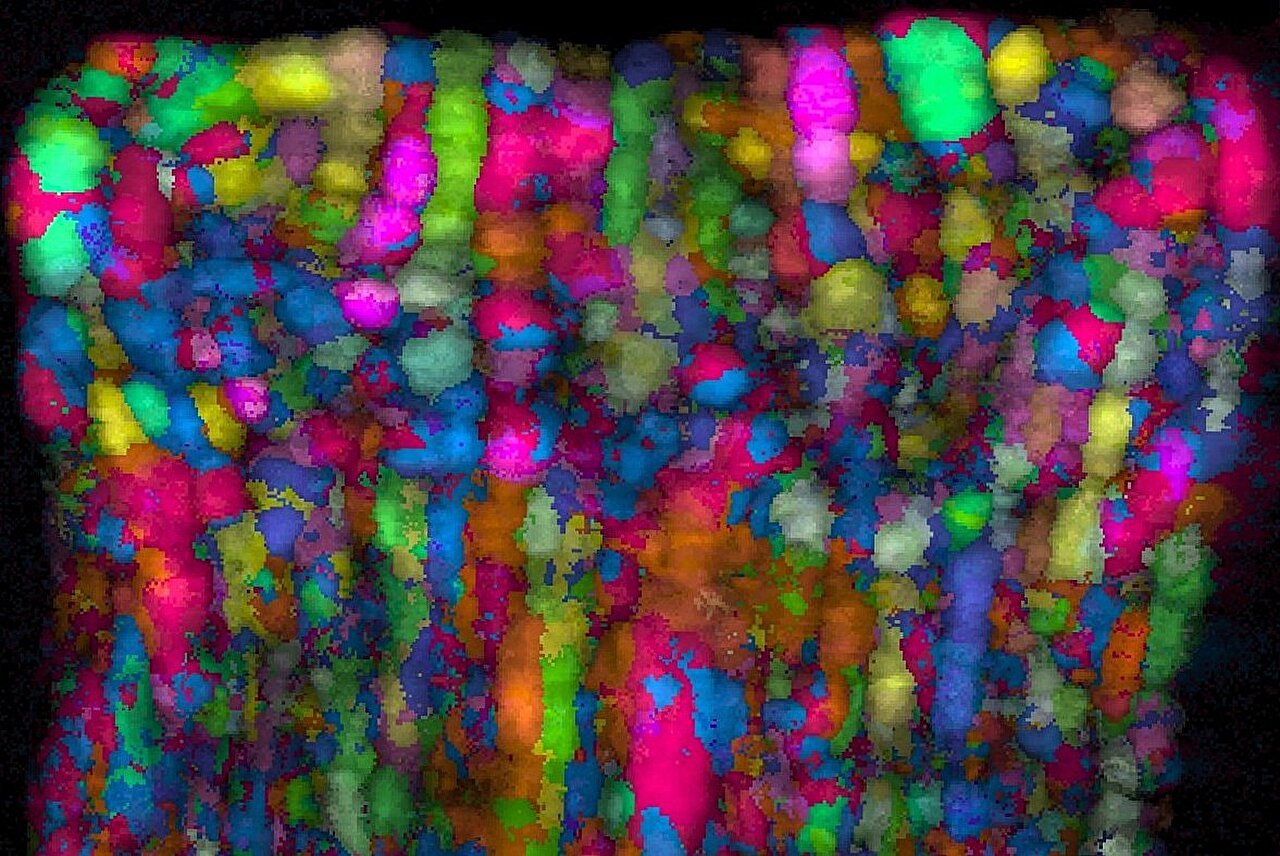
Purdue University engineers report that they have made cobalt aluminum intermetallics both very strong and able to deform plastically at room temperature. The finding matters because CoAl and related intermetallics are candidates for demanding parts in jet engines, gas turbines, energy storage systems and automotive technologies, according to Purdue.
The work, published in Science Advances, focused on a nanoscale design for CoAl, an ordered compound made from cobalt and aluminum. Purdue said bulk CoAl is strong but typically brittle, which limits processing and use in complex structural components.
Xinghang Zhang, a professor in Purdue’s School of Materials Engineering and corresponding author of the paper, said CoAl alloys that combine strength with plastic deformability could be useful in future turbine-blade materials for aeroengines. Purdue said such materials could help engine or turbo components withstand greater centrifugal forces.
Interfaces and defects drive the result
The Purdue team’s approach centered on two features: preexisting dislocations and a framework of amorphous interfaces. The paper identifies dislocations as microscopic disruptions in atomic order that help a material deform rather than crack under load.
According to Purdue, earlier efforts to make CoAl less brittle relied on composition changes or composite designs but did not create enough dislocations to produce strong plasticity at room temperature. The Purdue researchers instead introduced dislocations during sputtering deposition and designed flexible amorphous boundaries that could help generate additional dislocations during deformation.
The team used magnetron sputtering deposition, a thin-film fabrication method, to make CoAl intermetallics with amorphous aluminum-cobalt binary interfaces. Purdue said this nonequilibrium route forms material from alloy vapor into a solid, unlike traditional casting from liquid to solid.
Ke Xu, a Purdue postdoctoral researcher in materials engineering and first author of the paper, said the study shows CoAl can display substantial room-temperature plasticity. Xu also said the current CoAl nanolaminate system ranks among the strongest and most plastically deformable intermetallic systems reported so far, according to Purdue.
Tests show high strength and plastic strain
In micropillar compression tests, Purdue said the nanocomposites reached a yield strength above 6 gigapascals. The university said that is about six to 10 times higher than high-strength structural steel.
The tests also showed sustained work hardening to about 8.5 gigapascals and compressive plastic strain above 15%, according to Purdue. Researchers used in situ mechanical testing in a scanning electron microscope to observe deformation with micrometer precision.
The paper also involved Haiyan Wang, Purdue’s Basil S. Turner Professor of Engineering in materials engineering and in the Elmore Family School of Electrical and Computer Engineering. Outside collaborators included University of Houston professor Yashashree Kulkarni and doctoral student Anand Mathew, who performed molecular dynamics simulations.
Those simulations showed crystallization of the amorphous-interface framework and dislocation emission from layer interfaces into CoAl layers, Purdue said. The modeling supported the team’s explanation for how the nanoscale structure improved deformation behavior.
Next step is bulk material
Purdue said the next goal is to apply the interface concept to bulk CoAl nanocomposites suitable for industrial-scale applications. Xu said the researchers also plan to test the same idea in other intermetallics to evaluate whether amorphous-interface frameworks can broadly improve plasticity in this class of materials.
The study is titled “Plasticity in brittle intermetallics enabled by framework of amorphous interfaces and preexisting dislocations.” Purdue said Zhang’s Nanometal Group will lead follow-up work combining synthesis, in situ nanomechanical testing and atomic-scale microstructure characterization.
This story draws on original reporting from Phys.org.