
Puget Sound clam cancer traced to Atlantic lineage
Researchers say a contagious cancer in soft-shell clams reached high levels at two Puget Sound sites after likely arriving from Atlantic populations.
By Tom Brennan · Health & Medicine Correspondent
3 min read
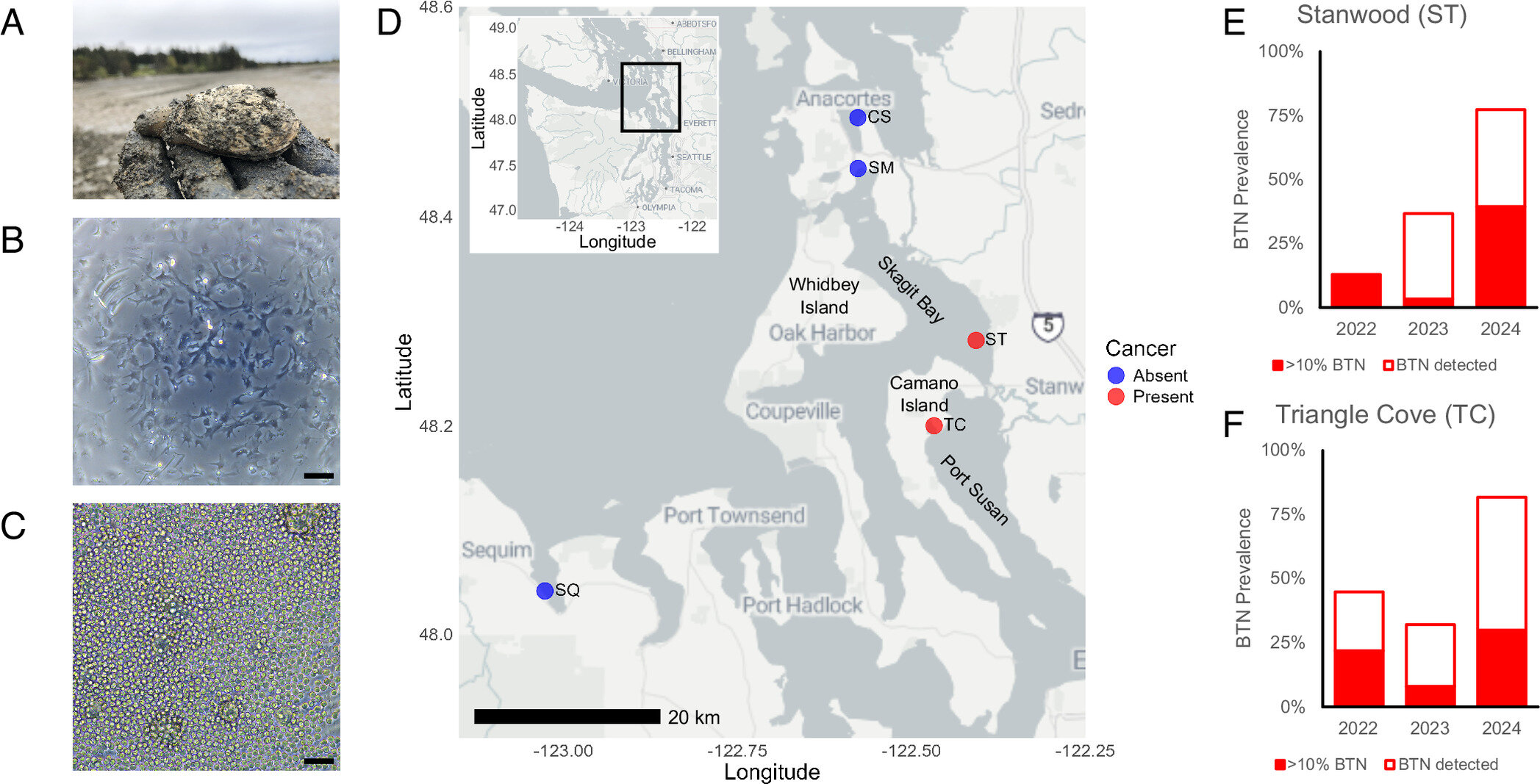
A transmissible cancer has spread through soft-shell clams in parts of Washington state’s Puget Sound, with researchers reporting infection rates above 75% at two sites by 2024. The finding matters because genetic evidence links the outbreak to Atlantic Coast clam populations, suggesting the disease crossed a continent or ocean to reach the Pacific Northwest.
The study, published in the Proceedings of the National Academy of Sciences, was led by researchers including Pacific Northwest Research Institute scientist Michael Metzger. According to the institute, the outbreak is among the most serious cases of bivalve transmissible cancer documented in the region.
Bivalve transmissible neoplasia, or BTN, differs from most cancers because the malignant cells can move between animals through seawater, according to the researchers. The disease had been seen before in soft-shell clams on the U.S. Atlantic Coast, but the team said it had not previously been documented in West Coast populations.
Researchers first found the disease in 2022 in clams from Triangle Cove and the Stanwood area in Puget Sound, according to the study. Surveys over the next two years showed a rapid increase, with more than three in four sampled clams at both locations testing positive by 2024.
Metzger, the senior author and an associate investigator at Pacific Northwest Research Institute, said the team was surprised to see a transmissible cancer spreading at that level in Pacific Northwest clams. He said the outbreak gives researchers a major system for studying how uncommon cancers of this kind arise and spread in wild populations.
Genetic testing showed the Puget Sound cancer belongs to the same lineage previously found along the East Coast, according to the study. The researchers said that points to a recent transfer across regions, though they have not determined exactly how the cancer arrived.
The team also reported that soft-shell clams in Puget Sound include hybrids of two related species, Mya arenaria and Mya japonica. According to the researchers, early evidence indicates the Japanese species may be less vulnerable to the disease, a finding that could help scientists study how genetics affects transmission and resistance.
To track the outbreak, the researchers developed an environmental DNA test designed to detect cancer-specific genetic markers in seawater. Using that assay, they surveyed 51 Puget Sound locations and found cancer DNA at sites where infected clams were present and in nearby waters, but not across the entire sound.
Metzger said the eDNA method could help scientists monitor transmissible cancers in marine systems and spot outbreaks before they spread widely. The researchers said the approach may be useful for tracking emerging marine diseases in wild populations.
Although the genetic data point to an Atlantic origin, Metzger said the route remains unknown. He said accidental human-assisted movement of an infected clam or seawater containing cancer cells is the most likely explanation, but the team lacks evidence identifying the specific pathway.
The study’s authors said the early-stage outbreak offers a rare chance to watch how a natural clam population responds to a contagious cancer. They also said the hybrid makeup of the Puget Sound clams may help researchers examine whether resistance can evolve in the wild.
This story draws on original reporting from Phys.org.