
Black hole merger signal reveals spacetime whirlpool effect
Researchers say the GW250114 merger exposed a direct wave near a new black hole’s event horizon, offering a sharper test of Einstein’s theory.
By Tom Brennan · Health & Medicine Correspondent
3 min read
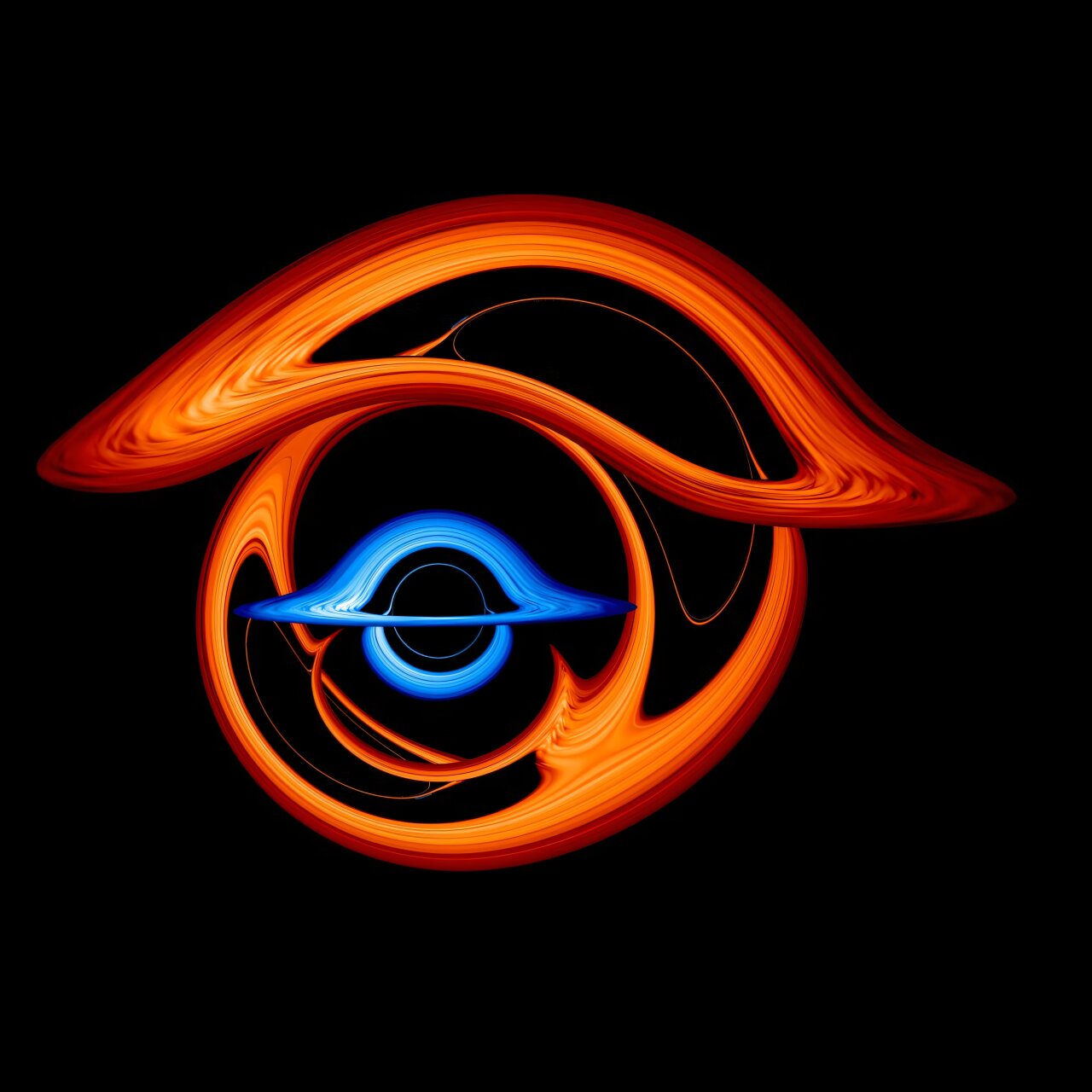
Scientists have identified a long-predicted piece of a gravitational-wave signal from a black hole collision, giving them a closer look at the region just outside an event horizon. The finding matters because it offers a new way to test how spinning black holes twist spacetime, according to research published in Nature.
The work centers on GW250114, described by researcher Neil Lu in The Conversation as the loudest black hole merger detected to date. The event involved two black holes spiraling together and forming a larger black hole, a process that sends gravitational waves across the universe.
Gravitational waves are ripples in spacetime. Lu wrote that they are faint enough by the time they reach Earth to shift distances by less than the width of an atom, requiring instruments such as the Laser Interferometer Gravitational Wave Observatory, or LIGO, to detect them.
A signal from near the horizon
Lu and colleagues report that GW250114 contained a previously hidden component known as a direct wave. The team says this signal comes from the region immediately outside the newly formed black hole’s event horizon, the boundary beyond which light cannot escape.
General relativity predicts that an event horizon is not a solid surface, but a boundary in spacetime with measurable properties. According to Lu, the direct wave can be used to study how quickly the new black hole rotates and how strong gravity is at the horizon.
The signal was difficult to isolate because it was buried among stronger waves produced as the original black holes circled and merged, Lu wrote. The researchers used new analysis methods to separate the direct-wave feature from the rest of the gravitational-wave data.
Evidence of frame dragging
The direct wave is tied to a general-relativity effect called frame dragging. In that effect, a rotating black hole pulls nearby spacetime around with it, meaning objects close enough to the horizon cannot remain still relative to distant space, according to Lu.
Lu compared the effect to a whirlpool, with spacetime rather than water forced into rotation. The GW250114 analysis, he wrote, provides an unusually clear view of this behavior near the black hole formed in the merger.
The authors say the detection opens a new channel for probing event horizons, which have long been central to theoretical physics but hard to examine directly. Light from near an event horizon is difficult to observe, while gravitational waves can carry information from that extreme region, according to Lu.
The result also sets up future checks of Einstein’s theory. Lu wrote that if general relativity is correct, measurements of the direct wave, the horizon’s rotation and its surface gravity should match in a specific way.
Black holes remain important test cases because they bring together extreme gravity and unresolved questions about quantum physics. Lu noted that general relativity and quantum mechanics both work well in their own domains, but do not fully agree at a deeper level, making black hole horizons a place where gaps in current theory may show up.
This story draws on original reporting from Phys.org.